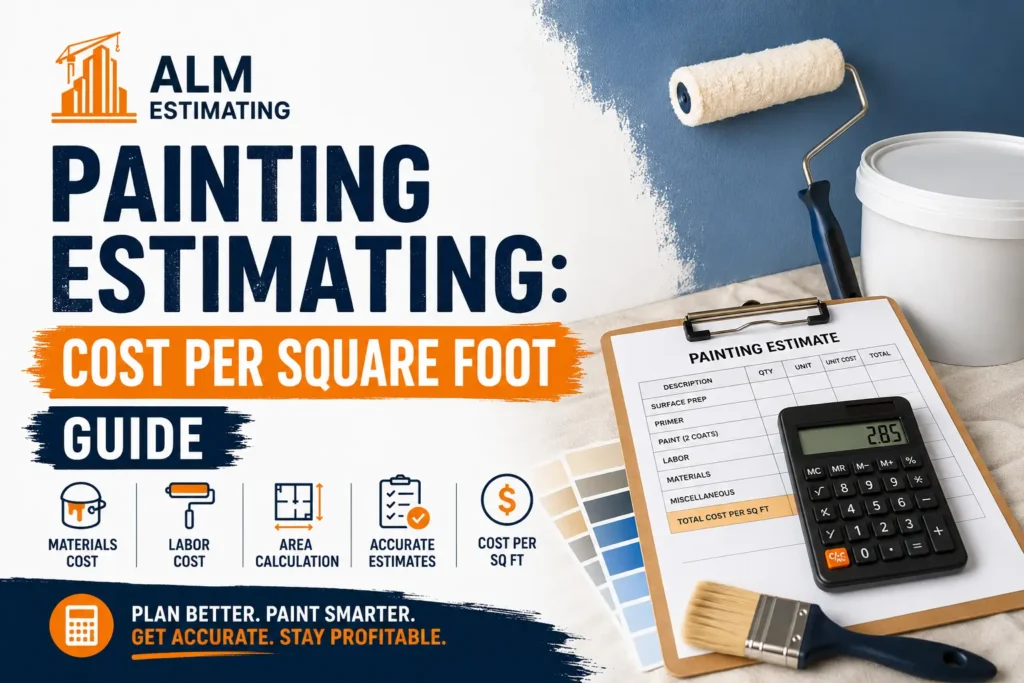
In all the finish trades, painting is the one most often estimated from gut feel rather than a proper takeoff. Painters know their square footage rates, they know how long a crew takes to roll out a floor, and they price accordingly. The problem is that rate changes significantly depending on what surface is being painted, what paint system the specification requires, how much prep the surface needs before a brush touches it, and how accessible the work actually is. A flat office wall and an exposed CMU gymnasium wall are both ‘paint’, their installed costs per square foot have almost nothing in common.
This guide covers commercial painting cost per square foot by surface type, walks through the paint systems and types that move the number most, and identifies what per-square-foot benchmarks consistently leave out.
Painting Cost Per Square Foot by Surface and System
Costs below reflect fully installed painting, surface preparation appropriate to new construction, prime coat, and the specified number of finish coats. Repaint work, patching, and specialty coatings carry separate cost considerations covered later in this article.
| Surface Type | Paint System | Method | Cost / SF | Key Variable |
| Drywall walls — new construction | Primer + 2 finish coats | Spray / roller | $0.75–$1.50 | Sheen level, accessibility |
| Drywall ceilings — new construction | Primer + 2 finish coats | Spray | $0.90–$1.80 | Height, lift required above 10′ |
| CMU / concrete masonry walls | Block filler + 2 finish coats | Roller / brush | $1.25–$2.25 | Block filler coat critical — porous substrate |
| Structural steel — exposed | Primer + 2 finish coats | Spray | $2.00–$4.50 | Shop prime vs field application; surface prep |
| Concrete floors — epoxy system | Primer + 2–3 epoxy coats | Roller / squeegee | $1.50–$3.50 | Surface profile, moisture testing required |
| Exterior masonry / stucco | Elastomeric coating system | Roller / airless spray | $1.75–$3.25 | Crack-bridging thickness, weather exposure |
| Metal doors and frames | Primer + 2 finish coats | Brush | $30–$75 / door | Priced per unit, not per SF |
| Wood trim and casework | Primer + 2 finish coats | Brush | $1.50–$3.00 | Detail work; lower productivity than open walls |
| Repaint — existing surfaces | Spot prime + 2 coats | Roller / brush | $1.00–$2.25 | Prep hours dominate; surface condition critical |
Doors and frames are priced per unit in commercial painting, not per square foot. The figure above reflects a standard 3’x7′ hollow metal door and frame painted both sides. Storefront and curtain wall frames, specialty doors, and wood doors are priced separately based on perimeter footage or unit count.
Paint Types and Their Cost Impact
The specification section on painting, typically Division 09 90 00; defines the paint system for each surface type in the project. Not all paints are interchangeable, and the specified product or performance standard affects both material cost and application requirements. These are the types that appear most often on commercial projects and that carry the most significant cost variation.
| Paint Type | Typical Application | VOC Level | vs. Standard Cost | Key Requirement |
| Interior latex | Walls, ceilings — standard commercial | Low to zero VOC | Baseline | Standard; most commercial projects |
| Alkyd / oil-based | Trim, doors, high-traffic surfaces | Higher VOC | +15–25% | Longer recoat time; better hardness and sheen |
| Epoxy | Floors, labs, commercial kitchens | Higher VOC | +80–150% | Concrete surface profile and moisture critical |
| Intumescent | Exposed structural steel — fire rated | Varies | +200–400% | Film thickness verified per UL design; specialty applicator |
| Elastomeric | Exterior masonry, stucco, tilt-up | Low VOC | +30–60% | Applied at high film build; crack-bridging thickness |
| Antimicrobial / healthcare | Hospitals, food prep, clean rooms | Low VOC | +20–40% | Specified product required; no substitution |
Intumescent paint for structural steel fire protection is a specialty scope requiring a certified applicator and third-party dry film thickness verification per the UL design. It is not a standard painting subcontractor scope and should be treated as a separate line item with its own solicitation.
What Drives Painting Cost Per Square Foot
The surface type and paint system in the specification set the baseline. These are the variables that push the actual cost above or below that baseline on any given project.
1. Surface Preparation
Prep is where painting estimates most often underperform. New drywall at Level 4 finish requires minimal prep before paint, light sanding at joints, a tack wipe, and the primer coat. Existing surfaces being repainted require washing, sanding, spot patching, and priming bare spots before any finish coat is applied. Concrete surfaces receiving epoxy coatings require mechanical surface profiling, shot blasting or grinding, to achieve the ICRI surface profile required for adhesion. Each of these prep requirements is a real labor and equipment cost that is separate from the paint application itself.
2. Surface Type and Porosity
Porous surfaces like concrete masonry unit (CMU) walls require a block filler coat before finish paint can be applied. Without it, the finish coat soaks into the block surface unevenly, coverage rates drop, and additional coats are needed to achieve the specified hiding power. A standard drywall rate applied to a CMU wall consistently produces a low number. The substrate determines the system and the system determines the cost.
3. Number of Coats and Paint System
A primer plus two finish coats is the standard commercial interior system. Moving to three coats, required for high-hide colors on dark substrates, for specific gloss levels, or where the specification explicitly requires it, adds a full application pass in both labor and material. On large open areas sprayed efficiently, an additional coat adds 20 to 35 percent to the total cost of that surface. On trim and detail work applied by brush, the percentage is higher because setup and access time dominates the labor.
4. Application Method
Airless spray is the fastest application method on large open surfaces and produces the best film build per pass. It requires masking of all adjacent surfaces, equipment setup and cleanup time, and ventilation considerations in occupied or partially occupied spaces. Roller application is slower but requires less masking and is standard for occupied renovation work where overspray is not acceptable. Brush work — trim, frames, cut-ins around fixtures and ceilings — is the slowest method and is typically the highest unit-cost work in a painting scope. A project with significant trim, door frames, and casework will carry a higher blended rate than one that is primarily open wall and ceiling.
5. Access and Ceiling Height
Painting above 10 feet requires a lift or scaffold, which adds rental cost and reduces crew productivity. Gymnasiums, warehouses, atriums, and mechanical spaces with ceilings above 14 feet require boom lifts or large scissor lifts, and the setup time per square foot increases significantly as height goes up. Painting exposed structural steel in a high-bay warehouse is among the higher unit-cost painting scopes precisely because the access requirement compounds the labor time on every pass.
What Per-Square-Foot Benchmarks Do Not Include
Standard painting benchmarks cover paint application. These related scope items are in most commercial painting specifications and are regularly left out of the first-pass estimate.
• Patching and skim coat repair — filling nail holes, skim-coating damaged drywall, and patching minor surface defects before painting is painter scope on most commercial projects. On renovation work, it can represent a significant share of the total labor hours.
• Masking and surface protection — floors, glass, hardware, millwork, and adjacent finished surfaces all require masking before spray or roller application. On projects where finished work is already in place, masking time can add 15 to 25 percent to the total painting labor.
• Concrete surface profiling for epoxy — shot blasting or diamond grinding to achieve ICRI CSP 3–5 on concrete floors before epoxy application is typically a separate scope from the epoxy coating itself. It requires specialty equipment and adds material and labor cost that is not in the epoxy coating rate.
• Intumescent coating as a separate specialty — fire-rated intumescent paint on structural steel is certified applicator work with third-party inspection. It is not part of the general painting subcontractor scope and should never be folded into a painting unit rate.
• VOC compliance and air quality measures — some jurisdictions and some project types require low-VOC or zero-VOC products that carry a material premium. Occupied renovation projects may also require phased application with specific dry times and air quality monitoring between coats.
On repaint and renovation work, prep always takes longer than expected. A rule that experienced painting contractors use: if the existing surface condition is unknown at bid time, carry prep at 30 to 40 percent of the paint application labor as a minimum floor — not a contingency.
Common Painting Estimating Mistakes
• Using a drywall rate on CMU or concrete surfaces. Block filler adds a full application pass that does not exist on drywall. CMU and concrete cost more per square foot to paint, and the specification will require it regardless of the rate used.
• Not reading the paint schedule in the specification. The specification assigns a paint system — by surface type and space — to every surface in the project. Pricing all walls at the same rate regardless of the specified system is a consistent miss on projects with multiple finish zones.
• Treating intumescent coating as standard painting scope. Intumescent is a specialty, certified scope. Including it in a general painting bid at a painting rate will produce a number that is far below the actual installed cost.
• Missing the door and frame count. Doors are priced per unit in commercial painting. A project with 80 doors at $45 per door is a $3,600 line item that disappears entirely when everything is rolled into a per-square-foot wall rate.
• Not separating repaint from new construction rates. Repaint work requires washing, sanding, spot priming, and working around existing occupants and furnishings. The prep hours on repaint can easily match or exceed the application hours. New construction rates do not reflect repaint conditions.
Painting Estimating With ALM
ALM Estimating provides Division 09 painting takeoffs and estimates for commercial contractors across all 50 states. Every painting estimate identifies surface types from the architectural drawings, applies the specified paint system from Division 09 90 00, counts doors and frames separately by unit, flags intumescent and specialty coating scope as separate line items, and separates new construction rates from repaint conditions where both appear in the same project.
Turnaround is 24 hours on most commercial painting scopes. Send drawings to info@almestimating.com or call +1 (917) 718-0084.
Frequently Asked Questions
What is the average commercial painting cost per square foot?
For standard interior drywall walls with primer and two finish coats in a commercial office or retail space, expect $0.75 to $1.50 per square foot. Ceilings run slightly higher at $0.90 to $1.80. CMU walls with a block filler system range from $1.25 to $2.25. Those figures assume new construction conditions, reasonable accessibility, and standard commercial latex paint. Specialty coatings, high ceilings, repaint conditions, and detail-heavy scopes all push the rate upward.
How is painting estimated — by square foot or by another method?
Commercial painting is primarily estimated by surface square footage, with doors and frames priced per unit and trim and casework priced by linear foot or per unit depending on complexity. The estimator takes off wall and ceiling areas from the architectural drawings, references the paint schedule and specification to determine the system for each surface type, and applies labor and material unit rates per coat. High-ceilings, specialty coatings, and access conditions are priced as separate adjustments to the base square footage rate.
What is intumescent paint and why is it so expensive?
Intumescent paint is a fire-protective coating applied to structural steel that expands when exposed to heat, forming a char layer that insulates the steel and delays structural failure. It is required on exposed structural steel that must achieve a fire-resistance rating, typically 1 or 2 hours under a UL design. The cost premium comes from the high film thickness required, the certified applicator requirement, and the third-party inspection of dry film thickness on every coated member. It is 3 to 5 times the cost of standard structural steel painting.
Does repaint work cost more than new construction painting?
Per square foot of paint applied, yes — almost always. Repaint requires washing, sanding, spot priming bare areas, masking finished flooring and hardware, and working around occupants if the space is partially occupied. The prep labor on repaint can match or exceed the application labor on the same surface area. New construction painting on open, accessible surfaces with no existing finishes to protect is consistently faster and lower cost per square foot than the equivalent repaint scope.
What CSI division covers commercial painting?
Division 09 — Finishes, covers painting and coating work. Painting falls primarily under 09 90 00, with interior painting at 09 91 00 and exterior painting at 09 96 00. Specialty coatings, epoxy floor coatings, elastomeric wall coatings, intumescent fire-resistive coatings, each have their own specification sections within Division 09 and are typically priced as separate scopes from standard architectural painting.