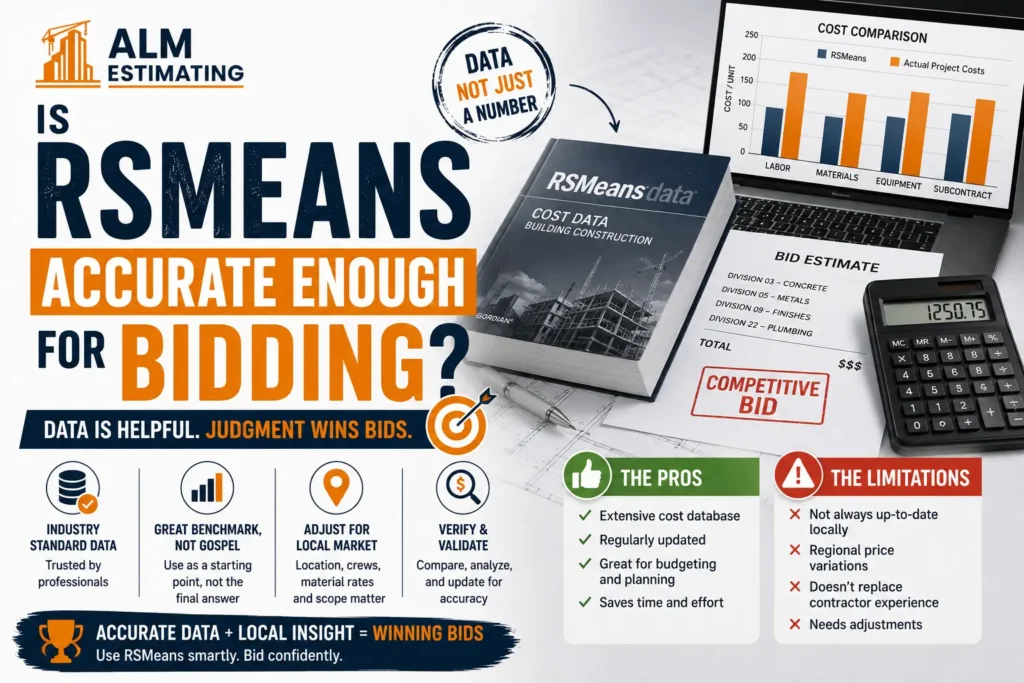
RSMeans data is accurate for budgeting and feasibility but typically requires 10–25% local calibration before it matches actual subcontractor pricing on a specific project, according to a 2026 ENR survey of 1,400 contractors. For a competitive bid, that gap is large enough to cost you the job or your margin, which is why most contractors use RSMeans for early numbers and a project-specific takeoff for the bid itself.
What “Accurate” Means for a Cost Database vs a Bid
RSMeans, published by Gordian, is built from over 30,000 research hours per year collecting national average unit costs across materials, labor, and equipment, adjusted by location factors for roughly 970 US markets. That makes it accurate in the sense that matters for a database: it reflects real market data, not guesses. A bid needs a different kind of accuracy, it needs to reflect your specific project’s quantities, your regional subcontractor pricing today, and site conditions a national average can’t see. RSMeans is accurate as a reference. It is not, by itself, accurate as a bid.
Where RSMeans Holds Up
1. Early Budget and Feasibility Numbers
Testing whether a project concept fits a target budget before drawings exist is exactly what RSMeans is built for. The location-adjusted national average is close enough at this stage because the goal is a reasonable range, not a bid-ready number.
2. Sanity-Checking an Incoming Quote
If a subcontractor’s number looks unusually high or low, RSMeans gives a fast way to check whether it’s in a plausible range before you dig further.
3. Conceptual-Level Estimate Classes
AACE International’s cost estimate classification system (Class 4–5, low-detail conceptual estimates) is exactly the level RSMeans-style data is designed for. Used at the right estimate class, it performs as intended.

Where RSMeans Falls Short for Bidding
1. The Calibration Gap
A 2026 ENR Cost Survey of 1,400 firms found that contractors typically need to adjust RSMeans figures by 10–25% to match real subcontractor pricing in their specific market. That gap is exactly where a competitive bid is won or lost, a number that’s 15% off in either direction is the difference between underbidding a job into a loss or losing the bid to a more accurately priced competitor.
2. No Quantity Takeoff Included
RSMeans gives you unit costs, it doesn’t measure your drawings. You still need to do (or outsource) a full quantity takeoff before any of that pricing data is useful, and a takeoff error doesn’t get caught by good unit cost data.
3. National Data, Local Market
Location factors adjust the national average, but they don’t capture short-term local conditions, a tight labor market in one metro this quarter, a material shortage affecting one region, or a specific subcontractor’s current backlog and pricing. Quarterly updates can’t keep pace with that.
The Practical Answer
Use RSMeans for what it’s built for, budgeting, feasibility, and sanity checks and get a project-specific takeoff for the actual bid. Many contractors do both: RSMeans-style data for the early go/no-go decision, then a detailed estimate once they’ve committed to bidding. This mirrors how AACE itself separates estimate classes by purpose rather than treating all cost data as interchangeable.

Get a Bid-Ready Estimate, Not a Calibration Guess
ALM Estimating delivers takeoffs priced from your actual drawings using current local supplier quotes and regional labor rates, no calibration math required, because the number is built for your specific project from the start. Send us your plans and get a complete, CSI-organized estimate back within 24 hours. Call +1 (917) 718-0084 or visit our contact page.
Frequently Asked Questions
How much does RSMeans data need to be adjusted for local pricing?
A 2026 ENR survey found contractors typically need to calibrate RSMeans figures by 10–25% to match actual local subcontractor pricing, depending on the market and trade.
Can I submit a bid using only RSMeans data?
It’s possible but risky for competitive work. RSMeans provides average costs that usually need local calibration and a project-specific quantity takeoff before they’re reliable enough for a bid you intend to win and profit on.
What’s the difference between a conceptual estimate and a bid estimate?
AACE International classifies estimates by detail level — conceptual estimates (Class 4–5) use limited project information and broader data like RSMeans, while bid-level estimates (Class 1–2) require detailed drawings and project-specific quantity takeoffs.
Is it worth using RSMeans if I also outsource estimating?
Yes, for different stages. RSMeans-style data is useful for the early decision on whether to pursue a project at all. Once you’ve decided to bid, an outsourced, project-specific estimate gives you the accuracy a database alone can’t provide.