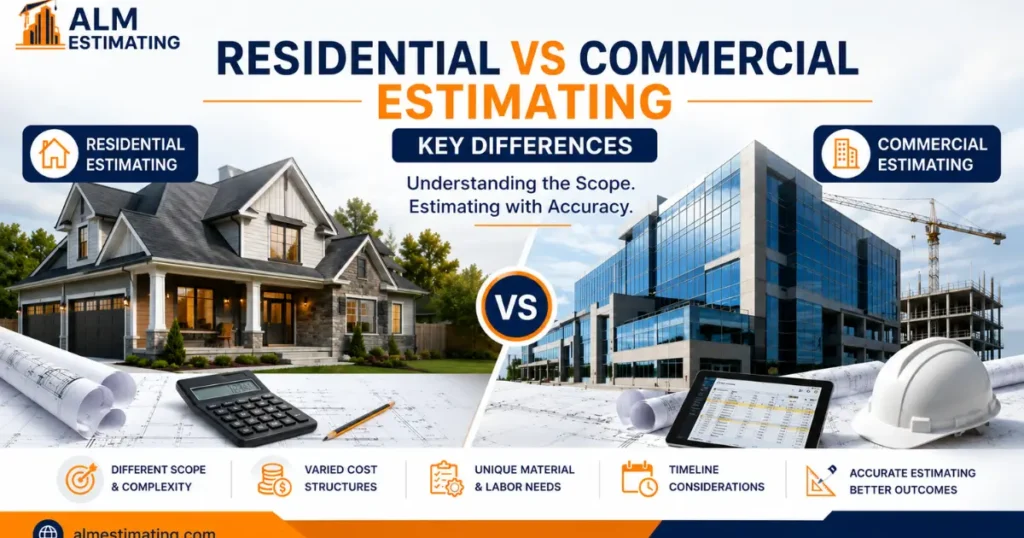
Residential and commercial construction share the same fundamental goal, getting a project built on time and within budget. But the estimating process for each is significantly different in complexity, code requirements, material specifications, labor structure, and financial risk. Misapplying residential estimating logic to a commercial bid or vice versa, is one of the most common causes of costly underbids and margin erosion. Here is what separates the two and what every contractor needs to know before submitting a quote.
1. Scope and Complexity
Residential projects — single-family homes, duplexes, small apartment buildings — have well-defined scopes with standard framing systems, familiar material specs, and predictable labor sequencing. An experienced estimator can work from a residential plan set with confidence, using historical unit costs and standard assemblies.
Commercial projects — office buildings, retail centers, healthcare facilities, warehouses, mixed-use developments — are fundamentally more complex. They involve advanced structural systems, multi-trade MEP coordination, specialized equipment, longer construction schedules, and formal specifications that can run hundreds of pages. Estimating a commercial project from incomplete documents is a high-risk exercise that requires explicit contingency management.
2. Building Codes and Compliance
Residential construction in the United States is governed primarily by the International Residential Code (IRC), administered at the state and local level. Requirements are well-understood by residential contractors and estimators. Code compliance costs are generally predictable and baked into standard unit pricing.
Commercial construction falls under the International Building Code (IBC) with additional requirements from NFPA fire codes, ADA accessibility standards, ASHRAE energy codes, and in some states, seismic design requirements. ADA compliance alone, accessible routes, bathroom clearances, parking ratios, elevator requirements — adds scope and cost that residential estimators often underestimate when crossing over to commercial work.
3. Materials and Specifications
Residential specifications are typically informal. Material choices appear on drawings or in brief notes, and the focus is on standard-grade products that meet code and client expectations. The estimator has reasonable flexibility in pricing equivalent products.
Commercial specifications are formal legal documents. Division 1 through Division 49 of the CSI MasterFormat govern everything from concrete mix design to the brand of plumbing fixtures. Commercial specs bind the contractor to specific products, installation methods, and testing requirements. Substitutions require formal approval. Pricing without the spec book is pricing blind.
4. Labor Structure
Residential construction typically uses open shop labor or small subcontractor crews with negotiated rates. Labor costs are more flexible and easier to estimate from historical project data.
Commercial construction often involves union labor — IBEW for electrical, UA for plumbing and HVAC, LIUNA for concrete and site work. Union labor comes with defined wage scales, benefit fund contributions, work rules, and jurisdictional boundaries. In major metropolitan markets, union labor adds 30–60 percent to equivalent open shop labor costs and requires precise knowledge of trade jurisdictions to estimate correctly.
Davis-Bacon Act prevailing wage requirements apply to federally funded commercial construction regardless of whether the contractor uses union or open shop labor, another layer of compliance that purely residential estimators are rarely equipped to handle.
Estimate Accuracy and Document Requirements
Residential estimates can be prepared from a relatively small drawing set, floor plans, elevations, and a material list. The scope of work is visible and measurable. Early-stage estimates carry acceptable contingencies that clients expect.
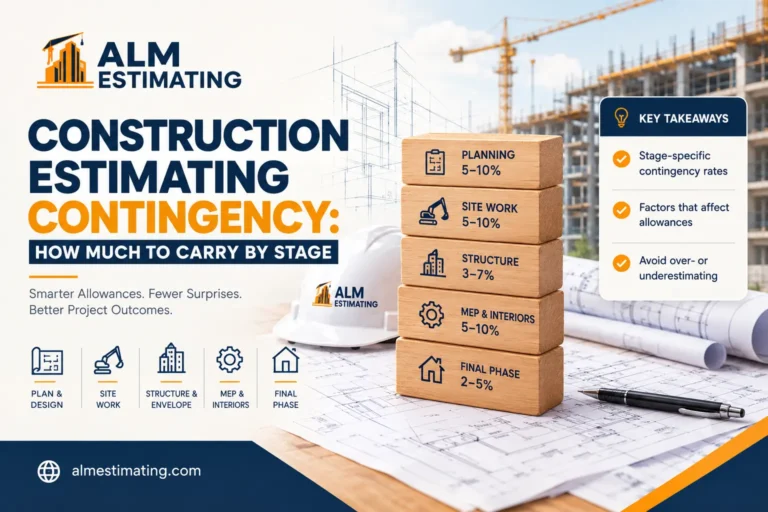
Commercial estimates are only as good as the documents they are built from. A schematic design estimate carries a 20–30 percent contingency. A design development estimate narrows to 10–15 percent. A complete construction document estimate with issued specifications should reach plus or minus 5 percent accuracy. Submitting a GMP or lump sum bid from incomplete commercial documents without appropriate contingency protection is a common path to a money-losing contract.
Cost Comparison at a Glance
| Factor | Residential | Commercial |
| Building codes | IRC — straightforward | IBC + ADA + NFPA — complex |
| Specs | Informal, flexible | Formal CSI MasterFormat |
| Labor | Open shop, flexible rates | Union or prevailing wage |
| MEP complexity | Standard systems | Advanced, coordinated systems |
| Estimate accuracy needed | ±10–15% acceptable early | ±5% required for GMP/lump sum |
| Typical estimating cost | $500–$3,000 for full set | $2,000–$15,000+ for large commercial |
| Profit margin | 10–20% typical | 5–15% typical (higher risk offset) |
Which Requires More Specialized Estimating?
Commercial estimating consistently requires more specialized expertise. The combination of complex specifications, union labor requirements, multi-trade coordination, and formal documentation standards means that applying residential estimating practices to commercial projects creates significant financial exposure. The reverse, a commercial estimator pricing residential work, tends to produce over-specified, over-priced estimates.
The most successful contractors either specialize in one sector or maintain separate estimating processes and personnel for each. Firms crossing sectors often benefit from outsourced estimating support to fill expertise gaps without carrying full-time overhead.
ALM Estimating: Residential and Commercial Expertise
ALM Estimating provides accurate cost estimates and quantity takeoffs for both residential and commercial construction projects across the United States. Our team uses PlanSwift and Bluebeam to deliver detailed, CSI-structured estimates within 24–48 hours. Whether you are pricing a custom home or a multi-story commercial build, we deliver the numbers you need to bid with confidence.
- Residential estimates: from custom homes to large apartment complexes
- Commercial estimates: offices, retail, healthcare, industrial, mixed-use
- MEP estimating: mechanical, electrical, and plumbing for both sectors
- Turnaround in 24 hours — upload your plans at almestimating.com