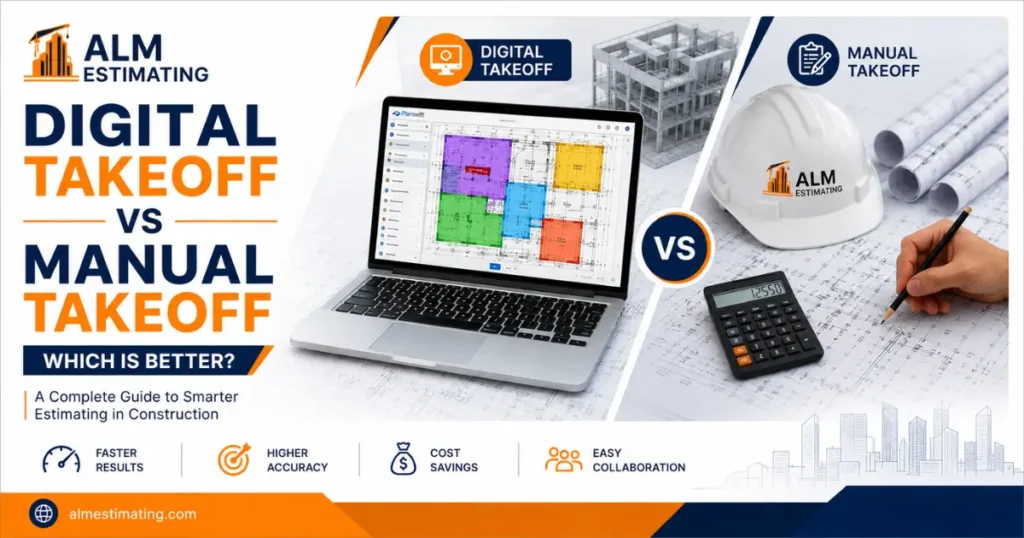
Every construction estimate starts with a takeoff, the process of measuring and quantifying all materials, labor, and scope from a set of drawings. For decades, estimators did this with printed blueprints, a scale ruler, and a calculator. Today, digital takeoff software has transformed that process. But which method is actually better for your business? This guide breaks down both approaches across the metrics that matter most: speed, accuracy, cost, scalability, and collaboration.
What Is a Manual Takeoff?
A manual takeoff is performed using printed drawings and physical tools. An estimator reviews paper blueprints, measures dimensions by hand with a scale ruler, counts materials, and records quantities on a takeoff sheet. The information is then transferred to a spreadsheet or estimate form for pricing.
Manual takeoffs have been the industry standard for generations and remain common on smaller projects or in firms with limited software budgets. They require no technology investment beyond printing costs, and an experienced estimator can produce reliable results from straightforward drawings.
What Is a Digital Takeoff?
A digital takeoff is performed using software, tools like PlanSwift, Bluebeam, STACK, or Procore Estimating. The estimator works directly on-screen with electronic drawing files (PDF, CAD, or BIM models), using automated measurement tools to calculate areas, lengths, volumes, and counts. Quantities populate directly into the estimate without manual transfer.
Digital tools support a full range of measurement types, annotation, color-coding by trade, and real-time collaboration across multiple estimators working on the same file simultaneously.
Head-to-Head Comparison
| Factor | Manual Takeoff | Digital Takeoff |
| Speed | 25–40 hrs for large commercial projects | 8–15 hrs for equivalent scope |
| Accuracy | Prone to human calculation error | Automated calculations; fewer mistakes |
| Cost | No software cost; high labor cost | Software subscription; lower labor cost |
| Scalability | Difficult to scale with volume | Handles multiple projects simultaneously |
| Revisions | Full redo required on plan changes | Update measurements in minutes |
| Collaboration | Physical document sharing only | Real-time multi-user access |
| BIM / CAD Integration | Not supported | Full PDF, CAD, BIM compatibility |
| Audit Trail | Manual records only | Digital markup history saved |
1. Speed: Where Digital Wins Decisively
Time is the most measurable difference between the two methods. A contractor using manual takeoffs typically spends 25 hours or more on a mid-size commercial project. The same takeoff using digital tools averages 8 hours, a reduction of more than 60 percent. On high-volume bidding environments, that time difference means the ability to submit more bids per estimator, without working overtime or sacrificing quality.
Digital takeoff platforms like PlanSwift and Bluebeam automate repetitive calculations, area totals, count items, linear footage, that take the most time manually. An estimator’s time shifts from measuring to analyzing, which is where expertise adds real value.
2. Accuracy: Where Digital Reduces Risk
Manual takeoffs introduce cumulative error. Each hand measurement, manual calculation, and data transfer step adds an opportunity for mistakes. On complex multi-trade projects, those small errors compound into material overages, missed scope, or pricing gaps that cost money after the contract is signed.
Digital tools automate calculations and flag inconsistencies in real time. Color-coded markups make it visually clear which elements have been counted and which have not. When plan revisions arrive and they always do digital tools allow targeted updates to specific measurements rather than restarting the entire takeoff.
3. Cost: The True Comparison
Manual takeoffs appear cheaper because there is no software subscription. But the labor cost tells a different story. An experienced estimator earning $70,000 per year spending 60 percent of their time on manual measurements costs far more in lost productivity than any software license. Digital takeoff subscriptions typically run $100–$500 per month per user, depending on the platform.
The ROI calculation is straightforward: if digital tools save an estimator 15 hours per project and that estimator bids 40 projects per year, that is 600 hours recaptured annually, hours that can be used to bid more work, improve estimate quality, or reduce headcount needs.
When Manual Takeoff Still Makes Sense
Manual takeoffs remain a viable choice in specific circumstances:
- Simple, small-scope projects where a quick hand count is faster than opening software
- Firms bidding only a handful of jobs per year where software ROI is limited
- Estimators who lack access to digital drawings and must work from paper prints
- Preliminary budget discussions where rough counts are sufficient
For any project above basic scope, or for firms bidding competitively in commercial or industrial markets, digital takeoffs are the clear advantage.
Outsourcing as the Third Option
Many contractors find that outsourcing takeoffs to a professional estimating firm gives them the benefits of digital takeoff, speed, accuracy, detailed documentation, without the internal overhead of software, training, or additional staff. ALM Estimating performs all takeoffs using PlanSwift and Bluebeam, delivering fully marked-up drawings alongside structured quantity reports.
Outsourcing is especially effective for contractors who experience seasonal bid volume spikes, who want to bid on project types outside their core expertise, or who need to submit multiple estimates simultaneously without expanding their internal team.
Which Method Is Right for Your Business?
Choose based on your bid volume, project complexity, and business goals:
- Small contractor, simple scope, low volume: manual takeoff is workable
- Growing contractor, competitive bidding, 10+ estimates per month: invest in digital takeoff software
- High-volume or specialty trade estimating: consider outsourcing to maximize capacity without fixed overhead
ALM Estimating delivers accurate construction takeoffs for residential, commercial, and industrial projects across the United States. Upload your drawings and receive a complete takeoff within 24 hours.