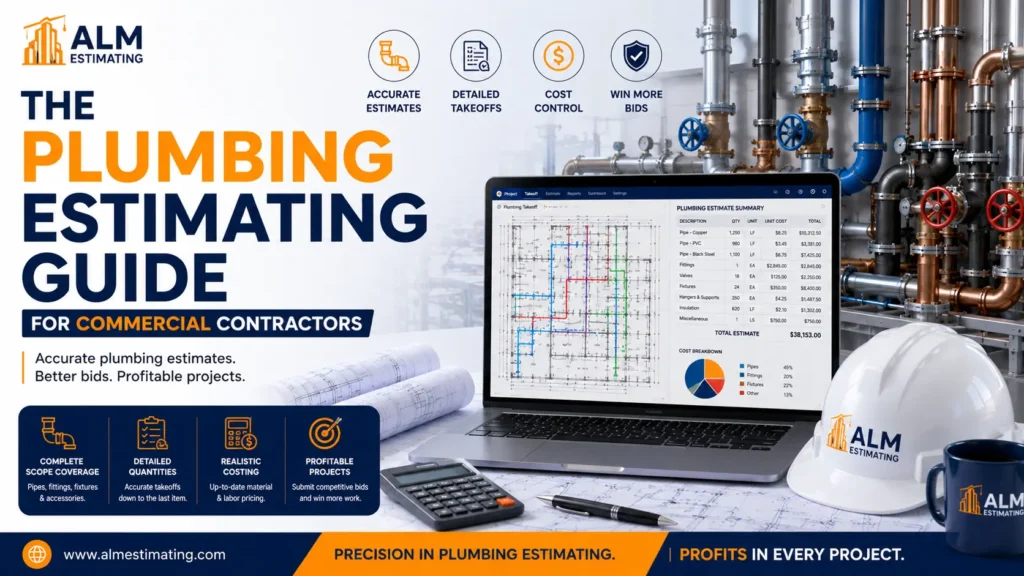
Plumbing is one of the more methodical scopes to estimate, you count fixtures, run pipe, account for underground work, and build up from there. The problem is not the counting. The problem is scope fragmentation. Plumbing drawings rarely tell the full story. Fixtures are on the architectural plans. Pipe routing is on the mechanical-plumbing sheets. Gas is sometimes on a separate utility drawing. Specialty systems like medical gas or process piping appear in their own specifications. And the coordination boundary between plumbing, mechanical, and fire protection is almost never as clean on paper as it needs to be in the field.
This guide walks through the full Division 22 scope, how to structure a plumbing takeoff, what drives cost on commercial plumbing work, and the mistakes that consistently produce numbers that do not hold up after award.
What Division 22 Actually Covers
Division 22 in CSI MasterFormat covers all plumbing systems in a building. That sounds straightforward until you start working through a set of drawings and realize how much falls under this umbrella and how much of it sits in ambiguous territory between trades.
1. Domestic Water Systems
Cold water distribution, domestic hot water supply, hot water recirculation piping, pressure reducing valves, backflow preventers, hose bibs, and the associated fixture connections. On multistory buildings, domestic water requires pressure zone design a 20-story tower cannot run a single water service without pressure regulation at intermediate floors. Each zone adds valving, PRVs, and piping complexity that is easy to undercount from a schematic drawing.
2. Sanitary and Storm Drainage
Sanitary drain, waste, and vent piping collects waste from fixtures and routes it to the building drain and eventually to the municipal sewer. Storm drainage handles roof drains, area drains, and site drainage connections at the building perimeter. Underslab piping, running beneath the concrete floor slab before it is poured, is typically the highest unit-cost work in the plumbing scope due to excavation, compaction, and the fact that it must be correct before concrete goes in. No callbacks, no access panels.
3. Gas Piping
Natural gas and liquefied petroleum gas distribution within the building falls under Division 22. Black steel pipe is the standard for commercial gas, either threaded or welded depending on pipe size. Gas piping requires pressure testing at rough-in, witnessed by the authority having jurisdiction in most markets. On restaurant projects, the gas load for commercial kitchen equipment, fryers, ranges, broilers, steamer connections — frequently represents the most demanding part of the gas design, and getting the pipe sizing right matters both for performance and for the permit.
4. Specialty Systems
Medical gas systems; oxygen, nitrogen, nitrous oxide, vacuum, and compressed air, fall under Division 22 on healthcare projects and are governed by NFPA 99. These systems require certified medical gas installers, third-party verification testing, and documentation that most general plumbing contractors cannot provide. Process piping, chemical drain systems in laboratory buildings, and specialty industrial fluid systems also fall under this division. If specialty systems are in the specification and your estimator is not flagging them as separate line items requiring specialized subcontractors, that is a scope gap.
How to Approach a Plumbing Takeoff
Step 1 — Start with the Fixture Schedule
The fixture schedule on the plumbing drawings lists every plumbing fixture in the building: water closets, lavatories, urinals, sinks, floor drains, janitor mop sinks, drinking fountains, and specialty items. Before touching the drawings, count the fixture schedule against the floor plans and confirm they match. Discrepancies between the schedule and the plan are common, especially when drawings are at 50 or 75 percent completion and they directly affect rough-in costs.
Step 2 — Separate Underground from Above-Grade Scope
Underground plumbing and above-grade plumbing are fundamentally different cost categories and should never be blended into a single line item. Underground work requires excavation or saw-cutting of existing slab, backfill, compaction, and pipe installation under conditions that limit crew productivity. Labor units for underground work run 30 to 60 percent higher than the same pipe installed above grade. Pricing them together, using an average unit cost produces a number that is wrong in both directions depending on the mix of work.
Step 3 — Count Piping by System, Material, and Size
Pipe takeoffs are done in linear feet, organized by system type (domestic cold water, domestic hot water, sanitary, storm, gas), material, and nominal diameter. Each size change in a run is a separate count because material cost and labor units both change with pipe diameter. Fittings; elbows, tees, reducers, unions — are counted separately or applied as a percentage of straight pipe footage depending on system complexity. Valves, supports, hangers, and sleeves through walls and floors are separate line items that get missed when estimators focus only on the main runs.
Step 4 — Price Equipment and Specialty Items Individually
Water heaters, booster pumps, hot water recirculation pumps, expansion tanks, pressure reducing stations, and backflow prevention assemblies should each be priced from current equipment pricing, not from a square footage allowance. These items appear on the plumbing riser diagrams and equipment schedules. Each one has a specific model or specification requirement that affects price. Pricing a tankless water heating system from a storage-tank allowance, or vice versa, produces a significant error on a single line item.
Plumbing Cost Benchmarks by Building Type
These figures represent fully installed plumbing costs, rough-in, fixtures, equipment, and all associated specialties, across commercial project types in the US. Use them for budget validation and bid review, not as a substitute for a proper takeoff.
| Building Type | Cost / SF (Low) | Cost / SF (High) | Primary System | Key Variable |
| Office — Class A | $8 | $15 | Domestic + sanitary | Floor count, restroom count |
| Healthcare / Hospital | $22 | $45 | Medical gas + domestic | NFPA 99, infection control |
| Retail / Restaurant | $10 | $22 | Domestic + grease interceptor | Grease trap sizing, gas load |
| Multifamily (5+ stories) | $10 | $20 | Domestic + sanitary | Riser count, pressure zones |
| K–12 / Education | $10 | $18 | Domestic + sanitary | Fixture density, eyewash stations |
| Industrial / Lab | $14 | $30 | Process + domestic | Chemical drain, process loads |
Healthcare figures include medical gas systems priced under NFPA 99 requirements. Restaurant and food service costs vary significantly based on kitchen equipment type and local health code requirements for grease interceptors. Regional labor rates apply — see the pipe material table below for additional context.
Pipe Material Selection and Cost Implications
Material selection drives a significant portion of plumbing cost variability across project types. The specification controls what is allowed, but estimators need to understand the cost implications of each material and flag when the specification requires something more expensive than the standard alternative.
| Material | Typical Application | Relative Cost | Labor Factor | Notes |
| Type L Copper | Domestic cold & hot water | High — tracks copper futures | Moderate | Most common for above-grade domestic; price volatile |
| CPVC | Domestic water, fire suppression | Lower than copper | Low to moderate | Faster install; not allowed in all jurisdictions |
| Cast Iron (hub & spigot) | Sanitary / storm drainage | Moderate | Higher | Required in many commercial floor/wall applications |
| PVC / ABS | Sanitary drain, waste, vent | Lower | Low | Not always permitted above concrete slabs in commercial |
| Black Steel | Gas piping | Moderate | Higher | Required for natural gas; threaded or welded connections |
Copper pricing tracks commodity markets and can shift 10 to 20 percent over a 60-day bid-to-award window. For projects with extended award timelines, carry a material escalation clause or price based on the futures market at expected procurement date.
What Drives Cost Variations in Commercial Plumbing
1. Copper Price Volatility
Type L copper is the dominant material for domestic water distribution in commercial buildings, and copper is a commodity that trades daily. A plumbing estimate produced when copper is at $4.00 per pound can be significantly off by the time the contract is awarded and material is purchased. On large commercial projects with long award timelines, copper pricing risk should be explicitly addressed in the bid, either with a material escalation clause, a futures-based pricing date, or a documented allowance with a noted expiration.
2. Labor Jurisdiction and Prevailing Wage
Commercial plumbing labor falls under UA (United Association of Plumbers and Pipefitters) jurisdiction in union markets. UA wage rates vary by local and can range from $65 per hour total package in right-to-work southern markets to over $130 per hour in New York City. On federally funded projects and many state-funded projects, Davis-Bacon prevailing wage rates apply regardless of whether the market is union or open-shop. Using the wrong labor rate or using a national average when the project is in a high-wage market is one of the most consistent sources of plumbing bid error.
3. Underground Volume and Soil Conditions
Projects with significant underslab plumbing; healthcare facilities, restaurant groups, school buildings, carry a higher percentage of underground work in the plumbing scope. Soil conditions matter: easy-dig sandy soil is different from rock, heavy clay, or a site with high groundwater. Most estimates use standard excavation rates without adjusting for site-specific soil conditions. When geotechnical reports are available in the bid package, read them before finalizing underground plumbing costs.
4. Building Height and Pressure Zone Design
High-rise and mid-rise buildings require pressure zone design for domestic water, the supply pressure at street level cannot serve upper floors without intermediate booster stations and pressure reducing valves. Each pressure zone adds booster equipment, PRV stations, and zone isolation valves. A 20-story building may have three or four distinct pressure zones, each requiring its own equipment. Estimating a high-rise plumbing system from a low-rise cost-per-square-foot benchmark will consistently produce a low number.
Common Plumbing Estimating Mistakes
• Mixing underground and above-grade unit costs. Using a blended unit cost that averages the two produces a number that is wrong on both ends. Always keep them separate.
• Missing vent piping in the takeoff. Sanitary vent stacks and individual fixture vents are required by code and represent a meaningful percentage of total pipe footage, but they do not carry water and can get overlooked when estimators focus on the supply and drain systems.
• Not reading the specification for material requirements. The spec may require copper where PVC would be the estimator’s default, or cast iron where ABS would be cheaper. Always cross-reference the specification section before selecting material pricing.
• Treating medical gas as a standard plumbing line item. Medical gas requires NFPA 99 compliance, certified installers, and third-party verification. It is not a standard UA plumbing scope and cannot be priced from standard plumbing labor rates.
• Underpricing testing and inspection. Plumbing rough-in requires pressure tests before concealment, witnessed by the building inspector in most jurisdictions. Final inspections, fixture testing, and specialty system verification (medical gas, gas pressure) add labor and schedule time that is frequently not included in the estimate.
• Missing the grease interceptor on food service projects. Grease interceptors or grease traps are required on virtually all restaurant and commercial kitchen projects. They appear on the civil or plumbing drawings and can be a $15,000 to $80,000 line item depending on size. Easy to miss on a first pass.
How ALM Estimating Handles Plumbing Scope
ALM Estimating provides Division 22 plumbing estimates for commercial contractors across all 50 states. Every plumbing estimate includes a complete fixture count cross-referenced against the floor plans, piping takeoffs organized by system type and material, underground scope separated from above-grade work, and equipment priced from current manufacturer data. Specialty systems; medical gas, process piping, grease interceptors are identified and flagged as separate line items with noted scope boundaries.
Turnaround is 24 hours for most commercial plumbing projects. Send drawings and bid details to info@almestimating.com or call +1 (917) 718-0084.
Frequently Asked Questions
Q1: What CSI division covers plumbing in commercial construction?
A. Division 22 — Plumbing; covers all plumbing systems in CSI MasterFormat. This includes domestic water supply and distribution, sanitary and storm drainage, gas piping, and specialty systems such as medical gas and process piping. Division 21 covers fire suppression, which is a separate scope typically bid by a specialty fire protection contractor.
Q2: How is a plumbing estimate different from a mechanical estimate?
A. Plumbing (Division 22) covers domestic water, sanitary and storm drainage, and gas. Mechanical (Division 23) covers HVAC; ductwork, air handling, piping for chilled water and heating hot water, and controls. They are separate scopes with separate labor jurisdictions UA plumbers handle plumbing, while both UA pipefitters and SMACNA sheet metal workers handle mechanical depending on the system type. On MEP projects, all three trades are estimated together to capture coordination and ceiling space requirements.
Q3: What is the most expensive part of a commercial plumbing estimate?
A. It depends on the building type. On healthcare projects, medical gas systems typically represent the highest unit-cost scope. On high-rise commercial buildings, pressure zone equipment booster pumps, PRV stations, drives significant cost. On restaurant projects, the combination of grease interceptors, commercial kitchen rough-in, and gas distribution is usually the most expensive portion. On standard office buildings, the dominant cost is typically domestic water distribution and sanitary drainage rough-in.
Q4: How do I account for copper price volatility in a plumbing bid?
A. The most defensible approach is to price copper material based on the futures market price at your expected procurement date rather than today’s spot price. If that is not practical, include a material escalation clause in your proposal that ties copper pricing to the published spot price at time of purchase. Document the copper price assumption in your bid clearly, most owners and GCs understand commodity pricing risk on plumbing work when it is explained transparently.
Q5: Should underground plumbing be priced separately in an estimate?
A. Always. Underground plumbing labor units run 30 to 60 percent higher than above-grade work of the same pipe size and material. Mixing them into a blended unit rate produces a number that overpays for simple above-grade runs and underpays for complex underground work, with the net result depending on the specific mix of each project. Keeping underground as a separate line item also makes it easier to review the estimate against subcontractor bids, which will virtually always break it out the same way.