
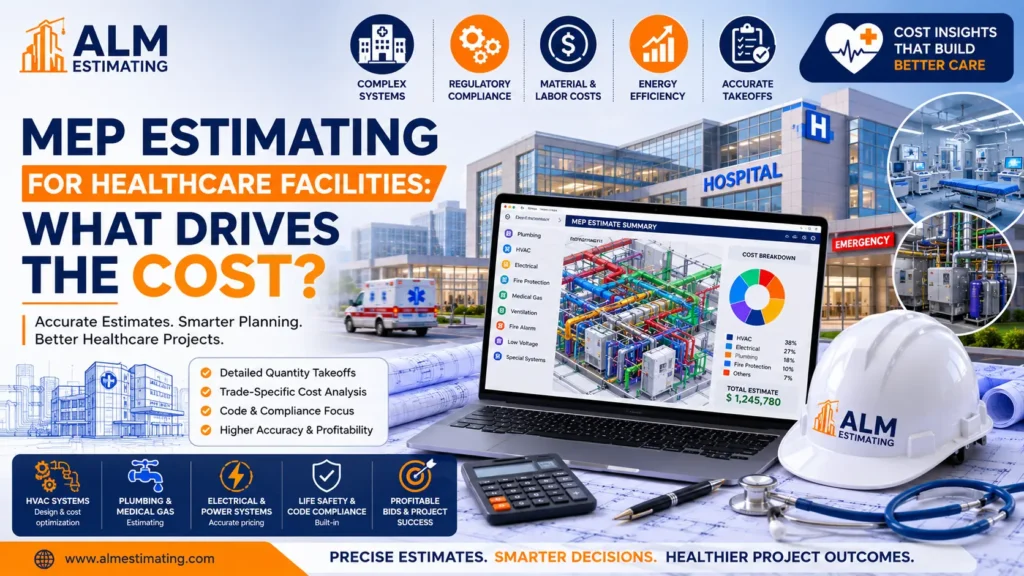
Healthcare MEP costs more than standard commercial MEP. Not slightly more on a per-square-foot basis, a hospital or ambulatory surgery center runs two to three times the MEP cost of a Class A office building at the same size. Contractors who price healthcare MEP using commercial benchmarks win bids they should not have won. The rest of the project is spent explaining why the number does not match the work.
The higher cost is not arbitrary. It comes from specific code requirements, redundant systems, and specialty scopes that simply do not exist in standard commercial construction. This article breaks down each trade and where the cost comes from.
Why Healthcare MEP Is in a Different Cost Category
1. Code Requirements That Apply Nowhere Else
Commercial construction is governed by the IBC, IMC, IPC, and NEC. Healthcare adds multiple layers on top of those. The FGI Guidelines for Design and Construction of Hospitals specify MEP system performance standards down to the individual space level. ASHRAE Standard 170 sets mandatory ventilation rates and pressure relationships. NFPA 99 governs medical gas, vacuum systems, and emergency power. NFPA 70 Article 517 covers healthcare electrical in detail.
If your estimating team is not familiar with these standards before opening the drawings, the number will be wrong before a single line item is entered.
2. Redundancy Is Mandatory, Not Optional
Standard commercial buildings have one electrical service, one HVAC system, and plumbing that serves the occupancy. Healthcare facilities are required by code and by operational necessity to keep systems running when primary infrastructure fails.
That means dual electrical feeders, automatic transfer switches, emergency generators sized to cover life-safety and critical systems, UPS for critical equipment, and HVAC designed so that a single unit failure does not compromise patient care areas. Every layer of redundancy adds cost. All of it is in the specification.
3. Commissioning Is a Defined Scope, Not a Startup Activity
Healthcare MEP commissioning is substantially more rigorous than standard commercial building Cx. Functional performance testing covers every piece of equipment under simulated failure conditions. Pressure relationship testing confirms that each room maintains its required positive or negative pressure. Medical gas systems require third-party testing and documentation before the system can be placed in service.
This is not a week of startup and a few signatures. It is a months-long process with specific documentation requirements that must be budgeted for in both the estimate and the schedule.
Mechanical (Division 23) in Healthcare
1. Air Change Rates by Space Type
The FGI Guidelines and ASHRAE Standard 170 specify minimum total air change rates and minimum outside air fractions for every space type in a healthcare facility. These are code minimums, not design targets and they must be verified by testing before occupancy. Operating rooms require a minimum of 20 total air changes per hour. ICUs require at least 6. Airborne isolation rooms require 12 ACH with 100 percent exhaust, no recirculation permitted.
These rates directly drive equipment sizing, duct sizing, and the number of terminal units in the mechanical scope. An estimate that does not price to the actual ACH requirement will consistently understate the mechanical scope.
| Space Type | Total ACH (min) | Outside Air ACH | Pressure Relationship | Governing Standard |
| Operating Room | 20 | 4 | Positive | FGI / ASHRAE 170 |
| ICU / CCU | 6 | 2 | Positive | FGI / ASHRAE 170 |
| Standard Patient Room | 6 | 2 | Neutral / Positive | FGI Guidelines 2022 |
| Airborne Isolation Room | 12 | 2 | Negative | CDC / FGI Guidelines |
| Sterile Processing | 10 | 2 | Positive | FGI / AAMI ST79 |
| Hazardous Drug Pharmacy | 12 | N/A | Negative | USP 800 / ASHRAE 170 |
| Soiled Utility / Toilet | 10 | N/A | Negative | FGI Guidelines 2022 |
Red rows indicate negative pressure spaces — exhaust exceeds supply to prevent airborne contaminants from escaping. These require 100 percent outside air and dedicated exhaust systems. Sources: FGI Guidelines 2022, ASHRAE Standard 170-2021.
2. Pressure Relationships and Dedicated Exhaust
Maintaining pressure relationships between spaces is a mechanical engineering and controls challenge that does not exist in standard commercial HVAC. An OR suite must maintain positive pressure relative to the corridor. An airborne isolation room must maintain negative pressure. A soiled utility room must be negative to adjacent spaces. These relationships must hold continuously, not just at design conditions, but under variable occupancy and system startup and shutdown.
Estimating healthcare HVAC without accounting for the controls infrastructure required to maintain these relationships, pressure sensors, damper actuators, building automation integration, understates the mechanical scope in a way that is hard to recover from post-award.
3. OR and Sterile Environment HVAC Systems
Operating room air handling units are typically dedicated to each OR suite. They include HEPA filtration, laminar flow diffusers, and unidirectional airflow specifically designed to minimize contamination at the surgical site. These are not standard VAV boxes connected to a central AHU. They are purpose-built systems with specific airflow patterns and filtration requirements that standard commercial mechanical equipment cannot meet.
Equipment cost for a single OR HVAC system can run $80,000 to $150,000 before ductwork, controls, and labor. Multiply that by the OR count and the mechanical scope grows quickly.
Electrical (Division 26) in Healthcare
1. The Essential Electrical System
NFPA 70 Article 517 requires healthcare facilities to have an Essential Electrical System separate from normal power distribution. The EES is divided into three branches: Life Safety, Critical, and Equipment System — each with specific load requirements and transfer timing.
Life Safety Branch loads; exit lighting, alarm systems, emergency communication, must restore within 10 seconds of a normal power failure. Critical Branch loads; patient care receptacles, nursing lighting, medication prep areas, must also restore within 10 seconds.
This infrastructure does not exist in commercial office buildings. It represents a significant portion of the electrical scope and cannot be treated as a standard distribution add-on.
2. Emergency Generation and UPS
Healthcare facilities require on-site emergency power generation sized to serve all Life Safety and Critical Branch loads. Generator sizing for a mid-size hospital typically runs 1,000 to 2,000 kW, often multiple paralleled units with automatic transfer switching. Fuel storage must meet NFPA 110 requirements, which in some jurisdictions mandate 96-hour operation capacity.
UPS systems provide seamless power for equipment that cannot tolerate even a 10-second transfer delay — certain OR equipment, imaging systems, and IT infrastructure. Both generators and UPS are significant equipment line items that require confirmation against the electrical specification before pricing.
3. Patient Care Electrical Requirements
Patient bed locations require a minimum number of duplex receptacles connected to the Critical Branch, including isolated ground receptacles. These are specified in NFPA 70 Article 517 and are not standard commercial wiring. Wet procedure locations; OR suites and procedure rooms, require isolated power panels with line isolation monitors. These panels are specialty equipment, not standard distribution panels.
Nurse call systems, patient monitoring infrastructure, and medical equipment power connections are coordinated with the medical equipment planner’s drawings. Missing the isolated power panels or the nurse call scope on a healthcare electrical estimate is a five to six figure gap.
Plumbing and Medical Gas (Division 22) in Healthcare
1. Medical Gas Systems Under NFPA 99
Medical gas systems — oxygen, nitrous oxide, nitrogen, medical air, carbon dioxide, and vacuum are among the highest unit-cost scopes in a healthcare MEP estimate. NFPA 99 requires Level 1 certified brazers for copper piping installation (ASSE 6010 certification), zone shutoff valves and alarm panels at every area served, and third-party verification testing and documentation before the system can be placed in service.
A medical gas system for a 100,000 SF hospital can represent $2 million to $5 million of the plumbing scope. It is not an allowance. It is a defined scope with specific equipment, specific labor requirements, and specific commissioning obligations.
2. Infection Control Plumbing
Healthcare plumbing must be designed and installed to minimize Legionella risk and other waterborne pathogen exposure. This means specific water heater temperatures per ASHRAE 188, recirculation system design that eliminates dead legs, and material selection that does not support biofilm growth.
In renovation projects, infection control during construction adds cost for temporary plumbing provisions, dust barriers, and HEPA filtration. These items do not appear in ground-up construction estimates and are easy to miss on a first pass through renovation drawings.
3. Specialty Fixtures and Equipment
Healthcare plumbing fixtures are not standard commercial fixtures. Sensor-operated faucets are standard in patient care areas. Bedpan washers and clinical sinks appear in soiled utility rooms. Scrub sinks for OR suites have specific dimension and sensor control requirements. Water softening and treatment systems protect medical equipment and sterilizers. Each is a defined specification item with a specific equipment cost.
The fixture schedule in the architectural drawings should be verified against the plumbing specification before any pricing is committed. Discrepancies between the two are common and each one represents a scope decision that needs to be made before the bid goes out.
Healthcare MEP Cost Benchmarks by Facility Type
These installed cost ranges include equipment, labor, commissioning, and the code-required redundancy and specialty systems described above.
| Facility Type | Mechanical /SF | Electrical /SF | Plumbing /SF | Total MEP /SF |
| Acute Care Hospital | $45–$75 | $35–$60 | $20–$40 | $100–$175 |
| Ambulatory Surgery Center | $35–$55 | $28–$48 | $16–$30 | $79–$133 |
| Medical Office Building | $18–$30 | $20–$32 | $10–$18 | $48–$80 |
| Outpatient / Clinic | $22–$38 | $22–$36 | $12–$22 | $56–$96 |
| Skilled Nursing Facility | $20–$35 | $18–$30 | $12–$22 | $50–$87 |
Acute care figures include emergency generation, essential electrical system, and full medical gas scope. ASC figures include OR-specific HVAC and isolated power panels. Medical office building figures are closer to standard commercial unless clinical procedure space is included.
A contractor who prices a 50,000 SF ambulatory surgery center at $48 per SF for MEP — using a standard commercial benchmark — is likely $1.5 to $2.5 million short before the first drawing is reviewed.
Common Mistakes on Healthcare MEP Estimates
• Using standard commercial AHUs for OR suites. OR air handling units are purpose-built systems with HEPA filtration and laminar flow capability. Standard VAV equipment cannot meet FGI and ASHRAE 170 requirements for surgical environments.
• Missing the Essential Electrical System scope entirely. The EES — Life Safety Branch, Critical Branch, Equipment System, transfer switches, and generator infrastructure — can represent 25 to 40 percent of the total electrical scope on an acute care project.
• Treating medical gas as a standard plumbing allowance. Medical gas requires NFPA 99 compliance, ASSE 6010 certified installers, zone valve panels, source equipment, and third-party verification. It cannot be priced from standard UA plumbing labor rates.
• Not accounting for seismic bracing on MEP systems. Most healthcare construction requires seismic bracing per OSHPD standards or IBC Chapter 13 regardless of geographic location. Bracing adds material and labor to every system and is frequently absent from early-stage drawings.
• Underpricing commissioning. Pressure relationship testing, medical gas verification, EES functional testing, and infection control documentation each add scope and schedule that must be reflected in both the estimate and the project timeline.
• Pricing renovation at ground-up rates. Renovation in an occupied healthcare facility carries cost premiums for infection control, off-hours work, phasing, and temporary utility provisions that can add 20 to 40 percent to the base MEP cost.
Working With ALM Estimating on Healthcare Projects
Healthcare MEP estimating requires estimators who understand the applicable codes, not just CSI structure. ALM Estimating’s team has worked across acute care, ambulatory surgery, and outpatient facility projects. Our healthcare scope covers Essential Electrical System infrastructure, NFPA 99 medical gas, ASHRAE 170 mechanical compliance, and the commissioning obligations that come with each trade.
If you have a healthcare MEP project to bid, send the drawings to info@almestimating.com or call +1 (917) 718-0084. We will confirm scope coverage and turnaround before you commit.
Frequently Asked Questions
Q1. Why does healthcare MEP cost so much more than standard commercial?
A. Three reasons: mandatory code requirements, redundant systems, and specialty scopes. FGI Guidelines, ASHRAE 170, and NFPA 99 mandate system performance standards that do not exist in commercial construction. Life-safety requirements mandate redundant electrical systems, emergency generation, and continuous monitoring. Medical gas, isolated power panels, and OR-specific HVAC are specialty scopes with no commercial equivalent. Every requirement adds cost, and none of it is optional.
Q2. What is NFPA 99 and how does it affect the estimate?
A. NFPA 99 is the Health Care Facilities Code published by the National Fire Protection Association. It governs medical gas and vacuum systems, electrical systems in patient care areas, and emergency power requirements. For estimating, the biggest impacts are on medical gas certified installers, third-party verification, zone valve panels, source equipment and on the electrical Essential Electrical System structure. Every healthcare project references NFPA 99 in the specification.
Q3. What is the difference between the Life Safety Branch and the Critical Branch?
A. Both are part of the Essential Electrical System required by NFPA 70 Article 517. The Life Safety Branch serves loads essential during an immediate power failure: exit lighting, alarm systems, emergency communication. The Critical Branch serves loads that support direct patient care, patient bed receptacles, nursing station lighting, medication prep. Both must restore within 10 seconds and must be on separate circuits from normal power wiring.
Q4. Do outpatient clinics have the same MEP requirements as hospitals?
A. Not always,3 but the gap is smaller than most contractors assume. Outpatient facilities that include procedure rooms, infusion centers, or any space where patients receive treatment are subject to FGI Outpatient Guidelines. Medical office buildings with purely clinical examination and no procedures are closer to standard commercial. The specification and the occupancy classification on the drawings define what applies on any given project.
Q5. How do I estimate healthcare MEP renovation differently from ground-up?
A. Occupied healthcare renovation carries cost premiums that ground-up construction does not: infection control enclosures, off-hours work in sensitive areas, temporary utility provisions during system cutovers, and phased sequencing that limits crew productivity. A reasonable starting premium for occupied healthcare renovation versus equivalent ground-up MEP work is 20 to 40 percent and that range can go higher on complex phased projects in active clinical environments.