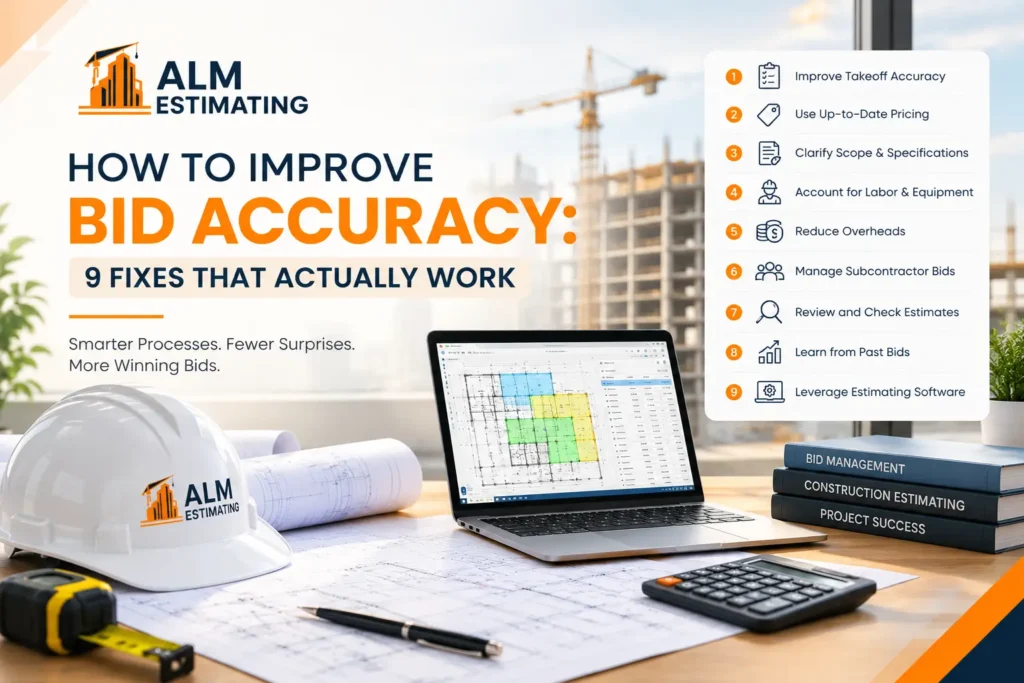
Winning a bid feels great, until you realize your numbers were wrong. One missing line item or one outdated unit rate can turn a winning project into a losing job. Most contractors win only one out of every four or five bids they submit, and inaccurate estimates are one of the most common reasons the ones they do win end up bleeding margin.
The good news is that bid accuracy is not about luck, and it is not about better math. It comes down to catching the same repeatable causes before the number goes out. This guide breaks down the nine causes that show up on job after job, roughly what each one costs when it slips through, and the specific fixes that working estimators use to catch them before submission.
What “Accurate” Actually Means in Construction Estimating
Before fixing bid accuracy, it helps to define what accurate means, because a 5% variance and a 30% variance can both be a correct estimate. It depends entirely on what stage the project is at when the number is produced.
AACE International’s estimate classification system (Recommended Practice 18R-97) sets five classes, running from a Class 5 rough order of magnitude on a barely defined scope to a Class 1 check estimate on a fully detailed design. Holding a Class 5 number to Class 1 tolerance is measuring the wrong thing.
| AACE Class | Design Completion | Typical Use | Expected Accuracy |
| Class 5 | 0–2% | Concept screening / rough order of magnitude | −50% to +100% |
| Class 4 | 1–15% | Study or feasibility | −30% to +50% |
| Class 3 | 10–40% | Budget authorization / bid-tender | −20% to +30% |
| Class 2 | 30–75% | Control estimate / bid-tender | −15% to +20% |
| Class 1 | 50–100% | Check estimate / bid-tender | −10% to +15% |
For a hard-bid submission — the scenario most contractors mean when they say “our estimate was off” you are operating in Class 2 or Class 1 territory. A well-run estimate at that stage should land within roughly 10 to 20 percent of the final cost, not the 30-to-50 percent swings that are normal at feasibility stage. If your bids are regularly missing that tighter band, the fix is almost always one of the nine causes below, not a wholesale rebuild of your estimating process.

The Nine Causes of Bid Inaccuracy and What Each One Costs
Most inaccurate bids do not fail because of arithmetic. They fail because of process gaps, a missed addendum, a stale unit rate, a scope gap where two trades meet. These same causes show up on job after job, across firms of every size. The table below summarizes the nine most common ones and the typical margin erosion each one creates when it slips through unchecked.
| # | Cause | Typical Cost Impact |
| 1 | Reading the drawing off the printed scale instead of stated dimensions | 1–3% |
| 2 | A missed addendum or late revision never incorporated into the takeoff | 0.5–5% |
| 3 | Unit rates carried from an old estimate without checking current pricing | 2–6% |
| 4 | A scope gap where two trades meet — nobody’s takeoff claims the item | 1–4% |
| 5 | General conditions carried as a flat percentage instead of built from duration and staffing | 1–3% |
| 6 | Contingency applied at the wrong stage, added at bid time, or dropped entirely | 2–8% |
| 7 | A plug number stood in for unpriced scope and was never revisited before submission | 1–5% |
| 8 | Labor productivity assumed at a standard rate, not adjusted for site conditions or crew size | 2–5% |
| 9 | Escalation not applied between takeoff date and bid day, or across a long lead time | 1–4% |
Each cause is detailed below with its fix.
1. Reading Off the Scale Instead of the Stated Dimensions
A printed or exported drawing sheet can drift from its stated scale. A photocopy, a resized PDF, or a plotter set to “fit to page” instead of 100% will shift every measurement taken with a scale ruler. An estimator who trusts the printed scale over the dimension strings inherits that drift into every linear foot, square foot, and cubic yard on the sheet. The fix is straightforward: always take the stated dimension over the scaled one, and use the scale only where no dimension is given. On digital takeoff platforms like Bluebeam or PlanSwift, calibrate the drawing scale against a known dimension before measuring anything else.
2. Missed Addenda and Late Revisions
Addenda arrive after the base drawing set, sometimes only days or hours before bid day. A scope change buried on page three of a brief addendum is easy to miss on a fast turnaround, especially when multiple projects are being bid simultaneously. The fix is not more careful reading. It is a standing checklist item: confirm the addendum log against the quantity takeoff before pricing starts, every time, regardless of how minor the addendum looks. Log the addendum number, the date received, and the specific sheets or specification sections it affects. If the addendum changes quantities already taken off, re-measure those items rather than applying a percentage adjustment.
3. Out-of-Date Unit Rates
Material and labor costs move, sometimes sharply between quarters. An estimator working from last quarter’s pricing is estimating last quarter’s job. Lumber, copper, steel, and concrete have all seen double-digit swings in recent years. Cross-check unit rates against a current source before every bid: RSMeans data for benchmark costs, the ENR Construction Cost Index for broad market movement, and live supplier quotes for the materials that make up the largest cost lines. A once-a-year rate-book refresh is not enough when material escalation can shift 2 to 6 percent in a single quarter.
4. Scope Gaps Where Two Trades Meet
Scope gaps hide at the boundary where two trades meet. Who furnishes the electrical rough-in box, the electrician or the general contractor? Who terminates a control wire, the mechanical sub or the controls contractor? Neither trade’s takeoff claims the item because each assumes the other has it. These gaps do not surface until buyout, when the subcontractor’s scope letter excludes the work and someone has to absorb the cost. Closing scope gaps means naming the boundary explicitly in the scope of work, not in the estimator’s head, but in writing. A division-of-work matrix that maps each CSI division’s boundary items against the responsible trade is the most reliable fix.

5. General Conditions Carried as a Flat Percentage
Applying a standard 8 or 10 percent for general conditions is faster than building the number up, but it stops tracking reality the moment the actual project duration, site logistics, or staffing plan differs from whatever job the flat percentage was borrowed from. A six-month renovation in a congested downtown site and a twelve-month greenfield build carry very different supervision, temporary facilities, and site overhead costs. For anything past a Class 3 estimate, build general conditions from the actual schedule and staffing plan: superintendent weeks, project manager allocation, dumpster pulls, temporary power, site fencing, and insurance by named exposure, not a blanket percentage applied to the direct-cost total.
6. Contingency Applied at the Wrong Stage
Contingency belongs in the estimate at the class-appropriate level, wider at Class 5 when scope is undefined, tighter at Class 1 when every line item has been priced. It should shrink as the design firms up, not get bolted on as an afterthought at bid submission or dropped entirely to look competitive. Either mistake distorts the number in a different direction: too much contingency loses the bid, too little erodes margin once the real costs land at buyout. Document contingency as a visible line item in the estimate summary, not buried in the total, so reviewers can evaluate whether the allowance is appropriate for the project’s actual stage and risk profile.
7. Plug Numbers That Were Never Revisited
A plug number is a placeholder, a rough allowance inserted for scope that has not been priced yet so the estimate can keep moving. The problem is not the plug itself; it is the plug that is still sitting in the estimate at submission because nobody went back to replace it with a real number. On a compressed bid-day schedule, plug numbers that were meant to be temporary become permanent by accident. The fix: flag every plug number in the estimate with a visible marker (a color code, a tag, a separate column), and include a final-pass check that requires each flag to be cleared or explicitly accepted before the bid goes out.
8. Labor Productivity Assumed at a Standard Rate
Standard labor productivity factors from a cost database assume standard conditions; adequate access, a trained crew, moderate weather, and no stacking of trades in the same work area. Real jobsite conditions are rarely standard. A high-rise mechanical rough-in with limited hoist access and trade stacking will burn more labor hours per unit than the same work in an open warehouse. Adjust productivity rates for the actual site: access restrictions, weather exposure, crew experience, work sequencing, and whether the project requires overtime or shift work. A 15 to 25 percent productivity adjustment on a labor-heavy trade can shift the total estimate by several points.
9. Escalation Not Applied Between Takeoff and Bid Day
An estimate priced in January for a project that breaks ground in July carries six months of unaccounted-for cost movement if no escalation factor is applied. On a project with long lead-time materials, structural steel, switchgear, custom HVAC units, the gap can be even wider. Apply an escalation factor tied to the ENR Construction Cost Index or a regional equivalent between the date the unit rates were set and the expected procurement or construction start. For large projects with phased procurement, apply escalation by procurement package rather than as a single blanket percentage.

What to Check in the Last Two Hours Before Submission
The final review window before a bid goes out is where most of the nine causes above either get caught or get missed. A standing pre-submission checklist; run every time, on every bid, is the single most effective quality gate an estimating team can adopt. Here is what that checklist should cover:
1. Addendum log matches the takeoff — every addendum item is accounted for, not just the ones that looked significant at first read.
2. No plug numbers remain unpriced or unflagged — every placeholder has been replaced with a real number or explicitly accepted by the reviewer with a documented reason.
3. Unit rates verified against a current source — not carried forward from the last similar job without a date check.
4. General conditions built from this project’s schedule — not copied from the template or from the last bid.
5. Contingency matches the estimate’s actual class — documented as a visible line item, not buried in the total.
6. Scope boundaries named in writing — boundary items between adjacent trades are assigned to a responsible party, not assumed.
7. Escalation applied from rate date to bid day — with long lead-time items escalated separately if procurement is phased.
8. Labor productivity adjusted for actual site conditions — not left at the standard database factor.
9. Drawing scale calibrated — digital takeoff tools calibrated against a known dimension, and scaled measurements cross-checked against stated dimensions.
When It’s a Capacity Problem, Not a Skill Problem
Some of these nine causes are not about estimator skill at all. They are about what a team can realistically verify on a compressed bid-day schedule. A firm bidding three or four projects a week with one or two estimators does not have the hours to re-verify every unit rate, cross-check every addendum, and review every scope boundary before each submission, no matter how experienced the team is.
When bid accuracy slips despite good estimators, the cause is usually capacity. And capacity has a fix that does not require hiring: outsourcing the quantity takeoff and pricing work [/outsource-estimating-services/] on overflow bids frees the senior estimator to focus on the review, the scope gaps, and the judgment calls that actually determine whether the bid is right. That is a better use of a skilled estimator’s time than re-measuring ductwork at midnight because three bids landed in the same week.
ALM Estimating provides construction cost estimating services [/cost-estimating-services/] that handle the takeoff and pricing, giving your team the capacity to run a proper pre-submission review on every bid, not just the ones where the schedule allows it.

Final Thought:
Bid accuracy is not about better math. It is about catching the same nine process gaps before the number goes out. A missed addendum, a stale unit rate, a scope gap between trades, a contingency applied at the wrong stage, these are repeatable failures with repeatable fixes.
The single most effective improvement is a pre-submission checklist that runs every time, on every bid. When accuracy still slips despite good estimators and a good checklist, the constraint is almost always time and the fix is adding capacity to the review process, not accepting a higher error rate as the cost of doing business.
FREQUENTLY ASKED QUESTIONS:
Q1: What is a good bid accuracy percentage for construction?
A. For a hard-bid submission at AACE Class 1 or Class 2, a well-run estimate typically lands within 10 to 20 percent of the final cost. Earlier-stage numbers; Class 4 or Class 5, are correctly much wider, sometimes 30 to 50 percent, because the design is not defined enough to be tighter. Judge accuracy against the estimate class, not a single fixed target.
Q2: What is the most common construction estimating error?
A. Out-of-date unit rates and missed addenda show up most often. Both are process gaps rather than math errors, and both are fixable with a standing pre-submission check, not more careful arithmetic. Scope gaps at trade boundaries are the third most frequent cause and tend to carry the highest per-item cost impact.
Q3: How do I check an estimate before submitting a bid?
A. Run it against a fixed checklist in the final hours before bid day. Confirm the addendum log matches the takeoff, verify that no plug numbers remain unpriced, check unit rates against a current source, ensure general conditions are built from the actual schedule, confirm contingency is documented at the right class, and name scope boundaries between adjacent trades in writing.
Q4: Does outsourcing estimating improve bid accuracy?
A. It can, mainly by adding the hours a busy in-house team does not have to re-verify rates, cross-check addenda, and close scope gaps before bid day. The improvement comes from added capacity for review, not from anything inherent to an outside firm. When the bottleneck is time rather than skill, outsourcing the takeoff and pricing work frees the senior estimator to focus on the judgment calls that determine whether the bid is right.
Q5: What is the AACE estimate classification system?
A. AACE International’s Recommended Practice 18R-97 defines five estimate classes based on the level of project definition. Class 5 is a rough order of magnitude on a barely defined scope, and Class 1 is a detailed check estimate on a fully documented design. Each class carries an expected accuracy range, and the correct benchmark for bid accuracy depends on which class the estimate was prepared for.
Let’s GET STARTED
Tired of Scope Gaps and Missed Items Costing You Margin?
Send us your plans and scope, and ALM Estimating returns a clean, trade-by-trade takeoff with verified quantities, current unit rates, and clear scope boundaries, no missed items, no double-counted work.
No retainer. No portal. Pay per project. Upload Your Plans | Contact Us | Or call +1 (520) 455-6525