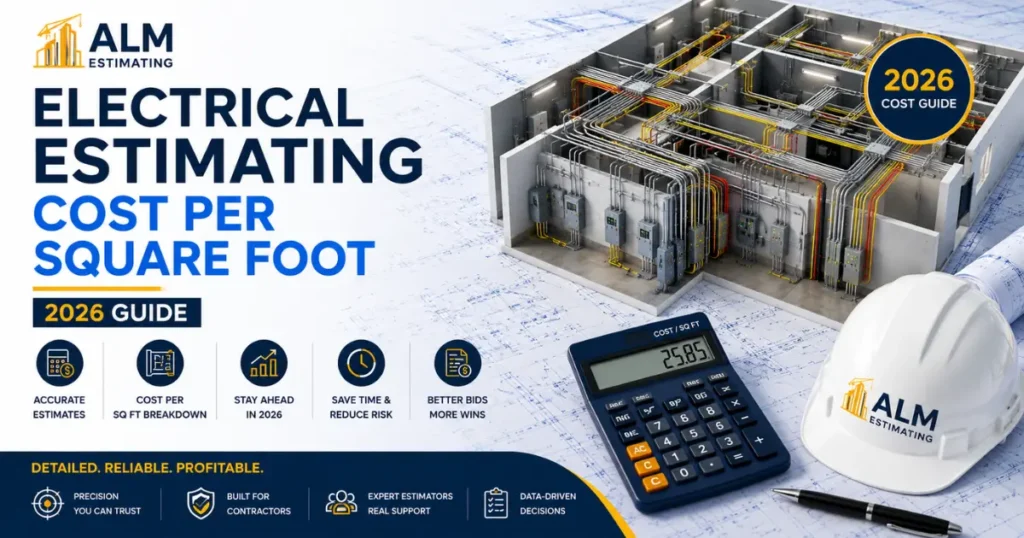
Electrical systems are the second-largest MEP cost on most commercial construction projects, and among the most complex to estimate accurately. Whether you are a general contractor pricing a bid package, an electrical subcontractor quoting a TI build-out, or a developer building a feasibility model, having reliable 2026 electrical cost-per-square-foot benchmarks is essential before any number commits to paper. This guide covers installed electrical costs by project type, the factors that move the number most, what a professional electrical estimate includes, and when a per-SF figure is not enough.
Electrical Installed Cost Per Square Foot — 2026 Benchmarks
The figures below represent total installed electrical construction costs per square foot, service entrance, distribution, wiring, devices, lighting, and controls. These are not estimating fees. Use them for early-stage budgeting and bid sense-checking.
| Project Type | Low ($/SF) | High ($/SF) | Typical Scope |
| Single-family residential | $3.50 | $8.00 | Service entrance, panels, wiring, devices, lighting |
| Multi-family / apartment | $4.00 | $9.50 | Individual unit panels, common area lighting, EV conduit |
| Light commercial / retail | $5.00 | $12.00 | Service, distribution, lighting, receptacles, low-voltage |
| Office build-out (TI) | $6.00 | $15.00 | Panels, lighting controls, UPS, low-voltage, data |
| Restaurant / food service | $7.00 | $16.00 | High-demand equipment circuits, hood suppression, signage |
| Healthcare / medical | $12.00 | $30.00+ | Critical branch, emergency systems, isolated power, ATS |
| Industrial / warehouse | $4.00 | $11.00 | MCC, motor feeds, lighting, specialty process circuits |
| Data center | $20.00 | $60.00+ | Critical power, UPS, PDU, generator, N+1 redundancy |
* Prices are estimates only. Actual cost depends on project scope, location, and complexity. Contact ALM Estimating for an exact quote.
Electrical costs per square foot vary more dramatically by project type than almost any other trade. A warehouse with basic lighting, receptacles, and motor feeds might sit at $4–$6 per square foot. A data center with critical power infrastructure, UPS systems, generator backup, and N+1 redundancy can reach $20–$60 per square foot for electrical alone, same footprint, completely different scope. Always confirm what is included in any per-SF figure before applying it to a budget.
What Drives Electrical Cost Per Square Foot
1. Service size and distribution voltage
The service entrance and distribution system are the foundation of every electrical estimate. A small retail build-out may require a 200A, 120/208V panel. A large commercial office building may need a 2,000A, 277/480V service with a main switchboard, multiple sub-panels, and a building-wide distribution system. The difference in installed cost between these two scenarios — before a single device or light fixture is counted — can be $15–$25 per square foot in a 50,000 SF building. Switchgear, main distribution boards (MDBs), automatic transfer switches (ATS), and metering equipment are the biggest single line items in any large commercial electrical estimate.
2. Lighting system type and controls
Lighting accounts for 15–25 percent of total electrical installed cost on most commercial projects. LED fixture packages in a standard office build-out are straightforward. Healthcare facilities with surgical lighting, clean room environments with explosion-proof fixtures, or warehouse projects with high-bay LED high-output fixtures are a different scope entirely. Add an energy management system (EMS), daylight harvesting controls, occupancy sensors, and DALI dimming throughout common in LEED and Title 24 projects and lighting control systems alone can add $2–$5 per square foot to the base lighting cost.
3. Low-voltage and specialty systems
Commercial electrical estimates increasingly include low-voltage systems that are specified in Division 27 (communications) and Division 28 (electronic safety and security) but priced by the electrical contractor. Structured cabling, fire alarm, access control, CCTV, and building automation system (BAS) wiring all add to the electrical scope. On a healthcare or laboratory project, nurse call systems, code blue systems, and isolated power panels add further. Contractors who exclude these from their base bid create scope gaps that surface as change orders — experienced estimators scope and price these systems explicitly.
4. Labour market and IBEW classification
Electrical installation in the United States falls under International Brotherhood of Electrical Workers (IBEW) jurisdiction on union projects. In major metropolitan markets, New York City, Chicago, San Francisco, Los Angeles, Boston, and Washington DC, IBEW journeyman electrician rates run $85–$125 per hour fully loaded with fringe benefits. In open shop markets across the Sun Belt, the same trade is priced at $45–$65 per hour. Projects subject to Davis-Bacon Act prevailing wage, federally funded construction, public schools, government facilities — must use published wage determinations regardless of local market conditions. This labour market variance alone shifts electrical installed costs by 30–50 percent per square foot between a New York City office tower and an equivalent building in Phoenix or Dallas.
5. Design stage and drawing completeness
Electrical estimates from schematic design (SD) or design development (DD) drawings carry a 15–25 percent contingency because panel schedules have not been confirmed, lighting layouts have not been coordinated, and specialty systems have not been scoped. A complete construction document (CD) set with issued Division 26, 27, and 28 specifications allows a full Bluebeam and PlanSwift quantity takeoff — replacing contingency with actual conduit runs, wire quantities, device counts, and equipment schedules. For competitive bid or GMP submissions, CD-level estimates are the minimum standard.
Electrical Estimating Fees: What Does a Professional Estimate Cost?
The table below shows outsourced electrical estimating fees from ALM Estimating, separate from the construction costs shown above.
| Project Size | Electrical Only | Full MEP Bundle | Turnaround |
| Small (under 5,000 SF) | $300–$750 | $950–$2,200 | 24 hours |
| Mid-size (5,000–50,000 SF) | $750–$2,200 | $2,200–$7,000 | 1–3 business days |
| Large (50,000 SF+) | $2,200–$7,500+ | $7,000–$22,000+ | 2–5 business days |
* Prices are estimates only. Actual cost depends on project scope, location, and complexity. Contact ALM Estimating for an exact quote.
ALM Estimating delivers fully itemised electrical estimates in 24 hours for most commercial projects. Upload your drawings at almestimating.com or call +1 (917) 718-0084.
What a Professional Electrical Estimate Includes
A complete electrical estimate from ALM Estimating is structured to CSI MasterFormat Division 26 and includes:
- Conduit and raceway takeoff — EMT, IMC, RGS, and PVC conduit by size and run length, produced from Bluebeam drawing markup
- Wire and cable quantities — branch circuit wiring, feeders, and specialty cable by type and circuit count
- Device and fixture counts — receptacles, switches, data outlets, light fixtures, and specialty devices itemised from architectural and electrical plans
- Panel and switchgear schedule — all panelboards, MDBs, switchboards, and ATS equipment with manufacturer, ampacity, and installed cost
- Low-voltage scope — fire alarm, structured cabling, access control, CCTV, and nurse call scoped from Division 27 and 28 specifications
- Labour hours — IBEW trade labour units adjusted for union or open shop classification and prevailing wage where applicable
- Excel workbook — CSI Division 26 structure, tabbed by system, ready for GC bid package submission
Frequently Asked Questions
What is the average electrical cost per square foot for a commercial building in 2026?
For a standard commercial office or retail building in 2026, expect $5–$15 per square foot installed for electrical systems including service, distribution, wiring, devices, and lighting. Projects in union labour markets sit toward the upper end. Open shop markets in the Sun Belt will land in the $5–$9 range for comparable scopes. Healthcare, data center, and industrial projects fall outside this range and require full project-specific estimates.
Does electrical cost per square foot include low-voltage systems like fire alarm and data?
It depends on the scope definition. A base electrical cost-per-SF benchmark typically covers Division 26 work, power distribution, wiring, devices, and lighting. Low-voltage systems under Division 27 (communications, structured cabling) and Division 28 (fire alarm, access control) may or may not be included depending on the source. ALM estimates explicitly scope and price all systems specified in the project documents — always confirm what is and is not included when comparing figures.
How much does a professional electrical estimate cost?
For a mid-size commercial project, an electrical-only estimate from ALM Estimating runs $750–$2,200. Full MEP bundles covering mechanical, electrical, plumbing, and fire protection run $2,200–$7,000. Most estimates are delivered within 24 hours at standard rates with no expedite fee.
What software does ALM Estimating use for electrical takeoffs?
ALM Estimating uses Bluebeam Revu for drawing markup and conduit measurement, PlanSwift for digital quantity takeoffs, and Microsoft Excel for final estimate delivery. All electrical estimates are structured to CSI MasterFormat Division 26 with separate tabs for service and distribution, branch wiring, lighting, low-voltage, and labour.
Does ALM Estimating cover electrical estimating for prevailing wage projects?
Yes. ALM Estimating prices electrical labour at current IBEW prevailing wage rates for all applicable jurisdictions including Davis-Bacon federal projects, state-funded construction, and public works contracts. Wage determinations are applied by county and trade classification as required. Contact us with your project location and funding type for specific prevailing wage pricing.
How is electrical estimating different from other trade estimates?
Electrical estimating requires coordinating across multiple specification divisions, Division 26 for power systems, Division 27 for communications, and Division 28 for electronic safety and security. It also requires understanding panel load calculations, fault current coordination, and arc flash compliance requirements that affect equipment selection and pricing. Missing scope gaps between these divisions is one of the most common causes of electrical bid overruns on commercial projects.
Get a Free Electrical Estimate — 24-Hour Turnaround
Upload your drawings at almestimating.com or contact us directly:
Phone: +1 (917) 718-0084 | Email: info@almestimating.com
Serving all 50 US states — Arlington, VA 22201