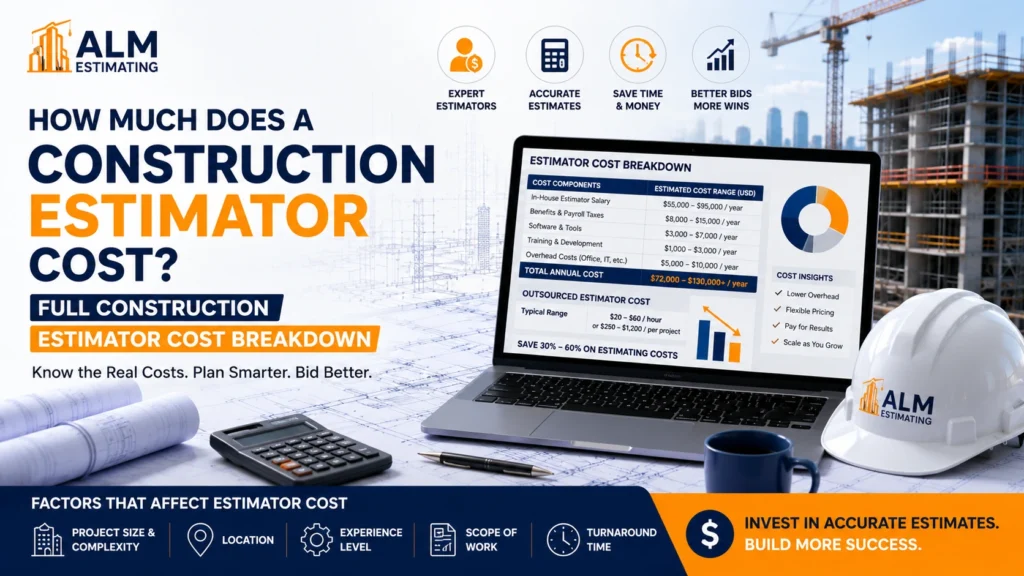
The question sounds simple. The answer depends entirely on which model you are buying. An in-house senior estimator in a major US market carries a fully loaded annual cost that can top $200,000. A freelance estimator bills $40 to $100 per hour depending on trade and experience. An outsourced firm prices per project, typically $500 to $2,500 for a mid-size commercial estimate. Same function, three completely different cost structures, and the right choice depends on how many bids you run per month and what those bids require.
Option 1: Hiring an In-House Estimator
1. What the Salary Range Actually Looks Like
Base salaries for construction estimators in the US run from $52,000 for a junior estimator doing residential takeoffs to $150,000 or more for a lead estimator managing complex commercial bids. Most contractors hiring their first dedicated estimator land between $75,000 and $95,000 for someone with 4 to 7 years of commercial experience.
| Experience Level | Base Salary | Loaded Cost (est.) | Typical Scope |
| Junior — 1–3 years | $52,000–$70,000 | $67,000–$95,000 | Residential, light commercial |
| Mid-level — 4–7 years | $72,000–$95,000 | $94,000–$128,000 | Commercial GC, single-trade MEP |
| Senior — 8+ years | $95,000–$125,000 | $124,000–$168,000 | Full MEP, healthcare, large commercial |
| Lead / Chief Estimator | $120,000–$150,000 | $156,000–$202,000 | Multi-trade, GMP, design-build |
Loaded cost includes payroll taxes, health insurance, PTO, and standard benefits. Regional markets; New York, San Francisco, Chicago — typically run 20 to 35 percent above the national figures shown here.
2. The Loaded Cost Nobody Quotes You
That salary number is not the real cost. Payroll taxes, health insurance, paid time off, and retirement contributions add 28 to 38 percent on top of base compensation. A $90,000 estimator costs the business $115,000 to $124,000 annually before a single tool is purchased.
3. Software Is Not Optional
A professional estimating workflow requires a digital takeoff platform — PlanSwift or STACK runs $1,800 to $3,500 per year per license. Add an RSMeans regional cost data subscription ($1,200 to $2,500 annually) and trade-specific tools for MEP work such as FastDuct and FastPipe (another $1,500 to $3,000). That is $4,500 to $9,000 in annual software costs before the first estimate is produced. It is a fixed cost that applies whether your estimator is at full capacity or idle.
4. The Utilization Problem
Construction bidding is not evenly distributed through the year. Bid volume peaks in spring and fall, drops in winter. An in-house estimator on full salary in February costs the same as one running at 100 percent capacity in September. If you are not running 12 to 15 competitive bids per month consistently, that fixed cost is difficult to justify on a per-estimate basis. Most contractors who run the math honestly find the utilization rate is lower than they assumed.

Option 2: Freelance Estimators
1. How Freelance Estimators Price Their Work
Freelance estimators typically charge $40 to $100 per hour depending on experience level, trade specialty, and market demand. Some charge a flat fee per project, particularly for residential or light commercial takeoffs where scope is predictable. The hourly model makes the cost transparent but unpredictable, a project that takes longer than expected because of drawing gaps or coordination issues can run well over the quoted estimate.
2. When the Model Works
Freelancers are well suited for contractors who need occasional surge capacity, a bid that overlaps with an existing deadline, a trade scope outside the in-house team’s depth, or a one-off project type that does not justify a full-time hire. The cost is incurred only when the work is there, which eliminates the utilization problem entirely.
3. The Consistency Risk
The challenge with freelancers is deliverable quality. Estimators working independently vary significantly in how they structure their output, what software they use, and whether they document assumptions. An estimate that is not built on a proper quantity takeoff, not organized to CSI MasterFormat, and not accompanied by marked-up drawings is not a bid-ready deliverable, it is a starting point that still requires internal review before it can be used. Before engaging any freelance estimator, ask for a sample deliverable from a project similar to yours. That single step will tell you more than any rate card.

Option 3: Outsourced Estimating Firms
1. Per-Estimate Pricing — What to Expect
Professional estimating firms price per project, per trade, or on a monthly retainer for high-volume clients. Per-estimate is the most common structure and the easiest to evaluate against alternatives.
| Project Size | Single Trade | MEP Bundle | Full Package | Turnaround |
| Small — under $500K | $150–$400 | $400–$750 | $500–$900 | 24–48 hrs |
| Mid-size — $500K–$5M | $400–$850 | $850–$2,000 | $1,100–$2,500 | 24–72 hrs |
| Large — $5M–$20M | $700–$1,600 | $1,500–$4,000 | $2,000–$5,000 | 3–5 days |
| Mega / Complex — $20M+ | Custom | Custom | Custom | By scope |
Fees reflect firms using industry-standard tools — PlanSwift or Bluebeam for takeoff, RSMeans for pricing, CSI MasterFormat structure. Services advertising significantly lower prices typically exclude marked-up drawings, documented assumptions, or trade-specific expertise.
2. What Is Included in a Professional Deliverable
A bid-ready estimate from a professional firm includes a fully itemized line-item cost breakdown organized by CSI MasterFormat division, a complete quantity takeoff with every measured item documented, marked-up drawings showing exactly what was counted and how, and a scope clarification section identifying assumptions, allowances, and exclusions. That deliverable can be used to review subcontractor bids, build a schedule of values, and defend your number in a scope dispute. A spreadsheet with totals cannot do any of those things.
3. The Flexibility Advantage
The per-estimate model means your estimating cost scales directly with your bid volume. During slow months, the cost drops to zero. During peak season, you submit more bids without hiring. Unlike a freelance arrangement, a professional firm also provides consistent deliverable formatting, committed turnaround times, and a process that does not vary based on who picks up your project on a given week.
A common objection: ‘We’d rather build that knowledge in-house.’ That makes sense at the right bid volume. If you are not there yet, you are paying for institutional knowledge that sits idle for months at a time.

What You Are Actually Paying For
1. The Real Cost Is in Getting the Number Wrong
The fee for a professional estimate is not the cost of the estimating service. It is the cost of getting the number right. A $1,200 outsourced estimate on a $3M project is 0.04 percent of the contract value. If it catches a scope gap that would have cost $60,000 to resolve post-award, the math is not complicated.
2. What Accurate Estimates Let You Do
A properly built estimate drawn from actual quantity takeoffs, priced with current regional data, and structured to CSI MasterFormat is a working document throughout the project. It gives you a framework to review subcontractor bids, identify gaps between your number and the subs, build a schedule of values, and set up a cost tracking system from day one. An accurate bid that wins is the start of a well-run job. A low bid that wins is a margin problem waiting to develop.
Which Option Makes Sense at Your Bid Volume?
The right model is almost entirely a function of how many bids you run per month and how consistent that volume is throughout the year.
| Bids / Month | Best Approach | Why It Works | Watch Out For |
| 1–4 | Outsourced firm | Per-estimate cost far cheaper than fixed salary | Picking a firm without trade-specific expertise |
| 5–12 | Outsourced or freelance | Flexible capacity, no fixed overhead | Freelancer quality varies — vet deliverable format first |
| 13–25 | 1 in-house + outsourced overflow | In-house handles familiar scope; outsourced covers complex or overflow bids | In-house estimator becoming a bottleneck during peak season |
| 25+ | In-house team + outsourced capacity | Volume justifies fixed cost; outsourced handles peaks and unfamiliar trades | Over-hiring in-house and carrying dead weight in slow seasons |
The hybrid model; one in-house estimator plus an outsourced firm for overflow and complex trades is the most common setup among mid-size GCs bidding 15 to 25 projects per month. It captures the institutional knowledge benefit of an in-house hire while keeping the flexibility to handle volume spikes without adding permanent headcount.

Working With ALM Estimating
ALM Estimating provides construction cost estimates and quantity takeoffs for contractors and developers across all 50 states, from our base in Arlington, VA. Our pricing follows the per-estimate model shown in the table above. Every deliverable includes a marked-up drawing set, CSI-structured line items, and full documentation of assumptions, exclusions, and allowances. Turnaround is 24 hours for most commercial projects.
If you want to know what an estimate for your next project would cost before committing, send the drawings to info@almestimating.com or call +1 (917) 718-0084. We will review them and give you a fee and turnaround confirmation within the hour.
Frequently Asked Questions
Q1. What is the average salary of a construction estimator in the US?
A. The national average base salary for a construction estimator sits between $78,000 and $85,000 according to Bureau of Labor Statistics data and industry salary surveys. That figure moves significantly by experience and market. Senior estimators in New York, San Francisco, and Chicago regularly earn $110,000 to $140,000 in base salary before bonuses.
Q2. s outsourcing estimating cheaper than hiring in-house?
A. For most contractors bidding fewer than 12 to 15 projects per month, yes. The fully loaded cost of an in-house estimator runs $100,000 to $170,000 annually. A contractor running 8 bids per month at an average outsourced fee of $700 per estimate spends roughly $67,000 per year and pays nothing during slow months. The break-even point depends on your bid volume, project size, and year-round consistency.
Q3. Does outsourced estimating work for MEP and specialist trades?
A. It depends on the firm. MEP estimating requires trade-specific expertise ductwork takeoffs need SMACNA knowledge, electrical estimates require understanding of panel schedules and IBEW labor jurisdiction. Before engaging any firm for MEP scope, ask specifically about trade experience and request a sample MEP deliverable. A firm that cannot provide one should not be estimating your mechanical, electrical, or plumbing work.
Q4. How do I know if an estimating firm is accurate?
A. The clearest measure is comparing their estimate against actual subcontractor bids once a project is awarded. A consistent gap in one direction tells you something specific about their methodology. Firms that produce estimates significantly below market on a particular trade are a liability on every project you win on that basis. Ask any prospective firm how their estimates have compared to actual bids on recent projects and whether they can share examples.
Q5. What should a bid-ready estimate actually include?
A. At minimum: a line-item cost breakdown organized by CSI MasterFormat division, a quantity takeoff with documented measurements for every item, marked-up drawings showing what was counted, and a written scope clarification identifying assumptions, allowances, and exclusions. If a deliverable does not include those elements, it cannot be audited against subcontractor bids, used to build a schedule of values, or defended in a scope dispute.