You priced every trade, the numbers are tight, and the bid goes out. Then the superintendent stays months longer than you carried, and a closeout package nobody budgeted takes the last of your margin. That loss rarely traces to one bad line. It traces to two terms estimators use as if they meant the same thing.
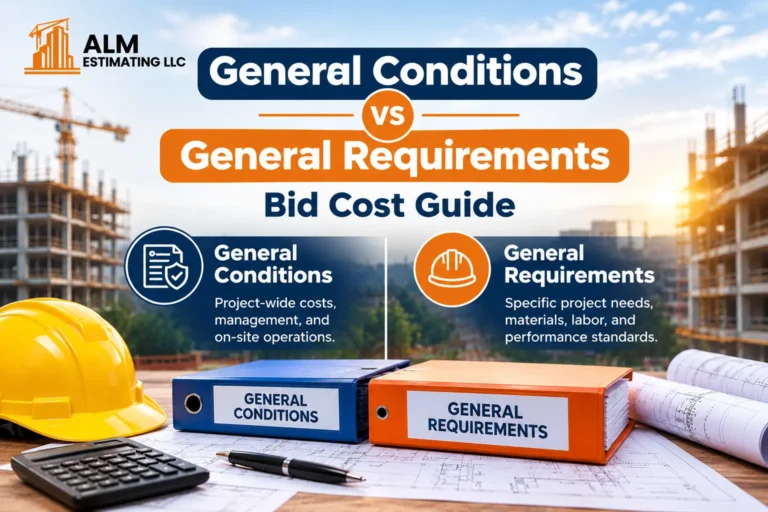
| Short answer: General conditions are the contract’s terms, the rights and responsibilities of owner, contractor, and architect. General requirements are Division 01 of the specifications, the project-wide procedures and temporary scope every trade follows. On a bid, “general conditions” also names the jobsite cost line that pays for both. Blur the three and general conditions construction cost lands in the wrong scope, or in none. |
Three Meanings Hiding Behind Two Terms
Most arguments about these terms are really arguments about which document the speaker is holding. A contract, a spec book, and a bid form each use the words differently. Sort them by document and the confusion mostly disappears.
1. General Conditions of the Contract
This is the contract form: AIA A201 on most private work, with ConsensusDocs and EJCDC maintaining their own families. It sets payment terms, claims and dispute procedures, insurance and bonding, and closeout and warranty. It governs how the parties behave, not what gets built.
2. General Requirements (Division 01)
Division 01 of the project manual sets the administrative, procedural, and temporary requirements that apply across every technical division. Submittals, scheduling, testing, temporary facilities, and closeout all start here. It is specification text, so it carries no prices until an estimator turns it into lines.
3. “General Conditions” as a Bid Line Item
Contractors also use the phrase for the jobsite costs of meeting both documents: supervision, trailer, temporary utilities, safety, and cleanup. This is the usage that hits your bottom line, and it is why some guides define the terms differently. Many contractors carry general requirements inside this same line. Others split them.
4. Contract Terms Can Carry Cost Too
The A201 has no price column, yet it moves your number. A liquidated damages rate, retainage, and project-specific insurance limits all add cost or risk. A201 leaves coverage limits to the agreement, and supplementary conditions can override standard terms. Read both before you bid.

Where Each Term Lives in the Project Manual
The project manual runs from legal to practical: bidding requirements, contract forms, general and supplementary conditions, then Division 01 and the trade divisions. Where a term sits tells you who wrote it and what you do with it.
| Term | Where it lives | Who writes it | Your job |
| General Conditions of the Contract | Front-end documents (MasterFormat 00 72 00) | Standard form publisher, owner or owner’s counsel, plus supplementary conditions | Read for risk: damages, insurance, payment, retainage |
| General Requirements | Division 01 (01 10 00 through 01 90 00) | Architect or specifier, per project | Convert each requirement into a priced line |
| General conditions (cost line) | Your bid form and schedule of values | You | Build up from duration and staffing |
The Division 01 Checklist for a Commercial Bid
MasterFormat 2018 divides Division 01 into nine sections, from 01 10 00 Summary to 01 90 00 Life Cycle Activities. Five carry most of the cost: administrative (01 30 00), quality (01 40 00), temporary facilities and controls (01 50 00), execution and closeout (01 70 00), and life cycle activities such as commissioning (01 90 00). It is one of the 49 MasterFormat divisions every spec book follows. Group your checklist by function, not section number, so nothing slips between sections.
1. Site Supervision
People on the clock. Every line here repeats monthly.
| Line item | Estimator’s note |
| Project manager / project engineer | Allocate by time; track separately if shared across jobs |
| Superintendent | Full-time on most commercial work |
| Assistant superintendent / foreman | Scales with project size and phasing |
| Safety officer | Where size, client, or jurisdiction requires |
| Scheduling (CPM updates) | Often its own line on larger projects |
2. Temporary Facilities
Rented or bought, then removed. Duration decides which.
| Line item | Estimator’s note |
| Jobsite trailer and field office | Rental, setup, furniture, utilities |
| Temporary power and lighting | Distribution plus consumption |
| Temporary water and toilets | Portable or connected |
| Dumpsters and waste removal | Construction debris plus office and cleanup waste |
| Fencing, barriers, enclosures | Site security and separation |
| Temporary heat and weather protection | Schedule-dependent; check winter exposure |
| Site security (personnel, cameras) | Urban projects carry more |
| Street cleaning and dust control | Requirements vary by jurisdiction |
| Job signs, photography, mobilization | Mostly fixed; does not change with duration |
3. Safety, Testing, and Compliance
Small lines that add up, and the easiest to assume someone else carries.
| Line item | Estimator’s note |
| Safety program administration | Documentation, training, meetings |
| PPE and safety equipment | Consumables and replacement |
| First aid and emergency provisions | Site-specific |
| Permit fees and plan review | Sometimes listed separately; verify inclusion |
| Testing and inspections | Confirm who pays for initial tests versus retests |
| Bonds and insurance | Often a separate line or a percentage; confirm how the bid form treats them |
4. Cleanup and Closeout
The end-of-job scope that tends to be priced last and priced thin.
| Line item | Estimator’s note |
| Daily and periodic cleanup | Often overlaps with waste removal |
| Final cleaning | Per specification |
| As-builts and record drawings | Documentation cost |
| O&M manuals | Compilation and delivery |
| Closeout submittals | Warranties, attic stock, training |
| Commissioning support | If Division 01 requires it |
These lines come from the specification and the schedule, not the drawings. That is the work our construction takeoff services handle for bid packages.

Why a Flat Percentage Loses Money
Most contractors carry general conditions as a percentage of contract value. It is fast and familiar. It is also wrong more often than it is right, because the cost follows the calendar, not the contract sum.
1. Cost Follows the Calendar
Supervision, trailer rental, temporary utilities, and site security are billed by the month. Add a month to the schedule and every one of them repeats. A percentage cannot see that.
2. Fixed and Variable Costs
Signage, mobilization, and permits do not change with duration. Supervision and rentals do. Construction Executive’s guidance on lump-sum general conditions draws the same line, which is why the number has to be built from the schedule.
3. A Worked Example
Take a $5M project that runs 18 months with general conditions burning $38,000 a month. That is $684,000, about 14% of the contract. A $10M project that runs 9 months with a larger crew at $70,000 a month carries $630,000, about 6%. The smaller job carries more dollars and more than twice the percentage. These figures are illustrative, not benchmarks.
4. When the Schedule Slips
The gap between planned and actual duration is extended general conditions. Recovering it depends on the contract’s time-extension language and on records kept from day one.
General Conditions as a Percentage of Contract Value
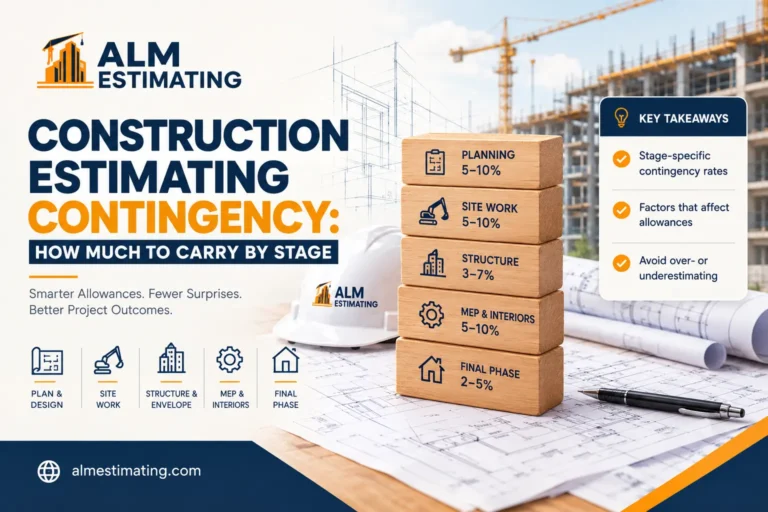
Percentages still have a job: a sanity check on a buildup, or a placeholder before drawings exist. Construction Executive puts typical commercial general conditions at 6% to 12% of total job cost, and other estimating guides cite roughly 5% to 10%. Small projects run higher because fixed costs spread over less work.
The table shows how the range shifts with size and duration. Treat it as a planning range, not published data, and test it against your own job-cost history.
| Project size | Under 12 months | 12–24 months | Over 24 months |
| Under $2M | 10–15% | 12–18% | 15–20%+ |
| $2M–$10M | 8–12% | 10–14% | 12–18% |
| $10M–$50M | 6–10% | 8–12% | 10–15% |
| Over $50M | 5–8% | 6–10% | 8–12% |
The pattern: as duration grows, the percentage climbs. As contract value grows, it generally falls because fixed costs spread across more work. A long, low-value project carries the highest percentage. A short, high-value project carries the lowest.
A $2 million, 10-unit multifamily build running 8 months at $20,000 a month carries $160,000, or 8%. Stretch the same project to 14 months at the same burn and the number rises to $280,000, or 14%. The scope did not change. The calendar did.
At concept stage, before drawings can support a buildup, a duration-checked percentage is the right placeholder. That is what a preliminary estimate is built for.

How We Carry Division 01 on a Bid Package
At ALM Estimating, we do not carry general conditions as a blind percentage. We build the Division 01 lines from the project manual and the schedule, then price each one.
1. Supervision
Carried as allocated person-months against the construction duration.
2. Trailer and Temporary Facilities
Carried as monthly rentals, or as purchases when the schedule justifies buying.
3. Safety and Compliance
Carried as lump sums or per-person costs where the specification is specific.
4. Cleanup and Closeout
Carried as lump sums, with as-builts and O&M manuals priced against the documentation scope in Division 01.
For a quick benchmark before a full takeoff, our cost estimating services can check a general conditions percentage against your duration and scope. Where the scope is defined and the bid needs a line-item breakdown, we build the Division 01 takeoff from the specification and carry every line.
Four Checks Before the Bid Goes Out
- Read the general and supplementary conditions for liquidated damages, retainage, and insurance limits.
- Walk Division 01 section by section and tie each requirement to a priced line.
- Build supervision and rentals from the schedule, not from the contract sum.
- Test the total against a percentage range, and explain any gap.
Every General Conditions Dollar Needs a Home
General conditions and general requirements are not the same thing, and treating them as one is how general conditions construction cost slips out of a bid. The contract form governs behavior and risk. Division 01 defines the work every trade relies on. The bid line carries the cost of both, and that cost follows the schedule.
Price supervision, temporary facilities, safety, cleanup, and closeout as documented lines tied to duration. Check the total against a percentage range. Then every dollar of scope has a home in the estimate, and the number reflects how long the project actually runs.
Frequently Asked Questions:
-
What is the difference between general conditions and general requirements?
General conditions are the contract’s terms: the rights, responsibilities, and relationships of owner, contractor, and architect, usually in AIA A201 or an equivalent form. General requirements are Division 01 of the specifications: administrative procedures, temporary facilities, quality, and closeout. On a bid, “general conditions” also names the jobsite cost line that pays for meeting both.
-
What percentage of a project is general conditions?
Commonly 6% to 12% of total job cost on commercial work, and roughly 5% to 10% in other estimating guides. Small or long-duration projects run higher. Duration drives the percentage more than contract value does.
-
What is included in Division 01?
Nine MasterFormat sections, from Summary (01 10 00) to Life Cycle Activities (01 90 00), covering price and payment, administrative, quality, temporary facilities, product, execution and closeout, performance, and commissioning requirements. On the cost side that means supervision, temporary utilities, trailer, dumpsters, safety, testing, cleanup, as-builts, O&M manuals, and closeout documents.
-
Are general conditions the same as overhead?
No. General conditions are project-level overhead tied to one job and its schedule. Home office overhead is company-level and spread across every job: rent, estimating staff, and administration.
-
Should general conditions be a lump sum or a percentage?
Neither is universally right. A lump sum built from line items and duration is the most defensible for bid and contract. A percentage is fast but can under- or over-recover when the schedule changes. A common hybrid on cost-plus work is a negotiated lump sum with adjustments tied to schedule changes.
-
Are general conditions a hard cost or a soft cost?
They are usually carried inside construction cost, not the owner’s soft costs such as design, legal, and financing. Some agreements define them separately within the Cost of the Work, so confirm the definition in your contract.
-
How do you estimate general conditions for a bid?
Start from the schedule. Price time-based items such as supervision, trailer, and utilities as a monthly rate times duration. Price fixed items such as mobilization and signage as lump sums. Then check the total against a percentage range.
Bid volume outrunning your estimating capacity?
| Division 01 takes hours that rarely survive a bid deadline: reading the project manual, mapping each requirement, building supervision against the schedule. If your team is stretched, outsourcing your estimating capacity lets you price the full scope instead of dropping a percentage on it. Upload your plans for a free quote: almestimating.com/upload-plans/ Talk to an estimator: almestimating.com/contact-us/ Call: +1 (520) 455-6525 |