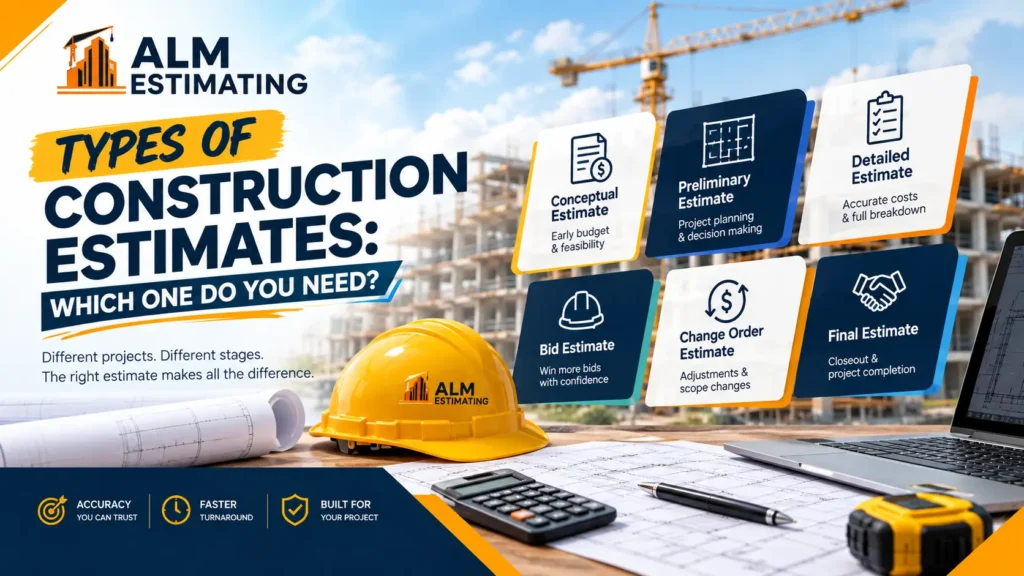
You asked for “an estimate.” You were quoted a price. But which estimate did you actually buy?
That question matters more than most contractors realize. The cost estimating profession recognizes five distinct classes of estimates, each tied to how much design information exists at the time the estimate is prepared. Each class carries a different accuracy range, requires a different level of effort to produce, and serves a different purpose in the project lifecycle. Using the wrong class at the wrong stage is how budgets break and disputes start.
AACE International’s Cost Estimate Classification System, published as Recommended Practice 17R-97 and adapted for building and general construction under 56R-08, is the framework behind the labels you keep hearing: ROM, budget, definitive. This guide breaks down all five classes, maps each one to a project stage, and explains what happens when the class is mismatched to the decision it is supposed to support.
The Five Classes at a Glance
The classification system rests on one primary characteristic: the maturity level of project definition. Everything else; accuracy, methodology, end use, flows from how much of the design is actually resolved when the estimate is prepared. The table below presents the five classes, adapted from AACE RP 56R-08 for building and general construction. The accuracy ranges reflect typical variation after contingency is applied, at roughly a 50 percent confidence level.
| Class | Common Name | Design Complete | Typical Accuracy | Best For |
| Class 5 | ROM, order of magnitude | 0–2% | −20% to −30% / +30% to +50% | Concept screening, go/no-go |
| Class 4 | Feasibility, conceptual | 1–15% | −10% to −20% / +20% to +30% | Option evaluation, preliminary funding |
| Class 3 | Budget, authorization | 10–40% | −5% to −15% / +10% to +20% | Funding approval, budget authorization |
| Class 2 | Control, bid/tender | 30–75% | −5% to −10% / +5% to +15% | Bid evaluation, control baseline |
| Class 1 | Definitive, check, pre-bid | 65–100% | −3% to −5% / +3% to +10% | Bid validation, change order pricing |
The ranges above come from AACE’s building construction recommended practice. They are typical starting points, not guarantees. AACE is explicit that accuracy ranges must be determined through project-specific risk analysis, not simply pulled from a table.

Class 5: Order of Magnitude (ROM)
This is the estimate you get when almost nothing is known. The project might be a site and a square footage, a capacity target and a location. That is it.
Class 5 estimates are prepared from 0 to 2 percent design completion. The estimating method is purely parametric: cost per square foot, cost per unit of capacity, factored ratios against historical data. The estimator is making a professional judgment based on analogous projects, not measuring anything from drawings.
Accuracy: Typically −20% to −30% on the low side and +30% to +50% on the high side for building construction. In the process industries, where AACE’s original framework was developed, the ranges are even wider.
When to use it: Business planning, early viability screening, deciding whether a project is worth pursuing at all. Not for budgeting. Not for commitments. Not for loan applications.
Class 4: Feasibility
Class 4 estimates sit at 1 to 15 percent design completion. You have more than a square footage — maybe a preliminary layout, a schematic design concept, some major equipment or systems identified. But you do not have enough resolved design to measure quantities line by line.
The methodology is still primarily stochastic or parametric, but grounded in more specific scope information. Assembly-level models, equipment factoring, and analogy to similar completed projects are the standard tools at this stage.
Accuracy: −10% to −20% low, +20% to +30% high for building construction.
When to use it: Feasibility studies, concept evaluation, preliminary funding decisions. This is the estimate that tells you whether to proceed to design development — not the number you take to a lender.
Class 3: Budget
Class 3 is the estimate most people mean when they say “budget estimate.” It is prepared at 10 to 40 percent design completion — enough that the major systems are defined and quantities can be estimated at an assembly level, but not enough for a full line-by-line takeoff of every material and labor item.
The methodology shifts from parametric to semi-detailed: unit costs applied to assembly-level line items. You are measuring something, but you are measuring assemblies and systems rather than individual components. The basis of estimate should document every assumption and exclusion at this stage.
Accuracy: −5% to −15% low, +10% to +20% high.
When to use it: Budget authorization, funding approval, the final investment decision. This is the number that goes to the lender or the board. It is also the number that sets expectations for the rest of the project — which is why getting the class right matters.

Class 2: Control or Bid
Class 2 estimates are prepared at 30 to 75 percent design completion. At this stage, the design is developed enough to support a detailed takeoff: forced quantities measured from drawings, line-item pricing, unit costs applied to measured work.
The term “forced detailed takeoff” means the estimator measures everything that is drawn, even where details are incomplete, and makes explicit assumptions about what is missing. Those assumptions are documented in the basis of estimate and tracked through the bid process.
Accuracy: −5% to −10% low, +5% to +15% high.
When to use it: Bid evaluation, control baseline establishment, tender preparation. This is the number you use to check subcontractor bids against your own takeoff and to set the cost code structure for project controls during construction.
Class 1: Definitive
Class 1 is the most defined estimate you can produce short of actual cost. It is prepared at 65 to 100 percent design completion, from complete or near-complete construction documents. Every quantity is measured. Every material is specified. Every labor hour is calculated against the production rates for the crews that will actually do the work.
Accuracy: −3% to −5% low, +3% to +10% high.
When to use it: Check estimate before bid submission, bid validation, change order pricing, GMP finalization. Class 1 estimates are typically prepared by contractors or their estimating partners, not by owners or designers.
What Each Class Costs to Produce
The effort required to prepare an estimate scales with the class, but the relationship is not linear and the cost is not purely about hours. Understanding this is part of buying the right estimate.
A Class 5 estimate can take an hour or hundreds of hours depending on whether the estimator is using a simple square-foot factor or building a custom parametric model from a proprietary cost database. A Class 1 estimate always requires substantial effort because it demands a complete takeoff of a complete design — every line item measured, every assembly priced, every allowance documented.
The practical cost question: When you commission an estimate, you are buying a class. If you pay for Class 1 effort at Class 5 design completion, you are paying for hours that cannot improve accuracy. The information does not exist to measure. The estimator will fill gaps with assumptions, and those assumptions will look like precision without being accurate. The basis of estimate will be full of qualifications, and the number will carry the same uncertainty as a Class 4 — at a Class 1 price.

The Mistake Behind Most Disputes
The AACE classification system exists to prevent one specific failure mode, and it is the one that causes more construction cost disputes than any other.
A Class 4 number gets presented as a Class 2 commitment
A developer gets a feasibility estimate at 10 percent design. The number carries a range of −20% to +30%. It looks like a budget. The developer treats it as one. The project proceeds through schematic design and into design development. At 70 percent design, the Class 2 estimate comes in 25 percent higher than the feasibility number. The developer is financially committed. The general contractor is held accountable for a number nobody on their team ever gave.
The accuracy range is not a margin of error around a true number. It is a statement about how much is unknown. A Class 4 estimate with a +30 percent high side is not “probably 5 percent higher than the low side.” It is a range that reflects genuine uncertainty about scope, quantities, site conditions, and market pricing. When the class is misrepresented, intentionally or through ignorance, the estimate stops being a planning tool and becomes a liability.
This is why every estimate ALM delivers states its class, documents its basis, and lists its assumptions and exclusions. The class label is not administrative overhead. It is the single most important piece of information on the cover sheet.
Which Class Do You Need?
Match the class to where your project actually is in design development, not where you wish it were. The decision framework is straightforward.
1. Deciding whether to pursue a project
Class 5. A rough order of magnitude is all the design supports. Do not pay for more and do not treat the number as anything other than a screening tool.
2. Evaluating options and need a preliminary budget
Class 4. This is the feasibility number. It tells you whether to proceed to design development and roughly what the project will cost, within a band that is still wide enough to accommodate unresolved scope.
3. Seeking funding approval or setting the project budget
Class 3. This is the authorization estimate — the number the lender or the board will hold you to. Make sure the design is at least 10 to 40 percent complete before commissioning it, and confirm the accuracy range with your estimator before presenting it as a commitment.
4. Preparing to bid or evaluating subcontractor bids
Class 2. Detailed enough to check sub pricing against your own takeoff, set the cost code structure, and establish a control baseline for the project. This is the estimate that becomes the WIP schedule once construction starts.
5. Validating a bid, pricing a change order, or finalizing a contract
Class 1. The definitive number, built from complete documents. This is what you need before you sign a GMP, submit a hard bid, or price a change order that will be negotiated dollar by dollar.

When It Is a Capacity Problem, Not a Classification Problem
Some estimate-class disputes are not really about classification at all. They are about a firm not having the bandwidth to produce the right class of estimate in the time available. A contractor bidding three projects in the same week with one or two estimators does not have the hours to produce a Class 2 estimate on all three. The corners that get cut, skipped assemblies, recycled unit costs from a different market, contingency percentages pulled from memory instead of a risk register, show up as accuracy problems that look like class problems.
When the bottleneck is hours rather than methodology, outsourcing the quantity takeoff and pricing work [/outsource-estimating-services/] is a fix that does not require hiring. It frees the senior estimator to focus on risk assessment, scope review, and the judgment calls that actually determine which class the estimate lands in.
ALM Estimating provides construction cost estimating services [/cost-estimating-services/] across all five AACE classes, with the class clearly stated on the cover sheet and the basis of estimate documented for every deliverable.
Final Thoughts:
An estimate is not a guess and it is not a guarantee. It is a professional opinion about probable cost, bounded by the information available at the time it is prepared. The AACE classification system exists to make that boundary explicit, so that everyone involved in the project knows what the number means, how far it might move, and what would need to change for it to get tighter.
Class 5 screens. Class 4 evaluates. Class 3 authorizes. Class 2 controls. Class 1 validates. Each class has a purpose, a cost to produce, and a legitimate use. The problems start when a number produced at one class is treated as if it were produced at another.
Match the class to the stage. State the class on the cover sheet. Document the basis. That is how an estimate earns the trust of the people who have to build to it.
FREQUENTLY ASKED QUESTIONS:
-
What is a ROM estimate in construction?
ROM stands for rough order of magnitude. It is a Class 5 estimate prepared when project definition is 0 to 2 percent complete. It uses parametric methods like cost per square foot and carries a typical accuracy range of −20% to −30% on the low side and +30% to +50% on the high side. It is used for early screening and go/no-go decisions, not for budgeting or financial commitments.
-
What is the difference between a budget estimate and a bid estimate?
A budget estimate is Class 3, prepared at 10 to 40 percent design completion to support funding authorization. A bid estimate is Class 2, prepared at 30 to 75 percent design completion to support tender submission and bid evaluation. The bid estimate uses a forced detailed takeoff, measures quantities from drawings, and has a narrower accuracy range. The budget estimate uses assembly-level pricing and carries wider uncertainty.
-
How accurate is a preliminary estimate?
It depends on which class of preliminary estimate was prepared. A Class 5 ROM runs −20%/+30% to −30%/+50%. A Class 4 feasibility estimate runs −10%/+20% to −20%/+30%. These ranges assume appropriate contingency is included and are based on AACE’s building construction recommended practice. Without contingency, the ranges would be wider.
-
At what design stage should I get a detailed estimate?
A detailed estimate — Class 2 or Class 1 — requires 30 to 100 percent design completion. Commissioning a detailed estimate before the drawings support it means the estimator fills gaps with assumptions. Those assumptions look like measured quantities on paper, but they do not improve the actual accuracy of the number. Wait until the design is developed enough to measure.
-
Can a preliminary estimate be used to get financing?
A Class 3 budget estimate prepared at 10 to 40 percent design is typically appropriate for a lending commitment. A Class 5 ROM is generally not sufficient because the accuracy range is too wide to support a fixed loan amount. Ask your estimator to state the AACE class and accuracy range explicitly, and confirm with your lender which class they require before commissioning the estimate.
LETS GET STARTED:
Need an Estimate at the Right Class for Your Project Stage?
Send us your plans and scope, and ALM Estimating returns an estimate at the class your project stage supports, with the class stated on the cover sheet, the accuracy range documented, and the basis of estimate included.
No retainer. No portal. Pay per project. | Upload Your Plans | Contact Us | Or call +1 (520) 455-6525