“Contingency” is not one number. It is three, and mixing them up is where most contingency arguments start. Design contingency covers what the drawings have not resolved yet. Construction contingency covers what goes wrong once work is underway. Owner contingency sits above both, held separately by the owner for decisions that are theirs alone to make.
Each is carried by a different party, sized differently, and drawn down on a different schedule. Most disputes over “the contingency number” turn out to be two people talking about different pools — an owner asking why construction contingency looks thin when what they actually mean is that design contingency evaporated earlier than expected.
This guide breaks the three pools apart, maps each one to a design phase with typical percentage ranges anchored to the AACE estimate classification system, and covers the factors that push the number higher or lower on any given project.
Three Contingencies, Not One
Before sizing any contingency line, the first question is which pool the risk belongs in. Each of the three types is carried by a different party, responds to different triggers, and shrinks or holds steady on a different timeline.
— Design contingency — held by the design team, sized against how much of the drawing set is still unresolved. It shrinks as schematic design turns into design development turns into construction documents. By the time construction documents are complete, this pool should be approaching zero.
— Construction contingency — held by the contractor or built into a GMP contract, sized against the risk of unforeseen field conditions once the price is locked. It is drawn down through change orders, not redesign. On a lump-sum bid this risk is embedded in the contractor’s price; on a GMP job it sits as a visible line the owner can track.
— Owner contingency — held separately by the owner, on top of both of the above, for scope decisions and allowances that are the owner’s call. This is not a risk allocation at all, it is the owner’s reserve for changes they choose to make after the price is set.
When a project team argues over “the right contingency percentage,” the first step is to confirm which of these three pools the conversation is about. A 5 percent number that sounds thin for design contingency at schematic design may be perfectly appropriate as a construction contingency after buyout.

Who Carries Each, and Where It Sits in the Estimate
The ownership question matters because it determines who controls the drawdown and who keeps any savings at closeout.
- Design contingency is inside the architect’s or engineer’s cost estimate, above the line-item subtotal. The design team is responsible for sizing and justifying it at each phase gate. As the drawings mature and unknowns are resolved, this number should drop and the reduction should be documented, not just assumed.
- Construction contingency is inside the contractor’s number on a GMP contract, usually carried as a named line the owner can see. On a hard-bid or lump-sum contract, the contractor prices this risk into their number without separately naming it. Either way, it is the contractor’s reserve for conditions the drawings could not fully predict — concealed conditions, minor coordination gaps between trades, and field-level adjustments.
- Owner contingency is outside both, in the owner’s own project budget. It never appears in the contractor’s cost estimate at all. It covers owner-directed scope additions, discretionary upgrades, and allowances the owner wants to hold rather than commit at pricing time.
Typical Contingency Ranges by Design Stage
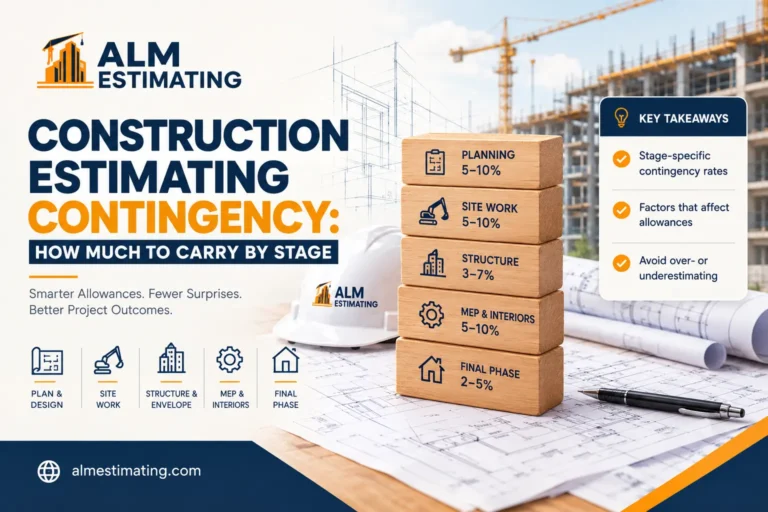
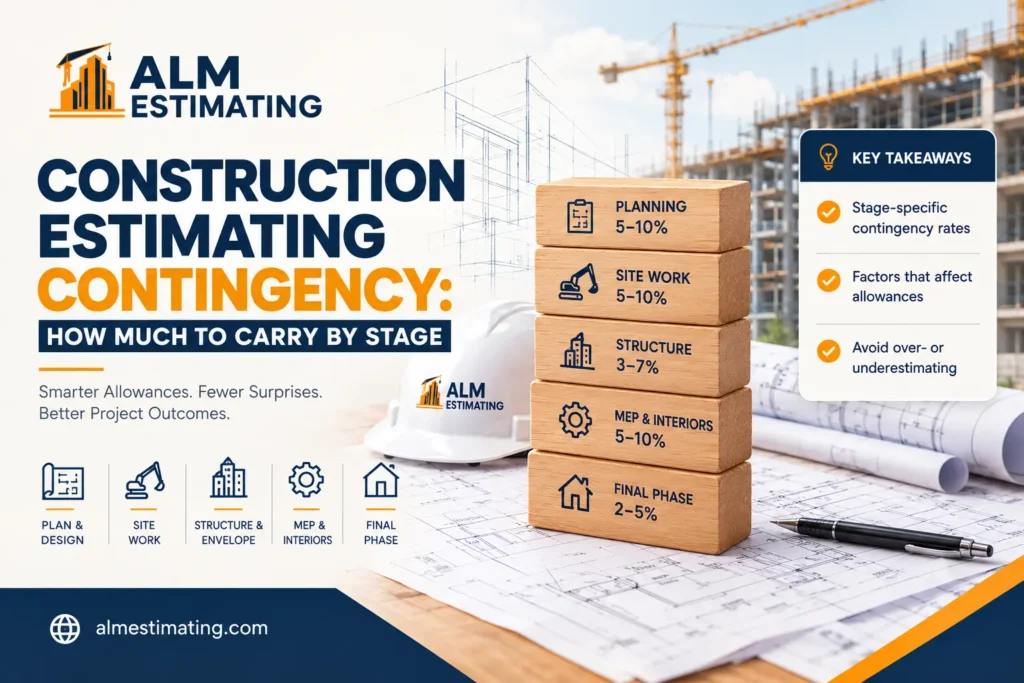
The table below maps design completion to the three contingency pools using AACE International’s estimate classification system (Recommended Practice 18R-97) as the framework. The percentages are industry-typical starting points, not a published AACE standard and should be adjusted for the specific risk profile of each project.
| Design Stage | Design Completion | Typical Design Contingency | Typical Construction Contingency |
| Pre-Design / Concept | 0–15% (~AACE Class 5) | 15–20% | Not yet applicable |
| Schematic Design | 15–30% (~AACE Class 4/5) | 10–15% | Not yet applicable |
| Design Development | 30–60% (~AACE Class 3/4) | 5–10% | Not yet applicable |
| Construction Documents | 85–100% (~AACE Class 2/1) | 3–5% | 5–10% |
| Bid / GMP / Buyout | 100% | 0–3% (largely retired) | 3–5% (held through construction) |
For a hard-bid submission — the scenario most contractors mean when they say “our estimate was off” — you are operating in Class 2 or Class 1 territory. A well-run estimate at that stage should land within roughly 10 to 20 percent of the final cost, not the 30-to-50 percent swings that are normal at feasibility stage.

What Contingency Is Not (and Why That Matters)
Contingency is a priced reserve for risks that are identifiable but not yet resolved. It is not padding, overhead recovery, profit margin, or a fund for owner-directed scope changes. Those belong in markup, general conditions, or a separate change order, not the contingency line.
Until something in the risk register actually happens, that money is not owed to anyone. And contingency should not be confused with retainage, which is withheld payment tied to completion obligations — a cash-flow mechanism, not a risk allocation.
Cost contingency vs. schedule contingency serve different purposes within the same estimate. A heavy civil project near a river may need schedule contingency to cover seasonal flooding that disrupts site access and deliveries, plus a separate cost contingency for winter concrete heating and fuel surcharges. One protects the calendar, the other protects the budget. Both belong in the estimate, they just solve different problems.
Keeping contingency this narrowly defined is not semantics. It is what lets a project team respond quickly when something does go wrong, without derailing the schedule or reopening the whole budget. That only works if the drawdowns stay visible: tracked in cost reports and WIP schedules, not absorbed quietly into a miscellaneous cost code where nobody can see the reserve shrinking.
How Contingency Interacts With Markup
Contingency and markup answer different questions and sit at different points in the number. Contingency covers risk on cost the contractor does not control. Markup, overhead and profit is the return the contractor is owed for taking on the job at all.
Get the sequencing wrong, marking up the contingency line as if it were guaranteed cost, for instance and the owner ends up paying overhead and profit on money that may never be spent. The correct sequence is to carry contingency as a cost item in the estimate summary, then apply markup on the direct cost subtotal that precedes it. If the contract structure requires markup on contingency, both parties should acknowledge that the total includes a return on a reserve that may not be drawn.

Factors That Push the Percentage Up or Down
The stage-based ranges in the table above are a starting point, not a rule. Within any given design phase, the right contingency number still depends on the specifics of the project. Here are the factors that most commonly move the percentage.
1. Project type and scale
A $5 million office fit-out with fully complete construction documents carries far less risk than a $40 million industrial project with mechanical design still unresolved. Larger projects with more trades and longer schedules have more interfaces where unknowns can surface.
2. Renovation vs. new build
Existing buildings hide conditions a drawing set cannot fully capture, concealed structural members, legacy wiring, asbestos, undersized footings. Renovation work routinely pushes contingency 5 to 10 percentage points higher than a comparable new build on an open site.
3. Level of design completion at time of pricing
This is the single biggest driver. The less resolved the drawings, the wider the contingency band needs to be. A contractor pricing off 60 percent design development drawings should carry more contingency than one pricing off a fully coordinated construction document set and both parties should expect that.
4. Escalation clause in the contract
A well-drafted escalation clause covering major commodity inputs; steel, copper, concrete, lumber, can let contingency run lower, because that specific material-price risk is already priced and allocated elsewhere in the contract. Without an escalation clause, the contractor absorbs that volatility inside the contingency line.
5. Long-lead equipment exposure
Switchgear, transformers, chillers, custom HVAC units, and other long-lead items carry pricing and availability risk that a standard contingency band may not fully capture. Lead times on some electrical switchgear have stretched past 40 weeks in recent years, and price locks on those items rarely hold beyond 30 to 60 days.
6. Fuel and trucking content in the scope
Heavy earthwork, aggregate hauling, and long-haul delivery scopes are more exposed to energy price swings than an enclosed interior package. A sitework-heavy project with significant trucking volume may warrant a named fuel allowance alongside the standard contingency line.
7. Credit quality and pay practices of the owner
A slower-paying or less-reliable owner adds financial risk on top of construction risk. Carry costs on delayed draws, cash-flow pressure on subcontractors, and the risk of a pay dispute mid-project all push contingency higher or should be priced as a separate risk allowance.
8. Local labor market conditions
Tight labor availability in the project’s metro area adds schedule and productivity risk that a purely cost-based contingency can understate. If the local market is short on specific trades; structural ironworkers, controls electricians, curtain-wall installers, productivity assumptions built from national cost databases may not hold.

How to Present Contingency to an Owner Without Losing the Job
The pressure to negotiate contingency out of a number is real. Owners and CMs will push to hit a budget target, especially when the backlog is strong and everyone wants the deal to pencil out on paper. But giving in is not a negotiating win — it is a margin problem the contractor has just agreed to absorb. Underpriced contingency does not disappear. It comes back later as change orders, disputes, or risk the contractor is carrying for free.
Removing a contingency line from a contract price does not remove the underlying risk. It reassigns that risk to the contractor without paying for it. A well-sized, well-documented contingency protects both sides from the same thing: a budget that quietly falls apart mid-project.
1. Language that holds up in the room
— “Producer prices for construction inputs rose over 11 percent in the past year. We are carrying [X]% contingency specifically against that exposure on fuel and energy-intensive materials.”
— “A portion of this contingency is tied directly to long-lead equipment packages, where input costs have been the most volatile line in our estimate.”
— “Removing this line does not remove the risk of price movement or supply delays. It just moves that risk onto us, with no way to recover it if it happens.”
2. What makes the line easier for an owner to accept
1. Break it into pieces — general contingency, trade-specific risk allowances (fuel, trucking), and any escalation allowance tied to a published index. Not one unexplained lump sum.
2. Commit to transparent reporting — monthly visibility into what has been drawn and what remains, tracked against the original basis of estimate.
3. Offer to return unused contingency to the owner on a defined schedule at project closeout.
4. Tie every dollar back to a specific, documented risk on the basis of estimate — not a general “just in case” number.
A contingency line built this way is not a sales weakness. It is what lets everyone move faster once something actually goes wrong. Because the risk was already priced and the release rules were agreed up front, change orders and draws get approved faster — which protects the schedule for the owner as much as it protects the budget for the contractor.

When It Is a Capacity Problem, Not a Sizing Problem
Some contingency disputes are not about the percentage at all. They are about the estimating team not having enough hours to build the risk assessment properly. A firm bidding three projects a week with one or two estimators does not have the time to develop a risk register, cross-check escalation exposure on every material line, or verify that design contingency has actually been retired at each phase gate.
When contingency numbers keep getting challenged because the backup is thin, the constraint is usually time rather than skill. And capacity has a fix that does not require hiring: outsourcing the quantity takeoff and pricing work [/outsource-estimating-services/] on overflow bids frees the senior estimator to focus on the risk assessment, the basis of estimate, and the judgment calls that actually determine whether the contingency line holds up.
ALM Estimating provides construction cost estimating services [/cost-estimating-services/] that include risk-based contingency recommendations anchored to the AACE classification system — giving your team a defensible contingency structure at every project stage.
Final Thougnts:
Contingency is not a number you pick. It is a number you build, from the unknowns that actually remain at the stage you are estimating, and from a clear-eyed view of which pool each risk belongs in.
Design contingency shrinks as design resolves. Construction contingency holds through buyout and closeout. Owner contingency belongs to the owner’s risks, not the contractor’s. Escalation and risk allowance sit alongside them, not inside them. The percentage that results is defensible because the reasoning behind it is written down, tied to the basis of estimate, tracked as it draws down, and visible to everyone with a stake in the budget.
FREQUENTLY ASKED QUESTIONS:
Q1: What is a normal contingency percentage in construction?
A. It depends entirely on the design stage. Commonly cited ranges run from 15 to 20 percent at concept through 3 to 5 percent once construction documents are complete, with a separate 3 to 5 percent construction contingency carried once work is underway. There is no single “normal” number across every stage — judge the percentage against the AACE estimate class, not a universal benchmark.
Q2: What is the difference between design contingency and construction contingency?
A. Design contingency covers what the drawings have not resolved yet and is held by the design team. It shrinks toward zero as construction documents are finalized. Construction contingency covers unforeseen conditions once work is underway and is held by the contractor. They are carried by different parties, respond to different triggers, and draw down on different timelines.
Q3: Does contingency go before or after markup?
A. Contingency is a cost item that markup is applied on top of. Sequencing it after markup means the owner pays overhead and profit on money that may never be spent. The correct structure is to carry contingency in the estimate summary as a cost line, then apply markup to the direct-cost subtotal that precedes it.
Q3: Who owns the contingency — the contractor or the owner?
A. It depends which pool. The design team sizes and holds design contingency. The contractor holds construction contingency — often as a visible line under a GMP contract. Owner contingency is held separately by the owner, outside the contractor’s number entirely. Each pool has different drawdown rules and a different party who controls it.
Q4: Should contingency be a separate line item in the estimate?
A. Yes. A contingency buried inside a lump-sum number cannot be tracked as it draws down, and it is the first thing an owner questions when they cannot see it. A named, visible line is easier to defend in a negotiation, easier to report against during construction, and easier to reduce on schedule as design matures.
LET’S GET STARTED:
Need a Contingency Structure That Holds Up at Every Stage?
Send us your plans and scope, and ALM Estimating returns a risk-based contingency recommendation anchored to the AACE classification system; with design, construction, and owner pools sized separately and every dollar tied to a documented risk.
No retainer. No portal. Pay per project. | Upload Your Plans | Contact Us | Or call +1 (520) 455-6525