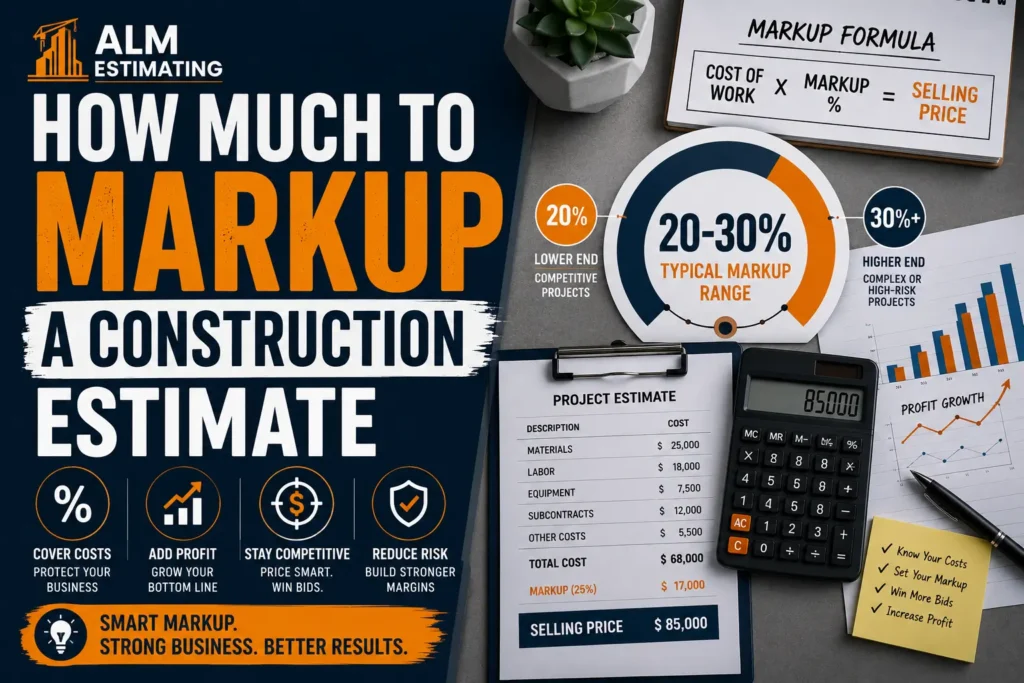
Most contractors markup their estimates 10–20% total, typically 5–15% for overhead and 5–10% for profit, though the right number for any given bid depends on project risk, competition, and how the work was priced in the first place. A markup that’s too low wins the job and loses money; too high loses the bid entirely. Getting it right requires knowing your real costs, not applying a habitual percentage to every job the same way.
Overhead vs Profit — They’re Not the Same Thing
Many contractors lump these into one markup percentage, which makes it hard to tell whether a thin bid is thin on profit (acceptable in a competitive market) or thin on overhead recovery (a structural problem that will eventually sink the business regardless of how busy you are).
1. What Overhead Covers
The cost of running your business that isn’t tied to any single job — office rent, insurance, admin staff, vehicles, software licenses, and the estimating time itself. This cost exists whether you win the bid or not, so it has to be recovered across the jobs you do win.
2. What Profit Covers
What’s left over after overhead and direct job costs are covered — the actual return on doing the work. This is the number that determines whether the business is growing or just staying afloat.

Typical Markup Ranges by Project Type
| Project Type | Overhead | Profit | Total Markup |
| Residential remodel / small TI | 10–15% | 10–20% | 20–35% |
| New residential construction | 8–12% | 8–15% | 16–27% |
| Commercial new construction | 5–10% | 5–10% | 10–20% |
| Public / government bid work | 5–8% | 3–7% | 8–15% |
| Design-build / negotiated work | 8–12% | 10–15% | 18–27% |
| Subcontractor bids (by trade) | 10–15% | 8–15% | 18–30% |
Public and hard-bid commercial work runs lower because competition compresses margin — you’re often one of several bidders and price is the deciding factor. Residential and negotiated work allows higher margins because there’s less direct price competition and more relationship-based trust in the number.
What Actually Moves Your Markup Up or Down
Five factors determine whether your markup should sit at the top or bottom of the typical range and why the same percentage shouldn’t apply to every job.
1. Project Risk
Unknown subsurface conditions, tight schedules, complex coordination between trades, or unfamiliar building types all justify higher markup because more can go wrong. A repeat client on a familiar building type justifies less.
2. Competition Level
A hard-bid public project with 8 bidders compresses markup toward the bottom of the range. A negotiated project with one bidder allows markup toward the top.
3. Cash Flow Terms
Slow-paying owners or long retention periods increase your effective cost of capital, which should be reflected in markup. Fast-paying, low-retention projects can run leaner.
4. Self-Performed vs Subcontracted Scope
Work you self-perform carries more risk and more potential upside, generally justifying a different markup than scope you’re simply passing through to a subcontractor with a smaller margin on top.
5. Bonding and Insurance Exposure
Higher bond requirements or unusual liability exposure on a project should be priced into markup, not absorbed as a cost of doing business.

Why a Fixed Percentage Markup Is a Risk in Itself
Applying the same 15% to every job regardless of risk is the most common markup mistake. A low-risk repeat job and a high-risk first-time project with unfamiliar scope do not deserve the same number, yet many contractors default to one “standard” markup out of habit rather than recalculating it project by project. This is also where estimating accuracy and markup strategy connect directly: if your underlying cost estimate is wrong, your markup is being applied to the wrong base number, and the error compounds. A markup percentage can only protect margin if the cost estimate underneath it is accurate in the first place.
How ALM Estimating Supports Your Markup Strategy
ALM Estimating delivers the accurate cost base your markup needs to actually work, verified material pricing, region-specific labor rates, and a coordinated multi-trade takeoff with no scope gaps. We don’t set your markup for you, but we make sure the number you’re applying it to is correct, so a 12% markup on our estimate means 12% margin, not 12% on top of an estimate that was already 8% short. For bid review process and catching estimating errors before they affect your margin, see our bid review checklist. Send us your plans and get a complete, verified estimate back within 24 hours, the foundation your markup decision should be built on. Call +1 (917) 718-0084 or visit our contact page.
Frequently Asked Questions
Q1: What is a normal profit margin in construction?
Most contractors target 5–15% net profit, varying by project type and competition level. Residential and negotiated work typically allows higher margins than competitive public bid work.
Q2: Is 10% a good markup for a construction estimate?
10% is reasonable for overhead alone on many commercial projects, but total markup (overhead plus profit) of just 10% is on the low end and usually only appropriate for highly competitive hard-bid work with low risk.
Q3: What’s the difference between markup and margin?
Markup is the percentage added to your cost to set your price. Margin is the percentage of your final price that represents profit. A 25% markup on cost results in a 20% margin on price, they are not the same number, and confusing them leads to underpricing.
Q4: Should subcontractors markup differently than general contractors?
Yes, generally. Subcontractor markups tend to run slightly higher as a percentage since their overhead is spread across a smaller revenue base per job, while GCs often apply a smaller markup on top of subcontracted scope they’re passing through.