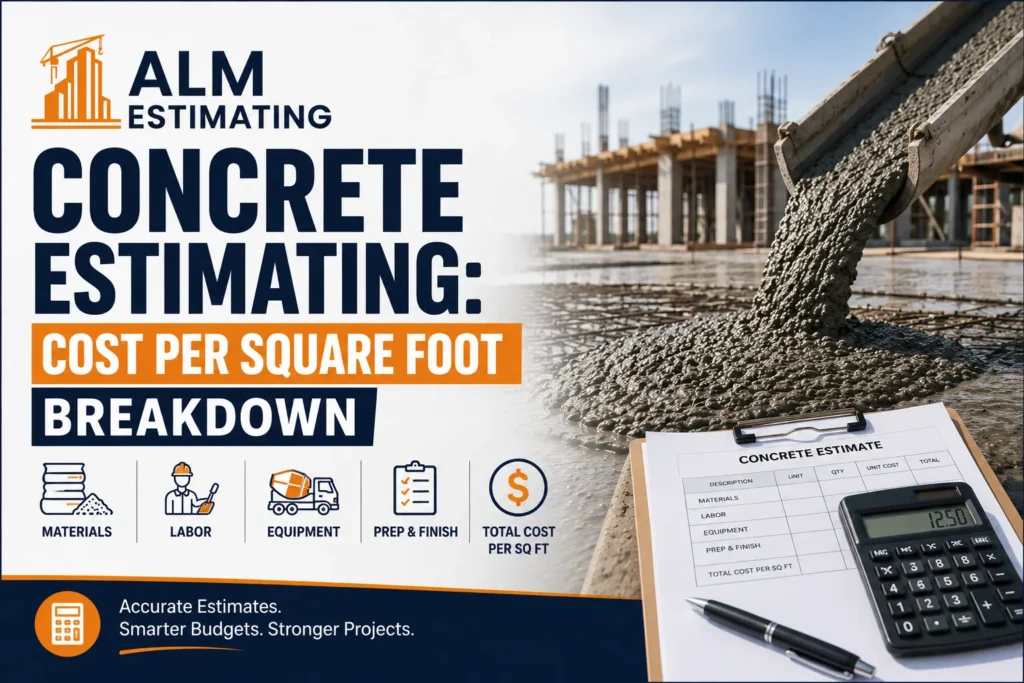
Concrete cost per square foot is one of those numbers that sounds simple until you start specifying what kind of concrete, how thick, on what subgrade, with what reinforcement, and finished to what standard. A 4-inch slab on grade in Dallas and a post-tensioned elevated deck in New York City are both ‘concrete’ and their installed costs per square foot have almost nothing in common.
This guide breaks down concrete Estimating costs by application type, explains the variables that move the number most, and covers what per-square-foot benchmarks typically leave out.
Concrete Cost Per Square Foot by Application
Costs below reflect fully installed concrete, material, forming, reinforcement, placement, and standard finishing. They do not include subgrade preparation, special testing, or premium finishes unless noted.
| Application | Thickness | Reinforcement | Cost / SF | Key Cost Driver |
| Slab on Grade — Light Commercial | 4″ | WWF or #3 rebar | $5–$9 | Subgrade prep, finishing type |
| Slab on Grade — Heavy Duty | 6″–8″ | #4–#5 rebar | $9–$15 | Rebar density, pour volume |
| Elevated Structural Slab | 8″–12″ | Rebar + shoring | $18–$32 | Forming, shoring, stripping |
| Post-Tensioned Deck | 8″–10″ | PT cables + rebar | $22–$38 | Stressing equipment, PT contractor |
| Tilt-Up Concrete Panel | 7″–9″ | #4–#5 rebar | $12–$22 | Panel count, crane cost, embeds |
| Sidewalk / Flatwork | 4″ | WWF or none | $5–$8 | Forming, control joints, access |
| Decorative / Stamped | 4″–6″ | WWF or fiber | $12–$25 | Pattern complexity, color, sealer |
Post-tensioned decks require a specialty PT contractor for cable installation and stressing — that cost is included in the range shown. Tilt-up panel costs include crane rental and erection but not foundation and panel connection hardware, which varies by structural design.
What Drives Concrete Cost Per Square Foot
The per-square-foot figure is a result, not a starting point. These are the variables that build it up or push it well above the benchmark range.
1. Concrete Mix Design and PSI Specification
Standard commercial slabs specify 3,000 to 4,000 PSI concrete. Structural elements, elevated slabs, columns, shear walls, often require 5,000 PSI or higher, which increases material cost. Admixtures add more: water reducers, accelerators, air entrainment for freeze-thaw exposure, and fiber reinforcement each carry a premium over a standard mix. The specification section on concrete typically Division 03 05 00, defines exactly what is required and needs to be read before pricing any mix design.
2. Reinforcement Type and Density
Welded wire fabric (WWF) is the lowest-cost reinforcement option and is appropriate for light-duty slabs. Conventional rebar, #3 through #5, adds both material and labor cost depending on spacing and bar size. Post-tensioning cable replaces much of the mild steel on elevated decks and parking structures and introduces a specialty subcontractor into the scope. Rebar density on structural elements like shear walls and mat foundations can represent a significant share of the total installed concrete cost.
3. Forming and Shoring Complexity
Slab on grade requires minimal forming; just perimeter edge forms and any blockouts. Elevated slabs require full shoring systems, deck forms, and stripping after the concrete reaches design strength, which adds labor, equipment rental, and multiple mobilizations to the scope. Walls and columns require gang forms or hand-set forming systems. The ratio of forming cost to concrete volume is one of the most consistent differentiators between ground-level and above-grade concrete work.
4. Finishing Standard
A standard broom finish on a slab on grade is the baseline. A hard-trowel finish for warehouse floors with flatness tolerances (F-number specification) requires additional passes and precise screeding, which adds both labor time and equipment cost. Decorative finishes; stamped, exposed aggregate, stained, or polished, are separate specialty scopes with unit costs well above standard placement. The finish specification is often underread during takeoff because it lives in the architectural specification sections rather than Division 03.
5. Pour Volume and Logistics
Concrete is priced per cubic yard at the batch plant, and that unit price drops on larger orders. A project that can pour 200 yards in a single placement gets a better material price than one ordering 30 yards at a time. Pump truck cost, wait time charges, and overtime for extended pours are all real cost items that do not appear in a square footage benchmark but will show up in the subcontractor bid. Access constraints — urban sites, tight staging areas, pours above the first floor, add pump line footage and crew setup time that increase cost further.
Regional Labor Rate Variation
Concrete labor rates vary more by geography than almost any other trade. The difference between a right-to-work southern market and a union market on the East Coast or West Coast is not a rounding error, it is a 40 to 60 percent cost differential that runs through every labor-intensive line item in the concrete scope.
| Market | Labor Rate (est.) | vs. National Avg. | Notes |
| New York City | $90–$115/hr | +45 to +60% | Carpenters Local 608 and Laborers union; prevailing wage on most public work |
| San Francisco / Bay Area | $85–$110/hr | +40 to +55% | High labor costs, OSHA-compliant shoring requirements, seismic rebar |
| Chicago | $75–$95/hr | +25 to +40% | Strong union market; cold-weather protection adds cost Oct–Apr |
| Dallas / Houston | $48–$65/hr | At or below avg. | Right-to-work state, open-shop competition, favorable climate year-round |
| Phoenix / Las Vegas | $45–$62/hr | At or below avg. | Hot-weather concrete protocols required in summer; material costs competitive |
| Washington DC / Arlington | $72–$90/hr | +20 to +35% | Prevailing wage on all federal and government-adjacent work; strong union presence |
Rates shown are total package including fringe benefits. On federally funded projects and many state projects, Davis-Bacon prevailing wage rates apply regardless of whether the market is union or open-shop. Always verify the applicable wage determination before finalizing labor-heavy concrete estimates.
What Per-Square-Foot Benchmarks Do Not Include
Published cost-per-square-foot figures for concrete work almost always reflect the concrete placement itself. These items are regularly left out of benchmarks and are regularly left out of bids as a result.
1. Subgrade Preparation
Slab on grade requires a prepared subbase, compacted granular fill, moisture barrier, and in some cases a layer of rigid insulation beneath the slab. The depth and specification of that subbase is on the geotechnical report and the civil drawings, not the structural slab drawing. Pricing slab on grade without accounting for subgrade preparation is a consistent miss on projects where the existing site conditions require significant import and compaction.
2. Concrete Testing and Special Inspection
Cylinder breaks, slump tests, air content testing, and temperature monitoring are required on most commercial concrete work and are performed by a third-party testing laboratory at the owner’s expense or the GC’s, depending on the contract. Special inspection of reinforcement placement, formwork, and concrete placement is required under IBC Chapter 17 for structural concrete. Both testing and special inspection belong in the GC’s general conditions as defined scope, not as afterthoughts.
3. Curing and Weather Protection
Concrete placed in cold weather requires insulated blankets, heated enclosures, or chemical accelerators to maintain curing temperature. Hot weather placements require ice in the mix, evaporation retarders, and shading or misting to control set time. Both scenarios add material and labor cost that is not reflected in standard per-square-foot benchmarks, and both are common enough in most US markets to warrant a line item rather than a contingency.
A common rule in concrete estimating: the floor plan tells you the area. The structural drawings, the geotechnical report, and the specification tell you what you are actually building. A benchmark without all three inputs is a starting point, not an estimate.
Common Concrete Estimating Mistakes
• Pricing the area without confirming the thickness. A 4-inch slab and a 6-inch slab on the same floor plan look identical in plan view. The structural drawing shows the thickness. Confirm it before calculating cubic yards.
• Using a single unit price for all concrete types on the project. Slab on grade, elevated slabs, walls, columns, and footings each have different forming requirements, reinforcing densities, and placement conditions. Blending them into one rate produces a number that is wrong on every element.
• Not separating the PT contractor from the general concrete scope. Post-tensioning is performed by a specialty contractor with specific equipment and certification requirements. It is not a standard concrete sub scope and cannot be estimated from standard concrete labor rates.
• Missing the subgrade and subbase scope. Granular base, compaction testing, moisture barriers, and underslab insulation are civil and concrete scope items that do not appear on the structural drawing and are consistently left out of slab on grade estimates.
• Not reading the finish specification. The floor flatness F-number, the finish type, and any surface treatments are in the architectural specification. A trowel finish to FF50/FL35 costs more in labor than a standard broom finish and the difference matters on large floor areas.
Concrete Estimating With ALM
ALM Estimating provides Division 03 concrete takeoffs and estimates for commercial contractors across all 50 states. Takeoffs include concrete volume by element, forming scope, reinforcement quantities by bar size, and finishing scope cross-referenced against the architectural specification. Subgrade and subbase scope is identified separately where geotechnical information is available in the bid package.
Turnaround is 24 hours on most commercial concrete scopes. Send drawings to info@almestimating.com or call +1 (917) 718-0084.
Frequently Asked Questions
Q: What is the average concrete cost per square foot for a commercial slab?
A: For a standard 4-inch slab on grade in a light commercial application, expect $5 to $9 per square foot installed; material, forming, reinforcement, placement, and broom finish. That range moves up quickly with slab thickness, rebar density, hard-trowel finish requirements, and regional labor rates. A 6-inch heavy-duty slab in a high-cost union market can run $14 to $18 per square foot before site prep.
Q: Why is elevated slab cost so much higher than slab on grade?
A: Forming and shoring. A slab on grade sits on prepared earth, the only forming needed is at the perimeter. An elevated slab requires a full shoring system below, deck forms above, and multiple mobilizations to strip the forms after the concrete reaches design strength. That forming and shoring scope typically represents 40 to 55 percent of the total installed cost on an elevated deck, which is why per-square-foot costs are two to four times higher than ground-level work.
Q: Does concrete mix design significantly affect cost?
A: Yes, especially at higher strength levels and with specialty admixtures. Standard 3,000 PSI concrete is the lowest-cost option. Moving to 5,000 PSI; required on many structural elements, adds $10 to $20 per cubic yard in material cost. Self-consolidating concrete (SCC), used in congested reinforcement conditions, adds more. Fiber reinforcement, air entrainment admixtures, and chemical accelerators each carry additional per-yard premiums that compound on large-volume pours.
Q: How do I account for cold-weather or hot-weather concreting in an estimate?
A: Cold-weather protection; insulated blankets, heated enclosures, or accelerating admixtures, adds $1 to $4 per square foot depending on the duration of protection required and the extent of heated enclosure. Hot-weather protocols, ice in the mix, evaporation retarder, extended finishing time — are less expensive but still add cost on large pours. Both should be carried as separate line items when the pour schedule falls within the expected temperature risk window for the project location.
Q: What CSI division covers concrete work?
A: Division 03 — Concrete; covers all cast-in-place and precast concrete work in CSI MasterFormat. Key sections include 03 10 00 (Concrete Forming and Accessories), 03 20 00 (Concrete Reinforcing), 03 30 00 (Cast-in-Place Concrete), and 03 35 00 (Concrete Finishing). Post-tensioning falls under 03 38 00. Precast structural concrete, tees, hollow-core planks, is covered under 03 40 00 and is typically a separate supplier and erector from cast-in-place work.