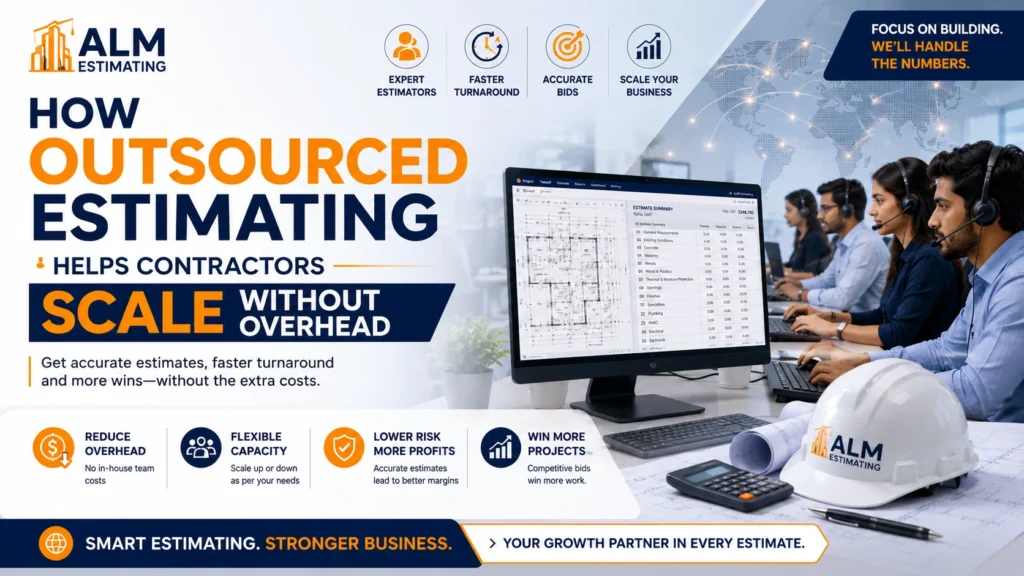
Most contractors hit a ceiling at some point. The work is there. The crews are capable. But the bottleneck is always the same: estimating. You can only produce so many bids per week with the people and hours you have. Miss too many bid deadlines and you lose jobs. Rush too many estimates and you win jobs at the wrong number. Neither outcome moves the business forward.
Outsourcing construction estimating is how a lot of contractors break through that ceiling without hiring, training, or carrying additional fixed overhead year-round. This article covers what outsourced estimating actually looks like in practice, what it costs compared to doing it in-house, and which types of contractors get the most out of it.
The Real Cost of Keeping Estimating In-House
The salary on a job posting for an experienced commercial estimator runs $75,000 to $110,000 annually across most US markets. That is the visible cost. The full cost is higher.
Add payroll taxes and benefits, typically 25 to 35 percent on top of base compensation and you are looking at $95,000 to $145,000 before the estimator produces a single number. Then add software: PlanSwift or STACK for takeoff, an RSMeans subscription for current cost data, and any trade-specific tools like FastDuct or FastPipe. That adds another $5,000 to $10,000 per year. Desk space, IT, HR time, onboarding — another $8,000 to $15,000. A fully loaded in-house estimating position costs most contractors $107,000 to $170,000 per year.
The harder problem is utilization. Construction bidding is not evenly distributed across the calendar. Bid season peaks and valleys mean an in-house estimator is at full capacity during busy stretches and underutilized the rest of the time. You pay the same salary either way.
| Cost Item | In-House Estimator | Freelance Estimator | Outsourced Firm |
| Base salary / fee | $75,000–$110,000/yr | $40–$80/hr (variable) | Per estimate / retainer |
| Payroll taxes & benefits | $20,000–$35,000/yr | None | None |
| Estimating software | $3,000–$8,000/yr | Usually included | Included |
| RSMeans / cost data | $1,200–$2,500/yr | Usually included | Included |
| Overhead (desk, IT, HR) | $8,000–$15,000/yr | None | None |
| Downtime / idle months | Full salary still paid | No cost when not used | No cost when not used |
| Total annual cost (est.) | $107,000–$170,000 | Scales with volume | Scales with volume |
For contractors bidding fewer than 6–8 projects per month, the per-estimate cost of an in-house estimator is rarely justified. See a detailed breakdown in our guide to in-house vs. outsourced estimating.

What Outsourced Estimating Actually Means
Outsourcing estimating does not mean sending drawings overseas and getting back a spreadsheet with no documentation. A professional estimating firm delivers the same product an in-house estimator would, quantity takeoffs, CSI-structured line-item pricing, markup drawings, scope notes, and assumption documentation. The difference is you are not paying for that capacity when you are not using it.
Here is what a typical engagement with a professional estimating firm looks like:
1. You send drawings and project information. Most firms accept PDFs, CAD files, or direct links. A brief scope description — project type, trades required, bid deadline, helps the firm scope the work and confirm turnaround.
2. The firm performs a quantity takeoff. Using digital takeoff tools like PlanSwift or Bluebeam, estimators measure and count every scope item. Drawings are marked up as the takeoff progresses, creating an auditable record of what was measured.
3. Pricing is applied from current cost databases. RSMeans regional data is the industry standard for labor and material costs in the US. Rates are adjusted for your local market and prevailing wage where applicable.
4. You receive a complete, CSI-structured deliverable. This includes the line-item estimate, marked-up drawings, and a scope clarification section identifying assumptions, exclusions, and allowances.
5. Revisions and addenda are handled on request. If the design team issues an addendum before bid, the firm updates the estimate. Most firms include one round of revisions in the base fee.
What you do not receive is a number on a napkin. A professional firm produces work you can present to an owner, use to review subcontractor bids, and track against during construction.

Three Ways It Helps Contractors Scale Profitably
1. You Can Chase More Bids Without Hiring
Bidding is a numbers game. A contractor submitting 15 bids per month with a 15 percent hit rate lands roughly 2 jobs. The same contractor submitting 30 bids with the same hit rate doubles the pipeline without changing their win percentage. The constraint is estimating capacity, not market demand. Outsourcing removes that constraint without adding a permanent employee to cover the volume spike.
2. You Stop Turning Down Work That Is Outside Your Usual Trade Mix
Contractors who estimate in-house are usually limited to scopes they know well. An electrical sub who gets a set of drawings with MEP scope; mechanical, electrical, and plumbing combined, either passes on it or prices the unfamiliar trades with limited confidence. A firm with estimators across all trades handles the full scope. You bid the whole project, or you hand off the trades outside your wheelhouse to a firm that knows them. Either way, you stop leaving bids on the table because the scope was unfamiliar.
3. Your Bid Quality Improves When Volume Pressure Is Off
An in-house estimator working at 100 percent capacity under deadline pressure cuts corners. Assumptions get buried. Scope gaps get covered with round-number contingencies. These are the bids that win at the wrong number and turn into problem jobs. When estimating capacity is flexible and deadlines are realistic, the quality of the number improves. The estimate covers the actual scope instead of the scope the estimator had time to price.

Who Benefits Most from Outsourcing Estimating
Outsourced estimating is not the right fit for every contractor. It works best for:
• Growing GCs and CM firms bidding 8 to 25 projects per month who need flexible capacity without the overhead of multiple in-house estimators.
• MEP subcontractors — electrical, mechanical, and plumbing, who need trade-specific expertise that goes beyond generalist takeoff. Firms like ALM Estimating carry estimators with direct SMACNA, IBEW, and UA trade knowledge.
• HVAC and mechanical contractors pricing commercial projects who need FastDuct-based ductwork takeoffs and Division 23 expertise rather than square footage rules of thumb.
• Developers and owners who need independent cost validation before committing to a GC proposal or authorizing design development spend.
• Contractors entering new markets — a commercial GC moving into healthcare or a residential builder taking on multifamily, who need accurate pricing for project types outside their experience base.
What to Watch Out For
Not every estimating firm delivers the same quality, and choosing wrong costs more than doing it in-house. Before engaging any firm, verify:
• They use industry-standard tools. PlanSwift, Bluebeam, RSMeans, FastDuct, FastPipe. If they cannot name the software they use for takeoff and pricing, that is a red flag.
• The deliverable includes marked-up drawings. An estimate without quantity documentation cannot be audited, compared against subs, or used for cost tracking. A number alone is not a professional deliverable.
• Turnaround commitments are in writing. A firm that misses your bid deadline by a day has done you no good. Confirm turnaround times before you upload drawings, not after.
• Revisions and addenda are included or clearly priced. The cheapest initial quote often has the most expensive revision policy.
Working With ALM Estimating
ALM Estimating provides construction cost estimating and quantity takeoff services for contractors, subcontractors, developers, and owners across all 50 states. Our estimators work across all trades — general construction, mechanical, electrical, and plumbing with turnaround in 24 hours for most commercial projects.
There is no long-term commitment required. Send us a project, we turn it around, and you decide from there. Upload drawings at almestimating.com or call +1 (917) 718-0084 for a free quote.

Frequently Asked Questions
Q1. How much does outsourced estimating typically cost per project?
A. Fees vary by project size, trade count, and document completeness. For a single-trade commercial estimate, electrical or mechanical, expect $300 to $800. Full MEP across all three trades for a mid-size commercial project typically runs $800 to $2,000. Large or complex projects are priced individually. These fees are a fraction of the cost of producing the estimate in-house when you factor in estimator time and software.
Q2. Will the estimate be accurate enough to use for bidding?
A. A professional estimating firm produces numbers based on actual quantity takeoffs and current regional cost data, the same inputs a qualified in-house estimator uses. Accuracy depends on drawing completeness. A 100 percent construction document set produces a tighter estimate than a schematic design set. The firm should document every assumption so you know exactly what the number is based on.
Q3. What if I need a revision after the estimate is delivered?
A. Most firms include one revision round in the base fee, covering addenda from the design team or changes to scope based on your review. Changes that represent new scope, a different system type, a significantly expanded floor area are typically billed additionally. Confirm the revision policy before engaging.
Q4. How do I know the firm understands my trade?
A. Ask specifically. Request an example deliverable from a project in your trade and at your typical project size. Ask which software they use for takeoff. Ask whether their estimators have trade background or are generalists. A firm that cannot answer these questions with specifics should not get your drawings.
Q5. What do I need to send to get an estimate started?
A. At minimum: a drawing set (PDF is fine), the project address, and your bid deadline. The more information you provide, specification sections, equipment schedules, an RFI log if one exists, the tighter the estimate. Most professional firms will review your drawings and confirm scope, turnaround, and fee before you commit.