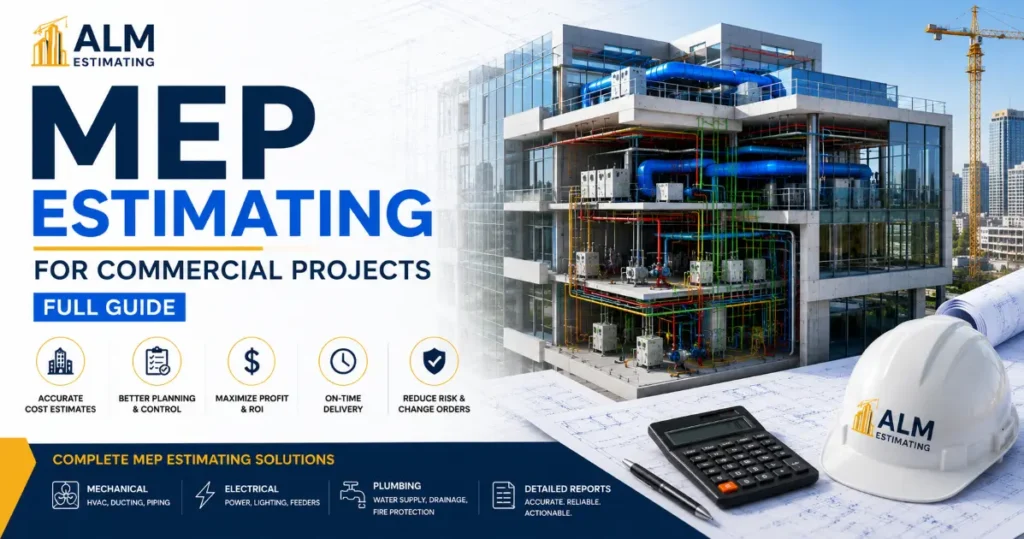
Commercial construction MEP estimating is fundamentally different from residential work, in scope complexity, code requirements, system integration, and the standards that estimates must meet to support competitive bid submissions, GMP negotiations, and owner presentations. For a general contractor, developer, or commercial MEP subcontractor, understanding what drives MEP costs on commercial projects is the first step to building accurate budgets and winning bids at the right margin. This guide covers MEP costs across major commercial project types, what makes commercial MEP estimation complex, and how ALM Estimating delivers bid-ready commercial MEP estimates in 24 hours.
How Much Does MEP Cost on a Commercial Project?
On most commercial construction projects, MEP systems; mechanical, electrical, plumbing, and fire protection, account for 35 to 65 percent of total construction cost depending on occupancy type. The table below shows MEP cost benchmarks across the major commercial project categories in 2026.
| Commercial Project Type | MEP % of Total Cost | Typical MEP Budget | Key MEP Complexity Drivers |
| Office build-out (TI) | 35–50% | $40–$85/SF MEP | VAV HVAC, lighting controls, data/comms, BAS |
| Retail / restaurant | 30–45% | $35–$75/SF MEP | Exhaust systems, high-demand electrical, grease waste |
| Hotel / hospitality | 40–55% | $55–$95/SF MEP | Per-room HVAC, domestic hot water, guest services |
| Healthcare / medical office | 50–65% | $80–$150/SF MEP | ASHRAE 170, medical gas, critical branch, HEPA |
| Laboratory / research | 55–70% | $90–$180/SF MEP | Lab exhaust, specialty gas, DI water, process piping |
| Mixed-use / multifamily | 30–45% | $40–$70/SF MEP | Per-unit mechanical, EV infrastructure, amenity loads |
* Prices are estimates only. Actual cost depends on project scope, location, and complexity. Contact ALM Estimating for an exact quote.
The wide range within each project type reflects the variance in system specification. A law firm office build-out with standard packaged HVAC, basic lighting, and no specialty systems will sit near the low end of the TI range. A pharmaceutical research tenant improvement with fume hood exhaust, lab-grade HVAC, specialty electrical, and process piping will approach the high end, in the same building, on the same floor area. Per-SF figures are a starting point for feasibility; they are not a substitute for a project-specific itemised estimate.
What Makes Commercial MEP Estimating Different
1. CSI MasterFormat specification depth
Commercial MEP projects are governed by full Division 21–28 specifications that define approved manufacturers, installation methods, testing and commissioning requirements, and warranty provisions. A commercial HVAC spec may run 150–200 pages for Division 23 alone, covering everything from approved AHU manufacturers to duct leakage test requirements to BAS points lists. Estimating from this specification depth requires a systematic reading of every section to identify scope items that are not visible on the drawings: seismic bracing, vibration isolation, building commissioning, test and balance, and O&M documentation. Residential work rarely has specifications at this depth.
2. Multi-trade coordination and clash avoidance
In commercial construction, HVAC ductwork, electrical conduit, plumbing piping, fire sprinkler mains, structural steel, and architectural ceilings all compete for the same building cross-section. BIM coordination using Navisworks clash detection is standard on commercial projects above a certain threshold, but even with BIM, the estimator must account for coordination contingency, RFI costs, and the labour premium of working in coordinated sequences rather than independent trade runs. An estimator who does not understand inter-trade coordination will undercount the labour hours in congested mechanical rooms, ceiling plenums, and equipment chases.
3. Prevailing wage and union labour
The majority of commercial construction in major US markets is performed under union collective bargaining agreements. HVAC ductwork falls under SMACNA Sheet Metal Workers jurisdiction. Electrical under IBEW. Plumbing and mechanical piping under UA. Fire protection under sprinkler fitters. In markets like New York City, Chicago, San Francisco, Boston, and Washington DC, prevailing wage rates for these trades run $85–$130 per hour fully loaded, and the fringe benefit structures, apprentice ratios, and overtime rules vary by local agreement. A commercial MEP estimate that applies open shop labour rates to a union project will underbid by 30–50 percent on labour alone.
4. Equipment lead times and procurement risk
Commercial MEP equipment, chillers, switchgear, AHUs, emergency generators, specialty medical equipment, carries lead times of 12–52 weeks in current market conditions. Estimators must identify long-lead items early, note them explicitly in the bid, and in some cases apply escalation allowances if the procurement window extends beyond 90 days from the estimate date. A GC who receives a fixed-price MEP bid without lead time disclosures is exposed to escalation risk that can eliminate the project margin before ground is broken.
The Commercial MEP Estimating Process
A professional commercial MEP estimate follows the same structured process regardless of project type:
- Specification review — every Division 21–28 section is read before takeoff begins to identify scope inclusions, exclusions, approved manufacturers, and testing requirements
- Drawing set review — all MEP floor plans, sections, details, equipment schedules, panel schedules, riser diagrams, and one-line diagrams are reviewed for completeness before quantities are taken
- Trade-by-trade takeoff — HVAC ductwork in FastDuct; mechanical and plumbing piping in FastPipe; electrical conduit, wire, devices, and fixtures in Bluebeam and PlanSwift; fire protection heads, mains, and hangers counted from fire suppression drawings
- Equipment scheduling — every major piece of equipment is listed from the drawing schedules with manufacturer, model, capacity, and installed cost sourced from current distributor pricing
- Labour application — trade labour hours applied at SMACNA, IBEW, and UA rates for union projects, or open shop rates for non-union, with Davis-Bacon prevailing wage determinations applied where required
- Assembly and delivery — the completed estimate is structured in Excel by CSI division and delivered within the agreed turnaround, 24 hours for most commercial projects
Common Commercial MEP Estimating Mistakes
- Applying residential per-SF factors to commercial scopes — commercial HVAC in a TI build-out is not the same as residential split system installation; the per-SF difference can be 300 percent
- Missing Division 27 and 28 scope — structured cabling, fire alarm, and access control are often priced by the electrical contractor but excluded from base electrical estimates if not explicitly scoped
- Not reading the specifications — sheet notes on drawings are not specifications; an estimator who skips the Division 23 spec will miss seismic bracing, duct leakage testing, and BAS commissioning requirements
- Under-counting coordination labour — in commercial ceiling plenums with four trades running simultaneously, coordination premium can add 15–25 percent to base labour hours for all MEP trades
- Ignoring equipment lead times — not flagging long-lead switchgear, chillers, or generators in the bid exposes the GC and sub to escalation risk on fast-track projects
Frequently Asked Questions
What percentage of commercial construction cost is MEP?
On most commercial construction projects, MEP systems (mechanical, electrical, plumbing, and fire protection) account for 35 to 65 percent of total construction cost depending on occupancy type. Standard office and retail projects run 35–50 percent. Healthcare facilities, laboratories, and data centers run 50–70 percent because their technical systems dominate the scope. This is why accurate MEP estimating is the single most important preconstruction step on any commercial project.
Do you need a separate estimator for each MEP trade?
Not with ALM Estimating. We cover all four MEP trades — mechanical and HVAC (Division 23), electrical (Division 26), plumbing (Division 22), and fire protection (Division 21) — under one roof. This eliminates the coordination overhead of managing multiple estimating firms for the same project and ensures that all four trade estimates are based on the same drawing set, the same assumptions, and the same delivery timeline.
How do I know if my MEP subcontractor bids are accurate?
The most effective way to validate MEP sub bids is to commission an independent third-party estimate from a specialist estimating firm before bid day. ALM Estimating regularly provides bid levelling support — where the owner or GC uses our independent estimate to compare against, and level between, competing sub bids. This identifies scope gaps, exclusions, and overpriced line items before award rather than after construction begins.
What is the difference between a commercial MEP estimate and a residential MEP estimate?
Commercial MEP estimates are governed by full Division 21–28 specifications, union labour classifications, multi-trade coordination requirements, and equipment procurement timelines that residential work rarely involves. Commercial HVAC systems (VAV, chilled water, BAS) are fundamentally more complex than residential split systems. Commercial electrical includes switchgear, emergency systems, and low-voltage infrastructure not present in residential work. The estimating process is more rigorous, the deliverable is more detailed, and the risk of scope gaps is significantly higher.
Can ALM Estimating handle fast-track commercial projects?
Yes. ALM Estimating delivers the majority of commercial MEP estimates within 24 hours of receiving a complete drawing set — at no expedite fee. For fast-track projects with phased drawing releases or early packages, we can provide preliminary estimates from partial sets and update them as the full CD set is issued. Contact us with your schedule and we will structure the delivery to match your bid timeline.
Get a Free Commercial MEP Estimate — 24-Hour Turnaround
Upload your drawings at almestimating.com or contact us directly:
Phone: +1 (917) 718-0084 | Email: info@almestimating.com
Serving all 50 US states — Arlington, VA 22201