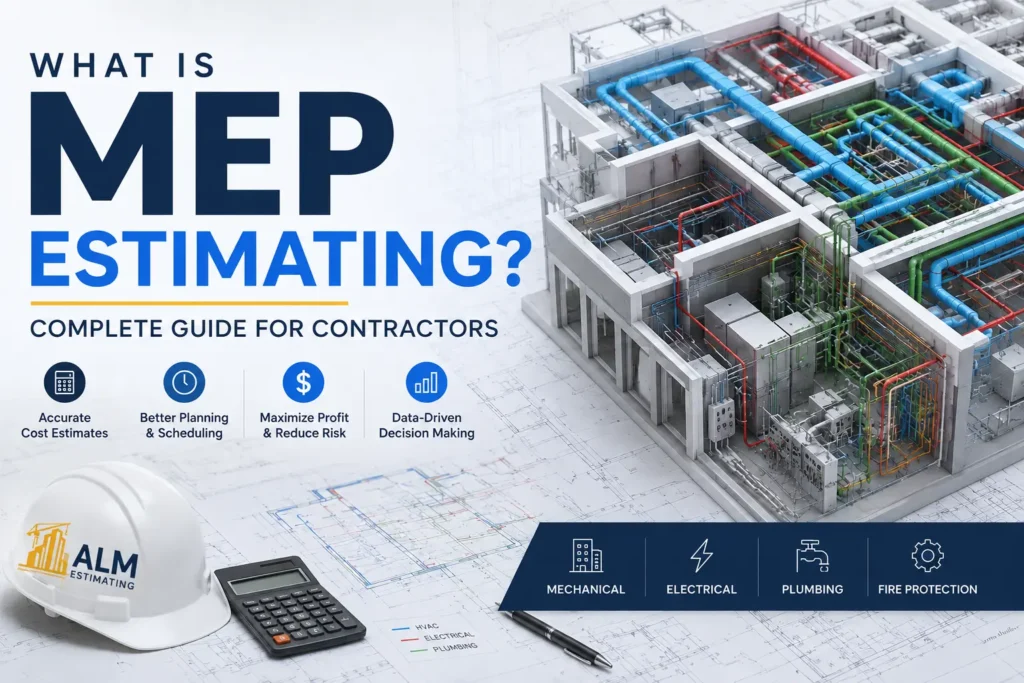
MEP estimating is the process of quantifying and pricing the mechanical, electrical, and plumbing systems in a construction project before the work begins. It is one of the most technically demanding areas of construction cost estimating, and one of the most financially consequential. On a typical commercial project, MEP systems account for 40 to 60 percent of total construction cost. Getting the MEP estimate wrong does not just affect the bid, it can eliminate the profit on the entire project.
This guide explains exactly what MEP estimating covers, how the process works, what it costs to outsource, and why most contractors benefit from using a specialist estimating firm rather than handling it in-house.
What Does MEP Stand For in Construction?
MEP stands for mechanical, electrical, and plumbing, the three primary building systems that make a structure function. In construction estimating, MEP is often extended to MEPFP, adding fire protection as a fourth trade. Each system is governed by its own CSI MasterFormat division, its own licensed trade, and its own set of codes and standards.
| Trade | CSI Division | Key Components | Specialist Trade |
| Mechanical / HVAC | Division 23 | AHUs, chillers, boilers, ductwork, VAV boxes, BAS | Sheet Metal Workers (SMACNA) |
| Electrical | Division 26 | Switchgear, panels, conduit, wiring, lighting, low-voltage | Electricians (IBEW) |
| Plumbing | Division 22 | Domestic water, sanitary, storm drainage, fixtures | Plumbers (UA) |
| Fire Protection | Division 21 | Sprinklers, standpipes, suppression systems | Fire sprinkler fitters |
All four trades must be coordinated with each other and with the structural and architectural systems. When HVAC ductwork, electrical conduit, plumbing piping, and fire sprinkler mains all compete for the same ceiling space, coordination clashes, and the costs of resolving them, are among the most significant risk factors on any commercial project. This is why MEP estimating requires more than just counting quantities, it requires understanding how the systems interact.
What Does MEP Estimating Cover?
1. Mechanical and HVAC estimating (CSI Division 23)
Mechanical estimating covers all heating, ventilation, and air conditioning systems. A complete mechanical takeoff includes ductwork quantities by gauge and size produced in FastDuct, air handling units (AHUs), variable air volume (VAV) boxes, chillers, boilers, cooling towers, exhaust fans, and all associated mechanical piping produced in FastPipe. It also includes insulation on ductwork and piping, building automation system (BAS) controls, and Division 23 specifications. HVAC systems are typically the largest single line item within a full MEP estimate.
2. Electrical estimating (CSI Division 26)
Electrical estimating covers the full power distribution and lighting scope of a project. A complete electrical takeoff includes service entrance equipment, switchgear, main distribution boards (MDBs), panelboards, conduit runs by size and type (EMT, IMC, RGS), wire and cable quantities by circuit, lighting fixtures and devices, and low-voltage systems under Divisions 27 and 28, structured cabling, fire alarm, access control, and CCTV. Labour is priced under IBEW jurisdiction on union projects, with wage determinations applied by trade classification and locality.
3. Plumbing estimating (CSI Division 22)
Plumbing estimating covers all domestic water, sanitary waste, storm drainage, and specialty plumbing systems. A complete plumbing takeoff includes cold and hot water supply piping by diameter and material (copper, CPVC, PEX), sanitary and vent piping, storm drainage, plumbing fixtures (water closets, lavatories, sinks, floor drains), water heaters, backflow preventers, and grease interceptors. On healthcare and laboratory projects, medical gas systems, deionised water, and specialty waste systems are included. United Association (UA) labour rates apply on union projects.
4. Fire protection estimating (CSI Division 21)
Fire protection estimating covers wet-pipe and dry-pipe sprinkler systems, standpipe systems, clean agent and gaseous suppression systems, and fire pump packages. Sprinkler takeoffs require hydraulic calculation review, head counts by coverage area, main and branch piping by diameter, and hangers and seismic bracing. On high-rise, healthcare, and data center projects, fire protection scope and cost can rival plumbing in scale.
How Does the MEP Estimating Process Work?
A professional MEP estimate follows a defined sequence regardless of project size or trade scope:
- Drawing review — the estimator reviews the full construction document set including mechanical, electrical, plumbing, and fire protection drawings, plus Division 21–28 specifications, addenda, and any issued RFIs
- Quantity takeoff — digital takeoff in FastDuct (HVAC ductwork), FastPipe (mechanical and plumbing piping), Bluebeam (electrical conduit and all trades), and PlanSwift produces itemised quantities for every material in the scope
- Equipment scheduling — all major equipment (AHUs, chillers, panels, fixtures, pumps) is listed by manufacturer, model, capacity, and installed cost from current distributor pricing and RSMeans/Gordian data
- Labour pricing — trade labour hours are applied by CSI division and adjusted for union or open shop classification, applicable prevailing wage determinations, and local market conditions
- Estimate assembly — the complete estimate is assembled in Microsoft Excel, structured by CSI division with separate tabs for each trade, equipment schedule, and labour summary
- Delivery — the completed estimate is delivered with a full quantity takeoff, material and labour breakdown, and equipment schedule, not a single lump-sum number
What Is the Difference Between an MEP Estimate and an MEP Takeoff?
An MEP takeoff is the quantity measurement step, counting and measuring every component from the drawings. An MEP estimate takes those quantities and applies unit costs, material pricing, labour rates, equipment costs, and subcontractor margins, to produce a priced document. A takeoff without pricing is useful for material procurement. An estimate without a supporting takeoff cannot be verified, levelled against sub bids, or used for change order management. A professional MEP estimate from ALM Estimating includes both, the full quantity takeoff is the foundation of every cost figure we deliver.
How Much Does MEP Estimating Cost to Outsource?
The cost of outsourcing MEP estimating depends on the scope of trades required and the size and complexity of the project. For a complete guide to MEP estimating costs with full pricing tables, see our detailed breakdown: How Much Does MEP Estimating Cost? 2026 Guide at almestimating.com/mep-estimating-cost/.
As a general benchmark: HVAC-only estimates for small commercial projects start at $350–$800. Full MEP bundles (mechanical, electrical, plumbing, fire protection) for mid-size commercial projects run $2,200–$7,000. Most estimates are delivered within 24 hours. The estimating fee is typically less than 0.5 percent of the MEP construction cost, and a correctly priced estimate prevents the kind of scope gaps and bid overruns that can cost ten to fifty times that amount in change orders.
Who Needs MEP Estimating Services?
- General contractors — to price MEP scope in bid packages, level sub bids, and prepare GMP proposals
- MEP subcontractors — to produce competitive bids for HVAC, electrical, plumbing, and fire protection scopes
- Developers and owners — to establish realistic MEP budgets at feasibility and design development stages
- Construction managers — to review and validate subcontractor bids before award
- Engineers — to support design-assist and value engineering exercises with accurate cost data
Frequently Asked Questions
What does MEP stand for in construction?
MEP stands for mechanical, electrical, and plumbing — the three primary building systems in any construction project. It is often extended to MEPFP to include fire protection as a fourth trade. In cost estimating, MEP typically refers to all four systems together: mechanical/HVAC (CSI Division 23), electrical (Division 26), plumbing (Division 22), and fire protection (Division 21).
What is included in an MEP estimate?
A complete MEP estimate includes quantity takeoffs for all ductwork, piping, conduit, wire, fixtures, and equipment across all four trades; labour hours priced at current union or open shop rates with applicable prevailing wage determinations; major equipment schedules with manufacturer, capacity, and installed cost; and a complete Excel workbook structured by CSI MasterFormat division. It is not a single lump-sum number — it is a fully itemised document that supports bid submission, scope review, value engineering, and change order management.
How long does MEP estimating take?
ALM Estimating delivers the majority of commercial MEP estimates within 24 hours of receiving a complete drawing set. Full MEP bundles for mid-size commercial projects are typically delivered within 2 to 3 business days. Large or complex projects — healthcare, data centers, industrial — may require 3 to 5 business days. Contact us with your drawings and deadline for a specific delivery commitment.
What is the difference between MEP estimating and MEP takeoff?
An MEP takeoff is the quantity measurement process — counting and measuring all components from the drawings using FastDuct, FastPipe, Bluebeam, and PlanSwift. An MEP estimate applies unit pricing to those quantities — material costs, labour rates, equipment costs — to produce a priced document. A professional MEP estimate includes both the takeoff and the pricing. A takeoff without pricing is not an estimate.
Can MEP estimating be outsourced?
Yes — outsourcing MEP estimating is standard practice for general contractors, MEP subcontractors, developers, and construction managers who want accurate, fast estimates without the overhead of in-house estimating staff. ALM Estimating provides outsourced MEP estimating services for projects across all 50 US states, covering all four MEP trades under one roof with 24-hour turnaround on most commercial projects.
Does ALM Estimating cover all MEP trades?
Yes. ALM Estimating covers mechanical and HVAC (Division 23), electrical (Division 26), plumbing (Division 22), and fire protection (Division 21) — all four MEP trades under one roof. You can request individual trade estimates or a full MEPFP bundle. We also cover sub-trade pages for piping estimating and mechanical insulation estimating as part of the full mechanical scope.
Get a Free MEP Estimate — 24-Hour Turnaround
Upload your drawings at almestimating.com or contact us directly:
Phone: +1 (917) 718-0084 | Email: info@almestimating.com
Serving all 50 US states — Arlington, VA 22201