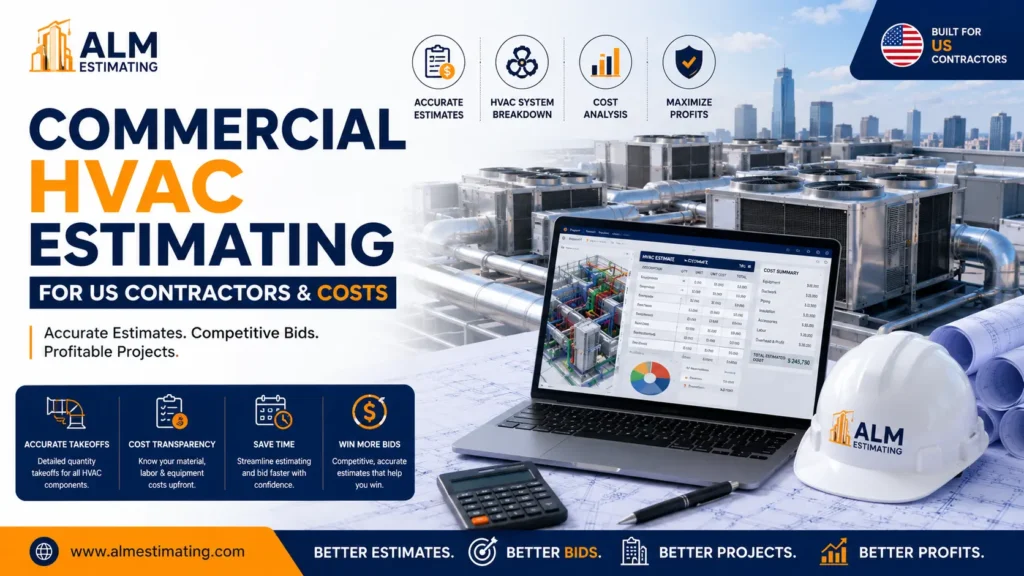
Commercial HVAC estimating is not a scaled-up version of residential HVAC pricing. The systems are fundamentally different, central air handling units instead of split systems, VAV boxes instead of zone dampers, SMACNA-compliant ductwork fabricated to pressure class instead of flex duct off the truck. The estimating process is different too. And the financial exposure when it goes wrong is considerably larger.
A missed scope item on a 2,000 SF residential HVAC job costs a few thousand dollars. The same kind of miss on a 200,000 SF office tower, a VAV box count that is off, a chilled water piping run that was not taken off, a control system that was not priced, can cost six figures in uncovered change orders. This guide covers what commercial HVAC estimating actually involves, what drives installed costs, how labor rates vary by market, and what separates an estimate you can bid on from one that will hurt you in the field.
What Goes Into a Commercial HVAC Estimate
A complete commercial HVAC estimate covers four distinct cost categories: equipment, ductwork, piping, and controls. Each has its own takeoff methodology and its own cost drivers. Treating them as a single line item, or pricing from square footage allowances without a proper takeoff, is the fastest path to a number that does not hold up against subcontractor bids.
1. Equipment
The equipment list for a commercial HVAC system typically includes air handling units, rooftop units, variable air volume boxes, fan coil units, chiller plants, cooling towers, boilers, and heat exchangers depending on the system type. Equipment is usually the largest single cost item in the estimate and also the most volatile, lead times on AHUs and chillers can run 16 to 26 weeks, and prices change with material market conditions. Getting the equipment schedule from the mechanical engineer before takeoff is critical. Estimating equipment from schedule placeholders or specification references without confirmed selections produces allowances, not prices.
2. Ductwork
Ductwork is fabricated and installed per SMACNA standards, which specify sheet metal gauge, seam type, reinforcement, and support requirements based on the system’s static pressure class. A supply system operating at 2-inch static pressure requires heavier gauge material and more reinforcement than a low-pressure return system, and those differences run all the way through the material cost and labor hours. FastDuct is the industry-standard software for ductwork takeoffs; it allows estimators to input duct sizes and lengths and automatically calculates sheet metal weight, fittings, and labor units per SMACNA.
3. Piping
Chilled water, heating hot water, condenser water, and refrigerant piping all have to be taken off separately. Piping takeoffs require pipe size, material (copper, steel, or PVC by application), insulation type and thickness, and the associated fitting, hanger, and valve count. FastPipe is the mechanical equivalent of FastDuct for piping systems. Underground piping and connections to equipment pads carry additional cost for excavation, concrete work, and pressure testing that are easy to undercount from a mechanical drawing alone.
4. Controls and Building Automation
Controls are consistently the most underestimated scope in commercial HVAC. The hardware, DDC controllers, sensors, actuators, communication wiring is visible on the drawings and can be taken off. The programming, commissioning, and owner training are not on the drawings and frequently get underpriced or treated as a minor allowance. On large commercial projects, the controls contract alone can represent 8 to 15 percent of the total mechanical budget. It deserves its own line item and its own subcontractor quote, not an estimate buried in general conditions.
Commercial HVAC Installed Costs by Building Type
These ranges reflect fully installed HVAC costs, equipment, ductwork, piping, controls, and labor, for commercial projects across the US. They are useful for budget validation and bid review, not final pricing.
| Building Type | System Type | Cost/SF (Low) | Cost/SF (High) | Labor Share |
| Office — Class A | VAV w/ AHU | $18 | $30 | 45–55% |
| Retail / Strip Mall | Packaged RTU | $10 | $18 | 35–45% |
| Hospital / Healthcare | Chilled water / AHU | $45 | $80 | 50–60% |
| School / K–12 | Unit ventilators / ERV | $20 | $34 | 45–55% |
| Multifamily (5+ floors) | Fan coil / PTAC | $12 | $22 | 40–50% |
| Industrial / Warehouse | Unit heaters / MUA | $6 | $14 | 40–50% |
Healthcare figures reflect NFPA 99 requirements, pressure relationships between spaces, and the redundancy requirements for critical care areas. Industrial costs vary widely based on process loads and ventilation requirements.
Regional Labor Rates: Why Location Changes Everything
Labor is the variable that most contractors underestimate when bidding HVAC work outside their home market. Sheet metal workers operate under SMACNA jurisdiction. Pipefitters fall under UA (United Association of Plumbers and Pipefitters). Both have local wage rates that vary significantly across the country, and on public projects, Davis-Bacon prevailing wage rates apply regardless of whether the project is in a union or open-shop market.
| Market | Sheet Metal (SMACNA) | Pipefitters (UA) | Notes |
| New York City | $115–$135/hr | $120–$145/hr | Highest labor market in the US; union-only on most commercial work |
| San Francisco / Bay Area | $105–$125/hr | $110–$130/hr | High prevailing wage requirements; seismic bracing adds scope |
| Chicago | $90–$110/hr | $92–$115/hr | Strong union presence; Davis-Bacon applies broadly on public projects |
| Dallas / Houston | $65–$85/hr | $68–$88/hr | Right-to-work state; open-shop competition keeps rates lower |
| Phoenix / Las Vegas | $60–$78/hr | $62–$80/hr | Growth markets; labor demand rising steadily since 2021 |
| Washington, DC / Arlington | $88–$108/hr | $90–$112/hr | Prevailing wage on virtually all federal and government-adjacent projects |
Rates shown are total package (wage + fringe benefits). Prevailing wage rates are published by the Department of Labor for each county and wage determination. Always verify current rates before bid submission.
What Moves the Number Most in Commercial HVAC Estimating
Experienced HVAC estimators know that the average cost per square foot is a starting point, not an answer. These are the variables that push the actual number well above or below that average.
1. System Type
A variable air volume system with a chilled water plant costs significantly more than a rooftop package unit serving the same square footage. The system type is established by the mechanical engineer and driven by building size, occupancy type, and energy code requirements. ASHRAE 90.1, the energy efficiency standard referenced by most state and local building codes, mandates system types based on climate zone and building use. A project in Climate Zone 5 that does not specify an economizer on the right system type is not code-compliant, and a bid based on that omission will face a change order when the permit reviewer catches it.
2. Drawing Completeness
Mechanical drawings at schematic design or design development level, typically 30 to 60 percent complete, require the estimator to make routing assumptions, equipment sizing assumptions, and control system assumptions. Each assumption carries risk. A 100 percent construction document set with coordinated mechanical, structural, and architectural drawings produces a more accurate estimate with less contingency required. When pricing from incomplete drawings, document every assumption explicitly and include a contingency line that reflects the actual level of uncertainty in the documents.
3. Coordination Requirements
On projects with dense MEP systems — healthcare, laboratory, data center, mechanical coordination with structural and other trades adds significant cost. BIM coordination, clash detection, and shop drawing production are real scopes with real labor hours. They do not belong in a contingency allowance. On large commercial projects, mechanical coordination can add 3 to 8 percent to the installed mechanical cost before a single hanger goes in the ceiling.
4. Refrigerant Type and Phase-Out Compliance
The phasedown of HFC refrigerants under the AIM Act is affecting commercial HVAC equipment costs and availability. Equipment using R-410A, the most common commercial refrigerant for the past two decades, is being replaced with lower-GWP alternatives including R-32, R-454B, and R-410A blends. Prices on compliant equipment are higher than legacy equipment, and not all markets have the same inventory. Estimating equipment costs without verifying the specified refrigerant type and current market availability for compliant equipment is a risk that is growing with every bid cycle.
Common Mistakes in Commercial HVAC Bidding
Most HVAC bidding mistakes are not calculation errors. They are scope interpretation errors, and they consistently produce the same problems.
Pricing from equipment schedules without confirming selections is the most common. An equipment schedule that lists a chiller as ‘400-ton centrifugal, TBD’ forces the estimator to assume a price for the most expensive item in the mechanical scope. The assumption almost always runs low, because estimators under bid-deadline pressure anchor to the lowest number that could plausibly be right. That is not a strategy, it is a guarantee of a change order.
Treating ductwork as a square footage allowance instead of doing a proper linear foot and weight takeoff consistently underprices complex distribution systems. A high-rise project with long duct runs, transfer ducts through fire-rated assemblies, and heavy coordination requirements cannot be priced per square foot without significant risk. FastDuct-based takeoffs are the industry standard for a reason.
Missing testing and balancing is the other frequent error. TAB is a required closeout scope on virtually every commercial HVAC project. It is a separate specialty, a separate contract, and a line item that appears late in construction, which is exactly why it gets missed or underpriced during the bid. It is not part of the mechanical contractor’s base scope unless the contract explicitly says so. Know before you bid.
How ALM Estimating Handles Commercial HVAC Scope
ALM Estimating provides Division 23 mechanical takeoffs and HVAC estimates for commercial contractors across all 50 states. Ductwork takeoffs are performed using FastDuct with SMACNA pressure class applied by system. Piping is taken off with FastPipe, including fittings, hangers, valves, and insulation. Equipment is priced from confirmed schedules where available, with documented allowances and notes where selections are pending. Controls are estimated as a defined scope, not buried in an allowance.
Turnaround is 24 to 48 hours for most commercial HVAC projects. If you have drawings and a bid deadline, send them to info@almestimating.com or call +1 (917) 718-0084. We will tell you exactly what we need and what we can deliver.
Frequently Asked Questions:
Q1: What is commercial HVAC estimating?
A. It is the process of calculating the installed cost of heating, ventilation, and air conditioning systems in commercial buildings, including equipment, ductwork, piping, controls, and labor. Unlike residential HVAC, commercial estimating involves large-scale central systems, building automation integration, and SMACNA-compliant fabrication
Q2: What CSI division covers HVAC?
A. Division 23, Heating, Ventilating, and Air Conditioning — covers the full HVAC scope. Division 25 covers integrated building automation and controls. Division 23 is further broken into subsections: 23 05 (common work results), 23 07 (insulation), 23 09 (instrumentation and controls), and system-specific sections.
Q3: How long does a commercial HVAC estimate take?
A. For a 50,000 SF office project with a VAV system, expect 2–3 business days for a thorough in-house estimate. Outsourced estimates from firms with trade-specific HVAC expertise can be completed in 24–48 hours. Timeline depends on drawing completeness, schematic sets take longer than full construction documents.
Q4. What is SMACNA and why does it matter for estimating?
A. SMACNA (Sheet Metal and Air Conditioning Contractors’ National Association) publishes standards for HVAC duct construction, including gauge requirements by pressure class. Estimating ductwork without applying the correct SMACNA pressure class understates material and labor costs, a common mistake on design-build projects where duct sizing is finalized late.
Q5. Does ASHRAE 90.1 affect HVAC costs?
A. Yes. ASHRAE 90.1 is the energy efficiency standard referenced by most commercial building codes. Compliance requirements, economizers, demand control ventilation, VAV versus constant volume systems, directly affect equipment selection and cost. Projects designed to older code editions will require upgrades on permit-driven work