
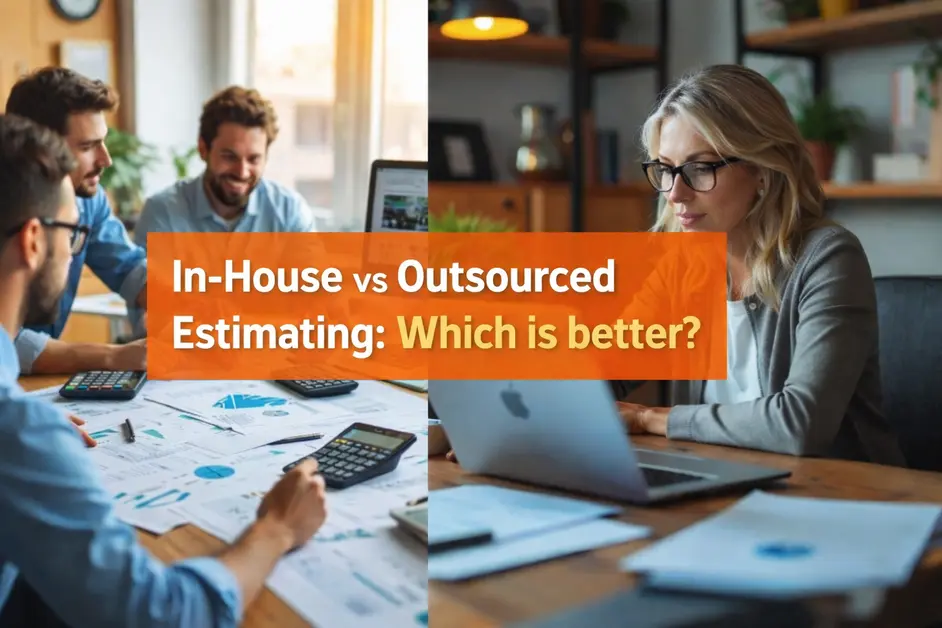
In construction estimating, getting the numbers right can make or fail your project. In recent times, many firms are looking for smarter and more flexible estimating strategies. For contractors, subcontractors, and construction companies it is challenging to either continue with an in-house estimator or to outsourced estimating services. This choice affects bidding, cost planning, material quantities, labor costs, and profits.
There are industry standards such as AACE standards and PMI project management frameworks for accurate cost planning and competitive bid preparation. Though, both in-house and outsourced estimating handle quantity takeoffs and bid preparation, they are quite different when it comes to cost, how long things take, how much control you have, and the final results you get.

What is an In-House Estimator
An in-house estimator is a full-time person or small team working only for your company. They review plans, do takeoffs, and build complete cost estimates using your crew’s real speeds, favorite suppliers, and your profit markup. They use tools like Bluebeam, PlanSwift, or On-Screen Takeoff, submit bids, and handle pre-construction changes.
In the US (2025–2026 data), base salary is typically $75,000–$90,000 per year. With benefits, taxes, insurance, training, software, and office costs, the total per person often exceeds $100,000 annually.
This fits best for large contractors or firms with steady, repeat work, where your company’s specific knowledge gives a strong advantage.
In-House Estimator: Key Features
Full control: You make changes yourself and all data stays inside your company
Very accurate: When using your own company methods and past job history, you have accuracy.
Deep Company Knowledge: Strong on your usual type of work and builds deep company knowledge over time. Team knows your exact way of doing things
Limited Team: Its hard and expensive to add more people fast
Slow Progress: Slower when very busy, delays happen if the team gets overloaded. There is a risk of burnout in peak season
Full Payment: You still pay full salaries even when work is slow.
Specialized Trade: Weaker on rare, complex, or very technical trades such as MEP. You have to keep paying time and money to train and upskill people
What Are Outsourced Estimating Services
Construction estimating outsourcing let you hire external experts or firms for takeoffs, full estimates, or overflow work. You send plans digitally, get a detailed quote back in 24–72 hours, and pay only for that job. No full-time payroll.
How Outsourced Estimating Services Work
These services use teams of estimators, advanced estimating software, and up-to-date market pricing databases. Many follow structured multi-review processes such as one person does the takeoff, other checks quantities, and a senior reviews your project. It is a type of on-demand model that is pay per project, per square foot, monthly packages for regular needs. It’s common for subcontractors, growing firms, or anyone with busy bidding seasons.

Outsourced Estimating Services: Key Features
- Moderate Control: Relies on clear communication and trusting the provider. Data goes outside but good providers keep it secure.
- High Flexibility: Scale up or down instantly, add capacity for busy times or cut back when slow.
- Fast Turnaround: Usually ready in 24–72 hours, even during rush periods. Available for your project discussion at your ease.
- Very Consistent Accuracy: Uses double-check processes, fresh market prices, and focused experts
- Broad Expertise and Dedicated Teams: Handle high pressure and bid spikes well. Access to specialists in complex trades like MEP, facades, or unique regions
- Less Stress on Your Team: Frees your main crew to focus on jobsites, clients, and actual work
- No Training Burden: Provider handles all staff training and keeps skills up-to-date
- Cost-effective for Variable Work: Pay only when you need estimates, no full salaries in slow times
- Fresh Perspectives: Bring ideas and current knowledge from many different projects
Cost Comparison: In-House vs Outsourced Estimating
Cost is usually the first question in outsourced estimating cost vs in-house.
| Factor | In-House Estimator | Outsourced Estimating |
| Salary/Base | Fixed ($70k–$90k+ average base) | Per project (typically $300–$1,500 for medium jobs; $150–$500 small) |
| Benefits/Taxes/Insurance | Yes (adds 30–50% to base) | No (you pay only the service fee) |
| Software | Paid by company (licenses $500–$2,000+/year per user) | Usually included in service fee |
| Scalability | Limited. Hard to add staff quickly | Flexible. Scale up for peaks, down for slow times |
| Total per Estimate (example) | $800–$1,000 (spread over bids) | $300–$1,200 (direct cost, no overhead in slow months) |
Outsourcing usually saves 50–70% for firms with variable workloads, not paying full salary during off periods.
Pros and Cons of In-House Estimating
Pros
Full control and quick updates
You can make changes right away if plans change or new information comes in. You can oversee every detail.
Deep company knowledge
Your estimator understands your team’s real productivity, preferred suppliers, past projects, and unique ways of working. This leads to more accurate and consistent estimates over time.
Strong data security
All project information and pricing details stay inside your company, so there is no risk of sharing sensitive data externally.
Long-term improvement
Over time, your team builds strong institutional knowledge. You can improve pricing, adjust win rates, and align estimates with your business goals.
Smooth team integration
The estimator works with project managers, engineers, and staff. It improves communication and outcomes.
Cons
High fixed costs
Salaries, benefits, taxes, training, software licenses, and office expenses can cost more than $100k per year, even during slow months.
Limited scalability
It can be hard and expensive to hire quickly during busy seasons. Adding staff takes time for hiring and training.
Workload strain and risk
Teams can become overloaded during peak periods, which may lead to rushed work, missed deadlines, or lost opportunities.
Possible skill gaps
A small in-house team may lack expertise in specialized trades, complex projects, or the latest market pricing trends.

Pros and Cons of Outsourced Estimating Services
Pros
Lower and variable costs
Pay only per project or as needed, no salaries, benefits, or overhead during slow periods. Many save 50–70% compared to in-house.
High scalability and flexibility
Easily handle bid spikes, seasonal rushes, or large volumes without hiring.
Faster turnaround
Dedicated teams deliver in 24–72 hours, even under pressure, helping meet tight deadlines and boost quoting capacity.
Access to specialized expertise
Tap into pros with broad experience across trades (e.g., MEP, commercial, facades), fresh regional/market data, and multi-review processes for consistent results.
Reduced internal stress
Frees your core team for jobsites, client work, installs, and billable tasks. It lowers burnout and allows focus on execution and growth.
Cons
Less direct control
Adjustments may take longer due to communication loops. You rely on the provider’s processes and timelines.
Potential communication challenges
Time zones, unclear briefs, or response delays can lead to misunderstandings or revisions.
Data security concerns
Sharing plans require strong NDAs, encryption, and trusted partners. Some feel uneasy about external access.
Variable quality if provider is poor
Depends on the service. Bad ones can miss nuances of your style, but good ones often match or beat in-house via structured checks.
Dependency risk
Tied to third-party schedules. Less influence on daily workflow compared to internal teams.
The Hybrid Model: A Smart Approach
Many contractors now use a hybrid approach. It keeps core estimating in-house for control and outsourced for overflow, specialized takeoffs, or busy seasons. This blends in-house knowledge with outsourced speed and savings. It improves turnaround, budget overruns, and high accuracy.
For example, handling final reviews and sensitive data in-house while outsourcing for quantity takeoffs or MEP estimates. Trends show more companies using hybrids for better risk management, project timelines, and growth.

Which One Fits Your Business
Choose In-House Estimating If:
- You have a large, steady workload (consistent high-volume bidding every week/month).
- You need long-term internal planning and deep company-specific knowledge.
Choose Outsourcing If:
- Your bids are variable or come in waves/seasonal spikes.
- You want strong cost control (pay only when needed, no fixed salaries).
- You face tight deadlines and need fast turnarounds.
Common Myths Busted
1. Myth: “Outsourcing is less accurate”
Reality: Not true with good providers. Outsourced teams often match or beat in-house accuracy thanks to multi-review checks, fresh market data, and focused work — especially when internal teams are overloaded and rushing.
2. Myth: “In-house estimators are always cheaper”
Reality: Only for constant high-volume bidding. For most firms, in-house costs more due to fixed salaries, even in slow months. Outsourcing is cheaper, you pay only per project, saving 50–70% on variable workloads.
Final Recommendation;
There is no single solution exists, when choosing between an in-house estimator and outsourced estimating services. The use of the right approach depends on workload, budget, and internal capacity. In-house estimating works best for firms having consistent bid volume that need long-term control and company specific knowledge. Outsourced estimating is suitable for companies with different workloads, short deadlines, and fixed cost.
Many contractors are now choosing a hybrid model and keep strategic oversight in-house while outsource specialized estimating services. This approach improves flexibility, reduces burnout, and helps maintain accuracy without increasing overhead.
Trialing outsourced support through ALM Estimating on a few overflow projects is a low-risk way to assess fit before scaling. Claim your 30% discount on the first estimate.
FAQs
1. What is an in-house estimator?
An in-house estimator is a full-time employee or a small team that works only for your company. They handle plan reviews, takeoffs, cost estimates, and bid submissions.
2. What are outsourced estimating services?
Outsourced estimating services are external firms or experts you hire for takeoffs, full estimates, or overflow work. You send your plans digitally, and they return the estimate within 24–72 hours.
3. How do outsourced estimating services work?
They use teams of estimators, advanced software, and up-to-date pricing databases. Usually, the work is reviewed by multiple people to ensure accuracy. You pay per project or through monthly packages.
4. Which option is cheaper: in-house or outsourced estimating?
Outsourced estimating is usually cheaper for firms with variable workloads. In-house estimating becomes more cost-effective only when you have steady, high-volume bidding every month.
5. Which option is more accurate?
Both can be accurate. In-house estimators know your company well and can make estimates tailored to your team. Outsourced services often use multi-review processes and fresh market data, which also leads to high accuracy.
6. Can outsourced estimating services handle complex projects?
Yes. Outsourced teams often have specialists for complex trades such as MEP, facades, or commercial projects, which may not be available in a small in-house team.
7. What are the main risks of outsourcing?
The main risks include communication issues, less direct control, data security concerns, and quality differences depending on the provider.
8. When should I choose in-house estimating?
Choose in-house estimating if your company has a steady workload, needs long-term control, and wants deep company-specific knowledge.
9. When is outsourcing a better option?
Outsourcing is better if your bid volume changes, you have tight deadlines, or you want to control costs without hiring full-time staff.
10. What is the hybrid model?
A hybrid model means keeping core estimating work in-house while outsourcing overflow or specialized tasks. This approach improves flexibility and reduces workload pressure.