
For buildings or remodels, drywall and interior finishing make up a big chunk of the budget. But what exactly goes into a solid estimate? It’s not just measuring square feet and picking a price per sheet. Drywall estimating covers walls, ceilings, and insulation. Walls include studs, sheets, tape, mud, and paint. Ceilings need special attention because workers lift materials overhead, which slows things down. Insulation fits behind the boards to control sound and temperature, adding another layer to the math. A good estimate also covers partition walls, those dividers that split rooms without bearing loads. These seem simple, but corners, doors, and windows complicate cuts and fits. In this blog, we will discover how to estimate drywall and interior finishing and how to avoid mistakes to keep your budget smooth.
Key Factors That Drive Up Costs
Costs increase for reasons that most people ignore until the bill arrives. Let’s break them down.
Material Waste
Drywall sheets usually have 4×8 or 4×12 sizes. Odd room shapes mean extra cuts. A 10% waste factor is normal, but tight layouts push it to 15% or more. Add damaged boards from handling, and you’re buying extras you didn’t plan for.
Labor Productivity
One worker hangs 50 sheets in a day on open walls. Drop that to 30 in a crowded remodel with furniture still inside. Heights over 10 feet need scaffolding, cutting the speed in half. Cold weather slows joint compound drying, stretching the timeline.
Layout Complexity
Rooms with angles, arches, or bulkheads turn straight runs into puzzles. Each custom cut takes time. Electrical boxes, vents, and plumbing chase through walls demand precise openings. Forget to count these, and crews stand around figuring it out on site.

Common Errors That Lead to Overruns
Even pros slip up. Here are the traps that burn budgets.
- Undercounting corners and edges. Metal beads protect every outside corner. Miss a few, and you rush orders mid-job at premium prices.
- Ignoring moisture areas. Bathrooms and kitchens need greenboard or cement board. Standard gypsum fails fast in damp spots.
- Flat labor rates. New crews take longer than veterans. Base your hours on real team speed, not averages from a book.
- No contingency for changes. Owners swap a window or add a closet. Build in 5-10% flex room upfront.
Keep this in mind on every set of plans, such as measure height and width twice, mark every door, window, and built-in, List board type per area, count beads, screws, and tape. Add waste % by room shape.
How to Estimate Drywall Cost Step by Step
Follow this path for wallboard installation cost estimating that stands up to the job.
- Collect plans. Use architect drawings or sketch the rooms. Label every opening.
- Measure surfaces. Length times height for walls. Subtract doors and windows over 10 sq. ft. Repeat for ceilings.
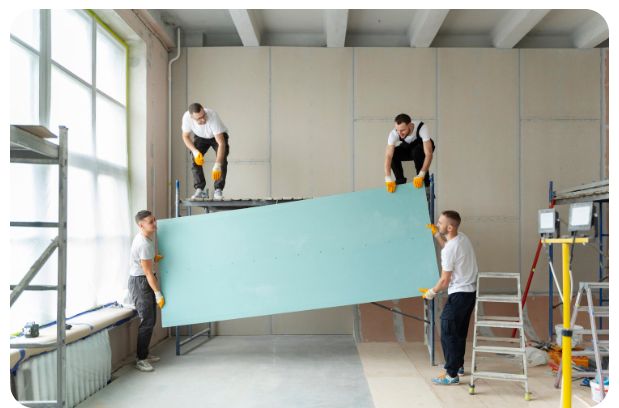
- Choose boards. 1/2-inch standard for walls. 5/8-inch for fire code or tall spaces. Green board in wet zones.
- Add waste. 10% simple, 15% complex. Price materials. Call local yards for sheets, mud, and tape. Buy in bulk for 5-10% savings. Track overhead such as fuel, tools, insurance, and 15% of labor.
Sample for a 12×15 room, 9-ft ceilings, one door, two windows:
Walls: 4 x (12+15) x 9 = 486 sq. ft. – door (16) – minus windows (30) = 440 sq. ft.
Ceiling: 12×15 = 180 sq. ft.
Total: 620 sq. ft. + 12% waste = 694 sq. ft.
Sheets: 694 / 32 = 22 (4×8).
Hang: 694 / 55 = 13 hours. Finish: 694 / 35 = 20 hours.
Labor: 33 hours x $48 = $1,584. Materials: $485.
Total: $2,069.
Why Finishing Estimates Overrun
Finishing turns boxes into rooms people love. Small oversights create big bills.
- Texture surprises. Smooth walls bid easy. Knockdown or orange peel needs extra mud and skill.
- Paint quality. Cheap paint takes three coats. Premium covers two but costs more per gallon.
- Trim every foot. Base, crown, casings, measure in linear feet. One short door jamb stops the crew.
- Schedule jams. Painters wait for dry mud to dry. One late trade stalls the rest. Rush charges follow.
Ceiling Finishing Estimate: The Overhead Challenge
Ceilings push every job harder than walls ever do. A single 4×8 sheet of 5/8-inch drywall costs 60 to 70 pounds. Hoisting this for eight hours a day naturally drops the speed. Most crews hang only 25 to 35 sheets per worker on ceilings compared to 50 or more on vertical walls. That alone adds hours you must count from the start.
Height Makes the Difference
Standard 8-foot ceilings let workers use benches or short stilts. At 12 feet or higher, every sheet needs two people plus equipment. Labor jumps 30% to 50%, just for the reach. Vaulted or cathedral styles stretch even further, plan on 75% more time than flat work.
Access and Protection
Open attic space above? Crews drop sheets through the joists and work from below. Easy wins. But in remodels with finished floors underneath, lay down a rams board or plywood first. One scuff on new hardwood, and you pay for repairs. Tight stairwells or narrow halls force workers to cut sheets outside and carry pieces in. Add 10% to 20% labor for every obstacle.
Ceiling Styles Change the Game
Bid each style as its own line item. Clients spot the value when they see “tray ceiling framing 42 linear ft. at $12/ft.” instead of a mystery lump sum.
- Flat ceilings stay simple: hang, tape, mud, sand.
- Drop ceilings with grids need an exact layout for tiles and lights. Miss a suspension wire, and the whole grid sags.
- Tray or coffered designs start with extra framing. Build the bulkheads first, then skin them. Each level adds linear feet of lumber and double boarding in spots.
- Acoustic treatments like sprays or panels require special adhesive and drying time.
Equipment Costs You Can’t Skip
Depending upon height, lifts rent for $150 to $250 per day. Scaffolding costs $100 a section. Add stilts, head lamps, and longer screws for thick boards. One week on a 2,000 sq. ft. ceiling easily hits $1,000 in gear. Build that into the estimate or watch profit vanish.
Pro Tip for Clean Bids
Separate ceiling totals from wall totals every time. Show square footage, board count, labor hours, and equipment side by side. Clients nod when they see the real reason ceilings cost more. One missed line, and you eat the difference.
Partition Wall Estimation: More Than Dividers
Great office builds start with great partition walls. They shape space without touching the structure, clean, efficient, and flexible. Simple on paper, tricky in the field.
- Start with the Skeleton
Metal studs are placed into the top and bottom tracks. Standard spacing is 16 inches on center on a 1/2-inch board, 24 inches for 5/8-inch. Stud count: divide wall length by spacing and add one. A 20-foot wall at 16 inches needs 16 studs. - Board Both Sides
Partitions get drywall on two faces. Calculate square footage per side, then double it. Waste climbs here because cuts rarely match from one side to the next. Use 12% to 15% waste instead of 10%.
Sound and Fire Ratings
- Sound control: Stuff rock wool or fibreglass between studs. One bag covers 40 sq. ft. at 3.5 inches thick. Skip it in conference rooms, and complaints follow.
- Fire ratings: Corridors or stairwells demand 1-hour or 2-hour walls. Switch to 5/8-inch Type X board and add fire tape. Local codes spell out the rules, check them first.
Doors, Glass, and Openings
- Door frames: Pre-hung units need rough openings 2 inches wider and 1 inch taller than the door. Add jamb material and hardware.
- Glass partitions: Aluminum frames plus tempered glass run $45 to $75 per sq. ft. installed. Measure height and width exactly. Borrowed lights or transoms are extra cuts and blocking.
Conclusion
Solid drywall and interior finishing estimates come from a complete scope, real-world factors, and double-checked math. Measure every surface, plan for waste and delays, and write bids clients can read in seconds. One accurate estimate builds trust and profit. One overrun damages both. Take charge of your numbers now; your next job.
Searching for an accurate interior finishing cost estimate? Get Your Free Detailed Estimate in 24 Hours! Secure your wallboard installation cost estimating with ALM Estimating. Don’t let mistakes sink your job. Get your free detailed quote now!
FAQs:
Q1. How do I measure drywall for a room with sloped ceilings?
Break the slope into rectangles and triangles. Measure height at the peak and base, then average for a close count. Add 15% waste for angled cuts. Use a laser level to mark lines and double-check totals against the plan.
Q2. What waste factor works best for remodels?
Plan 15-20%. Old walls rarely line up with new sheets, and obstacles force extra cuts. Walk the site, note every jog and chase, and bump waste higher if the layout looks tight or cluttered.
Q3. How much slower is ceiling work than walls?
Ceilings take 50-100% longer. Workers lift heavy sheets overhead and need lifts or scaffolding. A crew that hangs 50 sheets on walls manages 25-35 overhead, even with good access and experience.
Q4. Should paint go in the drywall bid?
Yes, if the client wants one number. List primer plus two finish coats and note the grade. Builder paint saves money but needs three coats; premium covers in two and resists stains better.
Q5. How do I price metal studs for partitions?
Measure the linear feet of the top and bottom track. Count studs every 16 or 24 inches based on board thickness. Add 5% for waste and corners. Check local supplier prices weekly; they shift fast.
Q6. What’s the cost difference between smooth and textured finishes?
Texture adds 20-40% to finishing labor. Extra mud, spray gear, and drying time pile up. Smooth level 4 is standard; knockdown or orange peel needs a pro with the right hopper gun.
Q7. When do I need fire-rated drywall?
Garages, furnace rooms, and shared walls in multi-family units. Local code lists exact spots and ratings, one-hour or two-hour. Use a 5/8-inch Type X board and fire-rated tape to pass inspection.
Q8. How can I speed up my takeoffs?
Use a laser measure and a simple spreadsheet. Plug in room dims, waste %, and local prices. Save templates for common board sizes and labor rates so new jobs take minutes, not hours.
Q9. What if plans change after the bid?
Include a 5-10% contingency line. Note that extras need signed change orders. Get lighting and vent plans locked before boards go up, one late switch can add days and dollars.
Q10. Is it worth hiring outside estimators?
Yes, for jobs over 5,000 sq ft or tight deadlines. They spot misses like soffits or fire ratings and save more than the fee. One accurate bid wins trust and referrals for years.