
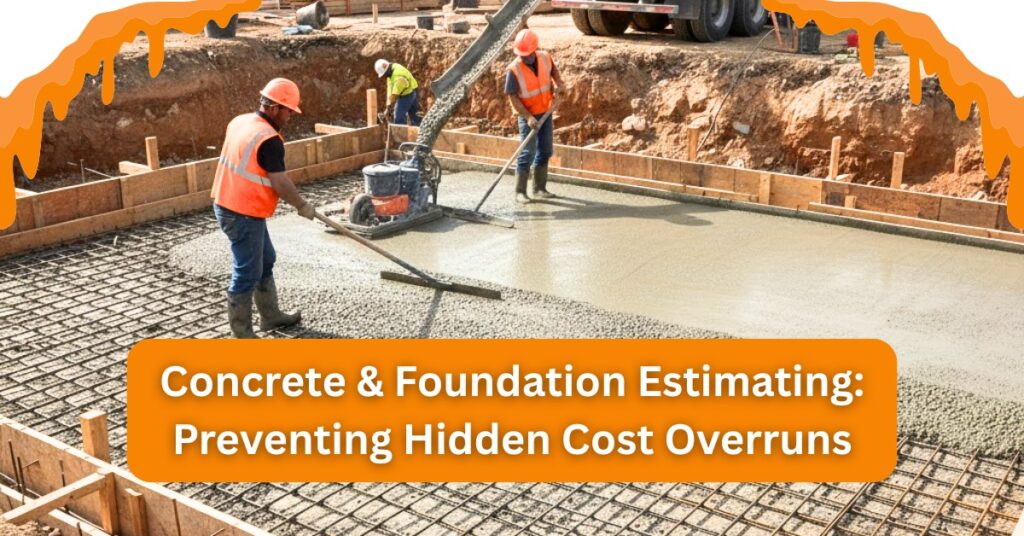
The common challenge for contractors in the USA is that they started building a project with confidence, but the budget rises due to surprise expenses. Things like uneven ground or extra materials can turn a smooth job into a money pit. But with smart foundation estimating, you can spot those risks early and keep everything on track. This guide walks you through the basics of concrete estimating services USA, from slabs to rebar, and shows how to handle tricky site issues. This guide breaks it all down in a simple way, starting from slabs, footings, rebar, to formwork, and the real-world challenges. Let’s dig in and build a plan that keeps your projects solid and your wallet intact.
Why Foundation Estimating Is the First Step to a Strong Build
Every building construction’s first step is to lay a solid foundation. Foundations are the base made up of any structure that can hold up walls, floors, and everything that forms the building. If the foundation is weak or of poor quality, then it can lead to cracks, building destruction, or even failure in completing the building. That’s where foundation estimating comes in. It’s not just about guessing how much concrete you need. It’s about knowing the exact volume, strength, and support for the project.
To estimate your concrete foundations accurately, start by reviewing the project by measuring the foundation area length, width, and depth. Then, for a simple slab, multiply the numbers to get the volume in cubic yards. Then, add other factors like soil type and load-bearing tools. Tools like concrete calculators can help, but always double-check with real measurements from the site.

Real costs in the USA tell the story; costs for concrete foundations vary by region and project complexity. For example, a residential foundation can cost $5 to $7 per square foot, while commercial projects can cost $9 to $14 per square foot. If you skip this basic step, you will be on the verge of losing bids. One builder from California has faced the budget overruns because they ignored the rocky soil, so excavation took twice as long. Miss the mark, and you’re eating the difference.
Slab Cost Estimating Commercial: Get the Numbers Right
Commercial slabs carry forklifts, storage racks, and constant foot traffic. They need to be thick, level, and tough. Slab cost estimating commercial starts with the basics: area and thickness. Most light-duty floors are 4 to 6 inches thick. Heavy industrial slabs go 8 to 12 inches or more. Current averages in the USA, installed concrete slabs cost between $6 to $12 per square foot. Concrete costs up to $150 to $180 per cubic yard. For a 5,000 sq. ft. with a 6-inch slab, that is 92.6 cubic yards making roughly $15,000 in materials only before the labor. In busy areas like New York, traffic and permits increase the budget. You must also include resistors such as vapor barriers or insulation, which can increase the price by10-20%. But the real budget busters hide in the details:
- Reinforcement mesh or fiber – adds $0.50 to $1.50 per square foot
- Vapor barriers – $0.20 to $0.40 per square foot
- Joint sealing and saw cuts – $1 to $2 per linear foot
- Thicker edges under walls – extra concrete and forming
Mastering Rebar Takeoff USA for Stronger Builds
Rebar takeoff USA means counting every bar, hook, and overlap. Start with the spacing grid. Residential foundations often use #4 bars (½ inch) at 18 inches on center. Commercial might need #5 or #6 bars at 12 inches. Rebar adds strength to concrete, preventing cracks under pressure. Rebar takeoff USA involves counting the bars needed based on the foundation design. Calculate the length for each section and measure the grid spacing, usually keeping 12 to 18 inches apart. Prices for rebar in 2025 remained around $840 to $915 per ton, depending on market shifts. For a typical foundation, you may need 1-2 pounds per sq. ft. Installation labor costs between $0.50 and $1.
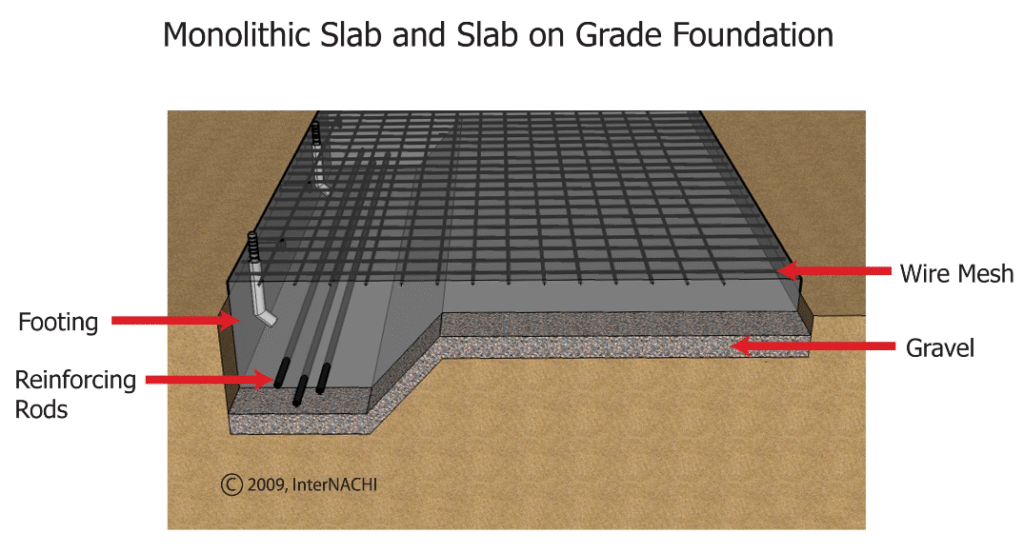
Common mistakes include forgetting overlaps or hooks at ends, which can weaken the structure. A Texas contractor caught the design flow early by detailed rebar takeoff. It saved them from redoing all from zero. This step ensures your foundation stands up to earthquakes, wind, or heavy use.
Formwork Estimate: Building the Mold for Success
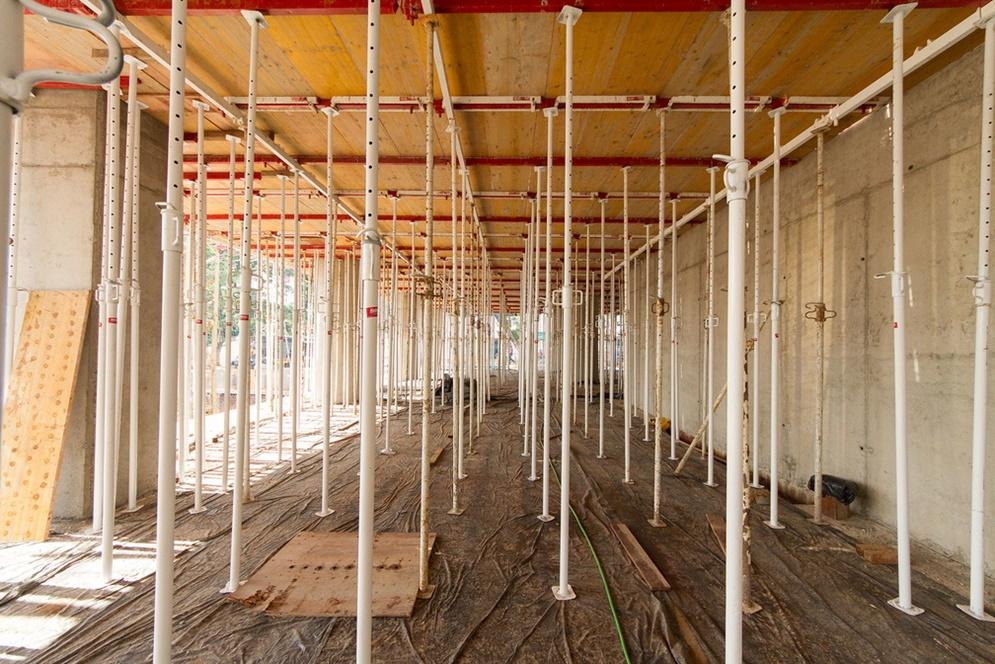
Formwork is a temporary structure that holds the concrete in shape until it sets. A good formwork estimate includes materials like wood or metal panels, and labor to set them and remove them. Basic wood forms cost $0.54 to $0.60 per square foot of contact area. That’s the surface touching the concrete. Methods include measuring the perimeter and height, then adding supports like props every 4-6 feet. Software tools can speed this up, but site visits confirm if adjustments are needed for slopes or curves. Curves, steps, or sloped sites need custom forming, budgeting extra. One Midwest builder underestimated formwork, which led to delays when short on panels. Proper estimating keeps pours on schedule and reduces waste.
Tackling Site Conditions and Access Challenges
Site conditions can make or break your budget. Rocky soil might require blasting, adding $2,000 to $10,000, while wet ground needs drainage pumps. Access issues, like narrow roads, mean smaller trucks and more trips, hiking the concrete pour cost USA by 15-20%. Check for utilities underground early, hitting a line can stop work and cost thousands in repairs. In urban spots, noise rules limit hours, stretching timelines.
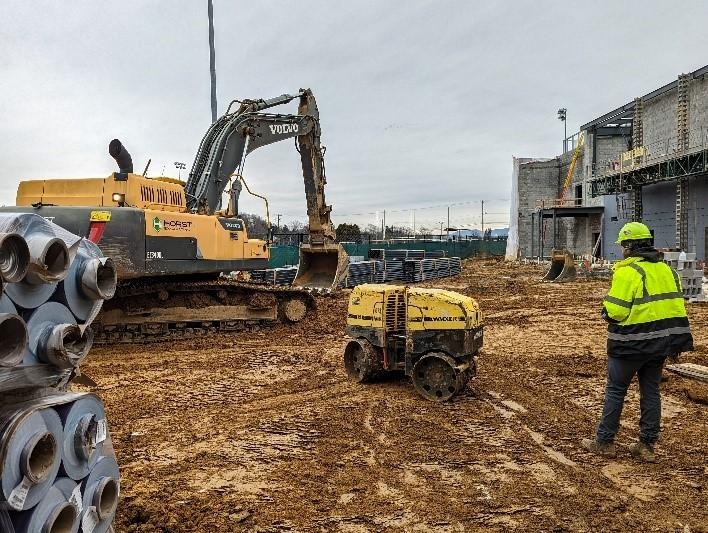
Urban jobs face street permits and off-hour pours, doubling the crew cost. A Seattle project hit both issues by booming a pump, conveyor belt, and adding $6,000 to a $40,000 foundation.” Scout the site early. Talk to neighbors. Plan the pour path.
Footings, Labor Rates and Concrete Pour Cost USA
Footings spread the load into the soil. Labor rates for footings in the USA average $3 to $7 per square foot. This includes digging, placing rebar, and pouring.
The cost of a concrete pour in the USA ranges from $120 to $150 per cubic yard, with labour costs adding $8 to $18 per square foot. For footings, factor in depth, usually 12-24 inches.
Hidden costs here include weather delays; rain can ruin a pour, wasting materials. Always schedule around forecasts. Weather plays a role. Cold snaps below 40°F need heated blankets and admixtures at $0.50 to $1 per square foot extra. Rain turns trenches into mud; pumps and delays follow. Schedule with a buffer.
Quick Guide to Contingency and Safety Factors
Nothing goes exactly to plan. Material prices jump. A storm floods the site. A permit gets held up. That’s why every estimate needs contingency and safety factors.
Contingency covers unknowns:
- 5% for simple, flat sites with good access
- 7% to 10% for sloped, rocky, or urban jobs
- 12% to 15% for renovations or poor soil data
Apply it to the total estimate, not just materials. A $50,000 foundation with 8% contingency has $4,000 buffer. Safety factors build strength into the design, like adding 1.5 to 2.0 for sliding resistance, 1.7 for bearing capacity, and 1.4 for seismic or wind uplift. These come from building codes and engineering tables. They ensure your foundation handles 50% to 100% more load than expected. Better to overbuild slightly than rebuild entirely.
Follow this checklist:
- List risks like soil, weather, access, supply chain
- Assign a percentage to each
- Total them for your contingency line
- Apply code safety factors to loads and dimensions
- Review with the structural engineer
Conclusion
Foundation and concrete isn’t just about mixing sand, gravel, and cement. It’s about planning every yard, every bar, every brace so your project stands tall and your budget stays intact. We’ve covered the essentials, from slabs and rebar to formwork and site hurdles, showing how each piece fits into a reliable plan. Remember, skipping details like soil tests or access checks can lead to costly fixes later. By using accurate measurements, current USA costs, and smart contingencies, you set up for smooth builds that stay profitable. Therefore, it’s about building trust with clients through reliable work. Take these tips, apply them to your next projects, and watch how they strengthen your business from the ground up. Don’t wait for problems to arise, plan ahead and build stronger.
Stop risking your project’s budget. Contact ALM Estimating today for a free concrete estimating services USA quote and lock in savings before costs rise! Get your detailed quote now!
FAQs:
Q1. How do I estimate concrete volume for a foundation?
To estimate, measure the length, width, and depth of the area. Multiply them to get cubic feet, then divide by 27 for cubic yards. Add 5-10% for waste. For example, a 20x30x0.5foot slab needs about 11 cubic yards.
Q2. What are average concrete pour costs in the USA?
In 2025, expect $120 to $150 per cubic yard, including delivery. Labor adds $8 to $18 per square foot, varying by location and project size.
Q3. Why include rebar in foundation estimates?
Rebar reinforces concrete against tension and cracks. Without it, foundations can fail under loads. Costs run $840 to $915 per ton, with 1-2 pounds needed per square foot.
Q4. How do site conditions affect estimating?
Poor soil or limited access can increase excavation and transport costs by 15-20%. Always survey the site to spot issues like rocks or utilities early.
Q5. What is a formwork estimate?
It calculates costs for molds that shape concrete, around $0.54 to $0.60 per square foot. Include materials, labor, and reuse rates for accuracy.
Q6. What contingency percentage should I use?
Aim for 5-10% of total costs. Use lower for simple projects, higher for risky ones with unknowns like weather or market changes.
Q7. How much do footings labor rates cost?
Rates average $3 to $7 per square foot in the USA, covering digging, rebar placement, and pouring. Urban areas may charge more.
Q8. What safety factors apply to foundations?
Use 1.5 to 2 for stability against sliding or loads. This ensures the design handles extras like wind or earthquakes safely.
Q9. Can I reduce hidden costs in concrete projects?
Yes, by detailed planning, site checks, and using tools for takeoffs. Stories from contractors show this cuts overruns by 10-15%.
Q10. When should I seek professional estimating help?
If your project is complex or commercial, pros can spot misses you might overlook. It saves time and prevents expensive errors.